







 Debunking Viral Claim About the Talmud and Minors





7 min read


Ancient Sinai inscriptions may hold the earliest extra-Biblical references to Moses, sparking fresh debate over the Exodus and the origins of the alphabet.
Israeli epigrapher Michael Bar-Ron has identified what he believes are several direct references to Moses on 3,500-year-old stone inscriptions from the Sinai desert. They are the earliest contemporaneous extra-Biblical references to the famous Prophet.
Bar-Ron’s investigation centered on two inscriptions found at Serabit el-Khadim, a historic turquoise mining site in the Sinai Peninsula. These texts, labeled Sinai 357 and Sinai 361, were inscribed in Proto-Sinaitic – believed to be the earliest known alphabetic writing system.
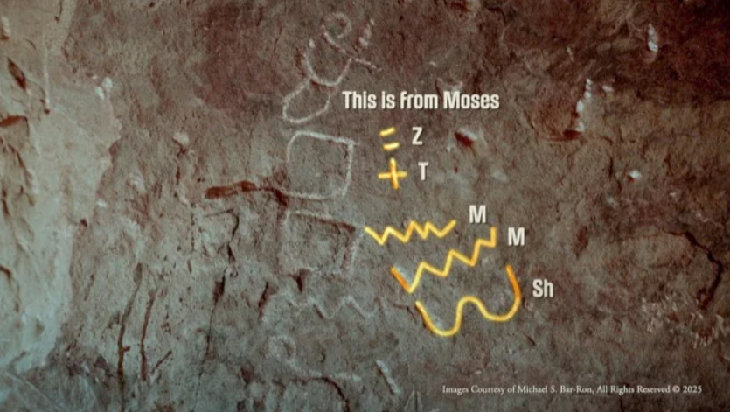
Among the inscriptions, Bar-Ron identified two phrases that point to individual authorship: “ZT MMŠ” (“This is from Moses”) and “NʾUM MŠ” (“A saying of Moses”). Similar markings appear near other inscriptions, namely Sinai 374 and Sinai 351.
“In all four inscriptions, the names are to the right of the main inscription, somewhat lower down, and either descend away from the main text, or bear glyphs facing the opposite direction of the main text,” Bar-Ron writes. “To me this broader view suggests these to be signatures of the author.”
He also notes that the inscriptions share stylistic and linguistic traits, a personal tone, and poetic structure, suggesting they were penned by a single Semitic author with deep knowledge of Egyptian hieroglyphs. This aligns with the biblical account of Moses being raised in Pharaoh’s court.
Bar-Ron’s discovery has made headlines, including National Geographic, CNN, The Guardian, Smithsonian Magazine and others. In contrast, the Hebrew media has been much more reluctant to share the discovery with its audience.
Bar-Ron’s theories are based on ancient inscriptions from part of a larger group of Proto-Sinaitic writings first uncovered by famed archaeologist Flinders Petrie in the early 1900s. Scholars believe they were etched by Semitic-speaking laborers during the reign of Pharaoh Amenemhat III (around 1800 BCE), making them some of the oldest alphabetic writings on record.
In 1905 Sir Flinders Petrie, the father of Egyptian archaeology, along with his wife Hilda, discovered several hieroglyphic-like inscriptions in ancient Egyptian copper and turquoise mines located in the southern Sinai-peninsula. Petrie initially thought these were regular Egyptian texts. But since they comprised the repeated use of a very small repertoire of the overall number of hieroglyphs, he identified these signs as an alphabetic script derived from Egyptian symbols. And yet he was unable to read them.
In his 213-page “proto-thesis” on the subject, Bar-Ron outlines how the Proto-Sinaitic alphabet evolved from Egyptian hieroglyphs, which were then adapted to represent Semitic sounds. With a phonetic writing system of just 22 letters, script could be used by the masses. In comparison, Egyptian hieroglyphs contained over 800 different complex pictures and was used only by highly trained scribes.
Some ten years after its discovery by Petrie the script was deciphered by the premier linguist of his day, the famous English Egyptologist, Sir Alan Gardiner. He identified the language as early Semitic “Canaanite”.
The script became known as "Proto-Sinaitic" and was dated to the late Middle Bronze Age. In the 1920's German Prof. Hubert Grimme, an expert in Semitic languages, identified the “Canaanite language” in the script as Hebrew.
For years the academic establishment has denied the existence of Moses, the sojourn of the Israelites in Egypt and even the Exodus. But the amount of evidence uncovered over the last several decades makes these claims increasingly difficult to accept.
Prof. Manfred Bietak of the Austrian Institute for Egyptology was the director of the at the Tell Ed Daba (Avaris) archaeological site located in Egypt’s northeastern Nile delta from 1966-2009. In a 2012 paper entitled Egypt and the Exodus Bietak wrote, “Summing up the evidence of the eastern Delta and Western Thebes, we conclude that early Israelites most likely were in Egypt during the late Ramesside period." In confirmation he notes the presence of typical Israelite four-room houses, official Egyptian accounts that closely mimic Biblical narratives, Egyptian references to Goshen and more.
Bar-Ron’s discovery not only confirms the Biblical accounts, but reveals the Israelites to be the originators of the alphabet – what many social scientists consider to be the greatest single leap in the advancement of knowledge. Until now, most academics credited the Phoenicians with the alphabet’s creation, even though the inscriptions were found hundreds of kilometers from Phoenicia.
The oldest Proto-Sinatic text dates to about 1800 BCE with the latest from the late 1500s BCE. After that, the alphabet stops appearing in Egypt and suddenly pops-up in Canaan. What Semitic people were known to have lived in Egypt and then suddenly moved to the Land of Israel? The scholars were mystified. In Canaan, it rapidly caught on with the various peoples living there and evolved into the Paleo-Hebrew and Paleo-Canaanite scripts more familiar to scholars.
Bar-Ron, spent eight years meticulously analyzing the inscriptions via high-resolution photographs, and direct study of casts of the inscriptions.
Unsatisfied with the existing photos of the engravings, he travelled from Israel to the US to take his own pictures.
“The discovery is thanks to the high-res images I merited to take in 2023 of an original cast by Hubert Grimme, which I held and photographed at different angles during my seminal trip to Harvard’s Museum of the Ancient Near East,” says Bar-Ron. “These original pictures enabled me to see elements there that nobody else noticed.”
Bar-Ron’s discovery has been confirmed by leading experts.
Dr. Pieter Gert van der Veen is Professor of Biblical Archaeology at Johannes Gutenberg University Mainz. Upon first seeing Bar Ron’s discovery her remarked, “You're absolutely correct, I read this as well, it is not imagined!
“Michael is doing an extremely careful job at this,” said van der Veen in an interview with the Patterns of Evidence blog. “He’s very self-critical and he’s trying to prove himself wrong. This is the only scholarly approach that I could recommend. If anything is to result from this in terms of early Israelite history, then it’s going to be through this type of high-level work.”
Dr. David Rohl, a world-famous Egyptologist and archeologist, was also impressed with the discovery. “Michael Bar-Ron has done an amazing and brilliant job in giving us the very best decipherment and translations of the Proto-Sinaitic inscriptions so far,” said Rohl in an interview to the Humble Skeptic blog. “I agree with much of his work and I am thrilled that we finally have inscriptions from Sinai and Egypt which relate directly to both the Biblical Sojourn and Exodus. The simple fact is that, at least to my mind, his translations convincingly demonstrate that Proto-Sinaitic is an alphabetic script which represents in writing the early Hebrew language.”
“As for the possibility that some of the inscriptions were written by Moses, I am sure that this is true, based on what the Hebrew actually has to say. There are certainly a few inscriptions in the same hand (stylistically). The contents would fit best as the words of Moses. For example, Sinai 357, commands people to follow the instructions from ‘the father’ about how to consume manna. This inscription has a small tagged inscription of five signs which reads ‘ZT M MSh’ which can certainly break down as ‘Zot m' Moshe’ — ‘This is from Moses’, labeling the column of signs directly to its left.”
However not everyone is convinced. Skeptics argue that proto-Sinaitic script is notoriously difficult to decode. Dr. Thomas Schneider, an Egyptologist at the University of British Columbia, dismissed the findings, calling them “completely unproven and misleading.” He claimed that these were “arbitrary identifications of letters” that could “distort” ancient history.
Whether ultimately accepted or disputed, Bar-Ron’s work has reignited debate over the historical roots of the Exodus and the origins of the alphabet. If his interpretations withstand greater scholarly scrutiny, they could offer a rare glimpse into the world of Moses and the earliest Hebrew writings; if not, they still contribute valuable data to the ongoing study of Proto-Sinaitic inscriptions and their place in the ancient Near East.












I like it! Always saw Moses as a leader and a hero!
Read the magnificent book When The Stones Speak by Doron Spielman it just confirms our history scientifically again.
For those who are ignorant this information can open a new world for them with joy.
I found a typo:
Scholarly ConfirmationBar-Ron’s discovery has been confirmed by leading experts.
Dr. Pieter Gert van der Veen is Professor of Biblical Archaeology at Johannes Gutenberg University Mainz. Upon first seeing Bar Ron’s discovery her remarked, “You're absolutely correct, I read this as well, it is not imagined!
It should be "he remarked."
Rabbi Bar Ron wrote a book with the titel "Song Of The Creator" in the book he shows the connection berween the chapters in the Tora but, starting with the first parasha and the last working towards the place where the parashot meet. Can't wait to read what he found this time. Great article.
It has been believed that only the tribe of Levi was in Egypt as some of the names have Egyptian roots, even Moshe. The Exodus story we used to unite the various tribes into one People. That some tribes, such as those decended from the handmaidens and Jacob, seem to be late additions to the fold. But the story of tge Exodus is part of Jewish history even if not accurate. The pharaohs did go into Canaan and took slaves. The Egyptians did work on pharoic building projects as an honour not as forced labour. The story of " we were slaves unto pharaoh in Egypt..." may not be true, but it is a cornerstonevof Jewish history. So while it may not be accurate is is, in a sense, still " true" as it is part of the epic of the origins of Israel.Too many theologians spend time trying to " prove" the Sto
Papyrus Brooklyn (Brooklyn Museum Papyrus) c. 1809-1743 BCE has a roster of Semitic slaves (80-95) who tried to feel their Egyptian masters. Some of those names are Menachema, Ashera, Shifra, 'Aqoba (Ya'aqov/'Aqiva), Dawidi (David) & the word "Hy'brw" similar to H'ivri or Hebrew). The Ipuwer Papyrus, also ancient, talks about an "upheaval" of famine, collapse, social chaos, violent escape of slaves, river turned to blood, halted fertility, servant become masters. That's a plausible match w/the Exodus.
Great article. I want to see more of the pictures/inscriptions and better descriptions If possible. More clarity would be great as well.
Suggest you look up any published articles on archeological websites.