







 Debunking Viral Claim About the Talmud and Minors




5 min read


An apocryphal meeting between a philosopher and a prophet can help us understand what Jews mourn on Tisha b'Av.
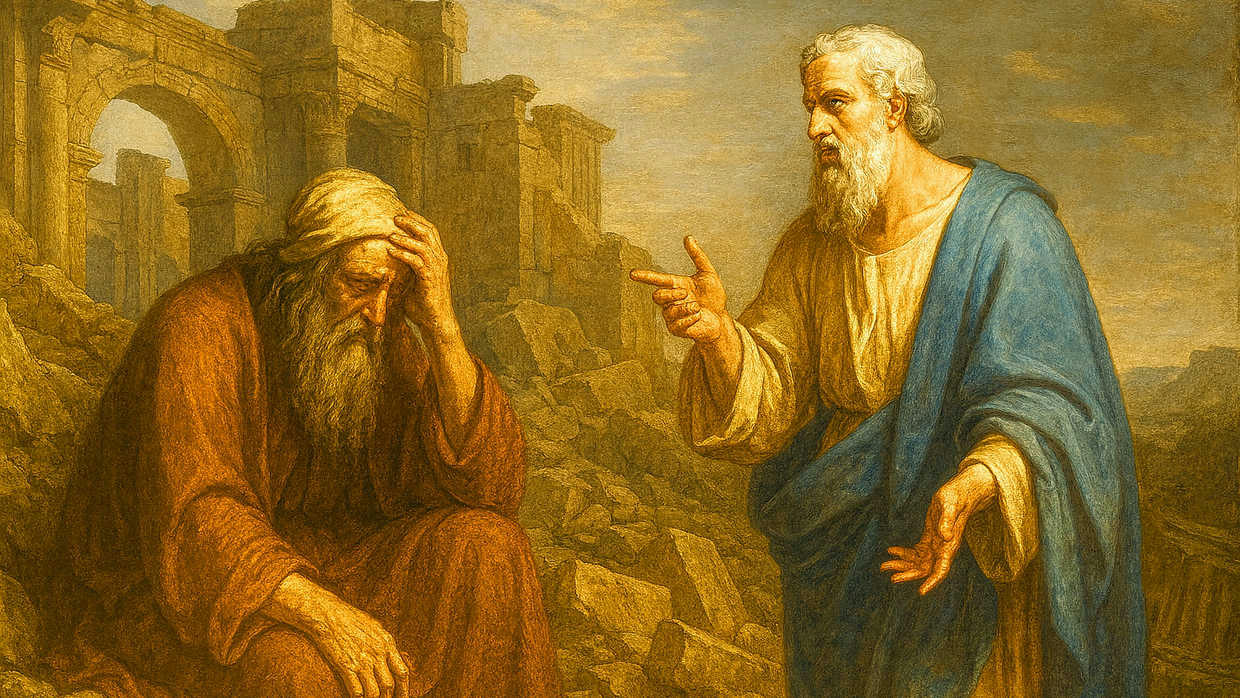
The story is almost certainly apocryphal—an imagined encounter between the Greek philosopher Plato and the prophet Jeremiah—but it has been passed down through generations and continues to resonate powerfully. It touches on something profound about what we lost with the destruction of the Temple on Tisha B’Av.
After witnessing the destruction of the First Temple, the prophet Jeremiah collapsed onto the ruins and wept. At that moment, he was approached by the Greek philosopher Plato. Plato was perplexed by the sight.
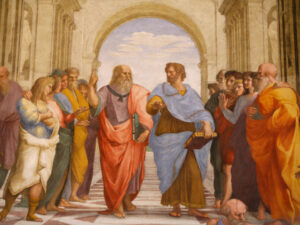
He asked Jeremiah, “You, the wisest of the Jews, are crying over mere stones and wood? Furthermore, why mourn the past? What’s gone is gone. A wise person doesn’t dwell on the past, but looks forward to the future and builds anew.”
Jeremiah responded cryptically: “You, as a great philosopher, must have many questions about life and wisdom.” Plato replied that he indeed had many philosophical questions, but didn’t believe anyone could answer them. To this, Jeremiah responded, “Ask your questions, and I will do my best to answer them.”
And so Plato asked, and Jeremiah answered without hesitation. Plato was astounded by the depth of Jeremiah’s wisdom. Then Jeremiah finally spoke the words that would remain etched in Jewish thought: “Know that all of my wisdom comes from these stones and wood. And as for why I cry over the past, this question is very deep, and you will not be able to understand it. Only a Jew can understand the depth of crying for the past.”
Jeremiah’s words—“All my wisdom comes from these stones and wood”—are deeply layered, and we can approach them from at least two possible angles, each of which reveals something tangible about the nature of wisdom and our relationship with the Divine.
The first approach relates to a philosophical and intellectual understanding of the Temple itself. The Torat HaOlah by Rabbi Moshe Isserles is an important work of Jewish thought that provides a detailed account of the Temple and its intricate rituals. Rabbi Isserles explores the idea that the Temple was not merely a place of sacrifice and worship. It was, in fact, a microcosm of creation, reflecting deeper philosophical and scientific truths about the world. The dimensions of the Temple, its structure, and even the services performed within it were, in Rabbi Isserles’ view, a symbolic reflection of the fundamental laws of the universe.
Perhaps Jeremiah’s statement to Plato was an allusion to this. He was hinting that the Temple was not only the center of Jewish worship—it was a place to encounter and reflect upon the cosmos as a whole. Plato, representing the Greek worldview, could understand the utility of sticks and stones—even the aesthetic beauty of fine architecture—but it did not occur to him that the Temple itself could teach.
Alternatively, we could interpret Jeremiah’s words as a reflection of something more personal. Jeremiah’s great wisdom, he tells Plato, comes from his deep connection to the Divine and to the spiritual essence of the Temple. The “stones and wood” are not merely physical; they represent the holy presence that once filled the Temple and the direct relationship with God that the Jews had in that sacred space.
Jeremiah's lesson for Plato is that true wisdom comes from a personal connection to the Source of wisdom, not merely from intellectual exertion. It’s not enough to ask questions or seek answers intellectually—the deepest truths are revealed through the pursuit of spiritual authenticity.
But perhaps the most haunting aspect of this story lies in the final words of Jeremiah to Plato: “Only a Jew can understand the depth of crying for the past.”
The intellect may tell us to move on, to focus on rebuilding, to leave the past behind. Yet, there is something sacred and essential about mourning, about confronting loss head-on. This is especially poignant as we approach Tisha B'Av, a day when we mourn not only the destruction of the Temple but the loss of our spiritual center.
Jeremiah, in his wisdom, tells Plato that understanding the importance of mourning the past requires more than intellectual grasp—it requires a deep, soulful connection to the events of history and their lasting impact. The Jewish soul is uniquely attuned to this idea. We don’t simply move forward; we remember, we mourn, and through that mourning, we gain a richer, more experiential appreciation of the long arc of history. As Tolstoy wrote, “The Jew is the symbol of eternity.”
As we observe Tisha B'Av, we are reminded that true wisdom is not only about seeking philosophical answers—it’s about connecting to the deepest truths of our tradition, our people, and our history. And perhaps, in the end, it is the act of mourning itself that yields the deepest, most meaningful wisdom. In mourning, we hold the memory of the past, the pain of the present, and the promise of the future all at once—and in doing so, we grasp more fully the unfolding story of the Jewish people and their enduring role as a light unto the nations.












A counter point: Israel is a geographically smallish country but is not so small that to travel to Jerusalem would be a number of days journey, even from Beer Sheva or Haifa or Tiveria.
The efforts of the rabbis in Babylon led to the creation of today's prayer rituals making synagogue services adaptable to many geographical locations. There are synagogues in many Jewish communities (small, medium and big).
Because G-d took the Palestinians out of Egypt amidst great miracles, gave them the Living Torah at Mount Sinai, commanded them to enter the Land of Israel & build a house of G-d in Jerusalem??? The Palestinians ELECTED Hamas as the government. After the Oct 7 Massacre, polls showed Hamas' popularity among Palestinians SOARED! Hamas just announced that they aim to take al-Aqsa Mosque which "somehow" was built ON TOP of the House of G-d, the Holy Temple which the Romans destroyed. Hamas vowed to hunt every Jew in the world & kill him. Looks like the hunter is being hunted. ANYONE who hunts Jews will have a Tisha' Be-av for themselves because G-d runs a tit-for-tat show with the world through their treatment of Jews. Palestinians destiny is of their own doing.
Inspiring! Thank you.
What does Tisha B'av have to do with the Palestinians? Why must Palestinians be tied into every Jewish historical tragedy when they are part of the cause?
We have learned a lot.We know now that our enemies are all around us, and we must never stop fighting. We love our children but some times others do not love their own.
So profound and deep. Thank you Rabbi Dovid!