







 Debunking Viral Claim About the Talmud and Minors



12 min read


The scandalous incident involving Chanah, the daughter of Matityahu, that instigated the rebellion of the Maccabees.
Within the municipal boundaries of the modern Israeli city of Modiin, about 20 miles northwest of Jerusalem, is an amazing excavation of a village from the period of King Herod (circa 37- 4 BCE). But the unearthed remains of the Herodian synagogue have yet more tantalizing secrets to reveal, as they are built on top of another synagogue from the Hasmonean period (140-37 BCE), which is in turn built on top of a similar structure dated to the period of the Maccabean Revolt (167-160 BCE).
Modiin is the hometown of the heroes of Hanukkah - Matityahu and his family. It is the location of the well-known story recounted in the Book of Maccabees I in which Seleucid (Syrian-Greek) stormtroopers attempt to coerce Jews to sacrifice a pig on a pagan altar. Matityahu attacks the soldiers and a Jewish collaborator before retreating to the hillside with his sons and supporters. That incident was the spark of the lengthy rebellion against Hellenist oppression, which led to the liberation of Jerusalem, the reassertion of Jewish sovereignty, and the rededication of the desecrated Temple.
Or was it?
Maccabees I, originally written in Hebrew and translated into Greek, was composed by an anonymous author who was most likely a Jew living in the newly independent Hasmonean kingdom established by the Maccabees. His chronicle is not part of the Jewish Biblical canon but it is considered a trustworthy source for understanding events in Judea beginning with the accession of the Seleucid Emperor Antiochus IV (“Epiphanes”) in 175 BCE.
Rashi writes that “the Greeks decreed that all married virgins must first give themselves to the governor and the miracle [of Hanukkah] was carried out through a woman.” What incident is he referring to?
The Seleucid dynasty, founded following the death of Alexander the Great and the splitting of the Greek empire in 323 BCE, conquered the land of Israel from its rivals, the Ptolemies, around 198 BCE. Antiochus IV appears to have been a committed Hellenizer who sought to impose Greek culture (and no less important, complete loyalty of the local priests and political class) on the lands he ruled. According to the Book of Maccabees, he outlawed many basic Jewish practices – such as learning Torah, keeping kosher, Sabbath observance, circumcision, and more – and placed a pagan statue in the Temple and ordered the ritual sacrifice of pigs.
In the works of the Greek historian Diodorus Siculus, written between 60 and 30 BCE, it is mentioned that Antiochus IV “tried his utmost to abolish [the Jews’] laws.” Among other things, “he put out the lamp (called by them eternal) which burns continually in the temple…. [and] forced the high priest and the other Jews to eat swine meat.”
In light of the Hanukkah story as told in the Book of Maccabees, a comment by the classical, authoritative commentator Rashi (Rabbi Shlomo Yitzhaki of Medieval France) on a sentence in the Talmud (Tractate Shabbat 23a) definitely raises an eyebrow. He writes that “the Greeks decreed that all married virgins must first give themselves to the governor and the miracle [of Hanukkah] was carried out through a woman.”
In the Talmud itself a few pages earlier (21b), we are told that the miracle of Hanukkah involved a single flask of pure oil found in the Temple for relighting the menorah (possibly the “eternal lamp” mentioned by Diodorus):
What is Hanukkah? Our rabbis taught: On the 25th of Kislev are the days of Hanukkah…. When the Greeks entered the Temple, they defiled all the oil there. And when the Hasmoneans defeated them, they found only one sealed cruse of oil remaining with the seal of the High Priest, with only enough for [lighting the Temple Menorah for] one day. But a miracle occurred and they were able to light it for eight days. The following year, they declared these [days] a holiday of praise and thanksgiving.
That is ostensibly the source of the eight days of candle-lighting we celebrate today. Yet, there is no obvious indication whatsoever that this miracle, per Rashi, was “carried out through a woman.” However, there is a fascinating lesser-known source describing events leading up to the miraculous victory of Hanukkah that does indeed align quite well with Rashi’s commentary.
The source is called Midrash Maaseh Hanukkah and one of its most important protagonists is Chanah, the daughter of Matityahu.
The midrash begins by describing the Syrian-Greeks conspiring to “issue harsh decrees against [the Jews] until they reject their God and embrace idolatry.” However, the Jews adjust their behavior each time in an attempt to adhere to both Jewish law and Greek edicts.
The Seleucids began by outlawing door locks on Jewish homes on penalty of death, in order to deprive “Israel of dignity and privacy, because a house with no door has no dignity or privacy. And any who wants to enter can enter whether day or night.” We are told the Jews “endured the decree for three years.”
The next decree was that every Jew who owned an ox or sheep had to carve into its horns: “I have no portion in the God of Israel.” In response, the people “sold their animals whether pure or impure, and Israel was traveling on foot.” God in turn responded by sending “deer, rams, and all species of kosher birds” directly into the homes of the Jews, “for their homes had no doors.”
Then the Syrian-Greeks took their oppression to a new level of invasiveness:
Anyone whose wife goes to immerse herself [in a mikveh, necessary for marital relations], he will be killed by the sword. And whoever sees her [going to immerse] will have her as a wife and her children as slaves.
The Jews then refrained from marital relations. The Greeks, learning of this, said: “Since the Jews are not using their beds, we will.”
God “caused springs of water to appear for each woman in their homes, and the women immersed at home, fulfilling the verse (Isaiah 12:3), ‘You shall draw water with joy from the wells of salvation.’”
The Syrian-Greeks declared that “no bride would enter her husband’s home on her wedding night before she was with the local governor.”
Seeing that their latest effort to coerce Jews to violate their religious laws was unsuccessful, the Syrian-Greeks declared that “no bride would enter her husband’s home on her wedding night before she was with the local governor.” The midrash tells us that this situation also endured for nearly four years, “until the incident of the daughter of Matityahu, the High Priest, who was betrothed to a son of the Hasmonean family named Eleazar.”
What was this “incident”?
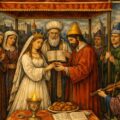
Imagine the scene: All of the couple’s respective families and the religious and political leaders of Israel gather to honor Matityahu at his daughter’s wedding. All of a sudden, during the festive meal, the bride stands up, claps her hands for attention, and then tears off her wedding dress, leaving herself “exposed before all of Israel, and before her father, mother, and in-laws.”
Needless to say, everyone is shocked, embarrassed and enraged. Just as Chanah’s brothers are about to rush at her in their fury, she speaks out forcefully:
“Hear me, my brothers and relatives! You are angered that I stood exposed before the righteous without committing any sin, and are you not angered that I am to be handed over to a pagan to be defiled! You must learn from Shimon and Levi, the brothers of Dinah, who, though only two, avenged their sister’s honor and destroyed a town like Shechem, risking their lives for the sake of God’s name, and God supported them and did not let them come to shame. But you, five brothers — Yehuda, Yochanan, Yonatan, Shimon, and Eleazar — and over 200 priestly youths, place your trust in God, and He will help you, as it is said (Samuel I 14:6): ‘For nothing can hinder the Lord from saving.’”
She began to cry and said: “Master of the Universe! If You will not have mercy on us, have mercy on the sanctity of Your great name, by which we are known, and avenge us now!”
Chastised and taken aback, Chanah’s brothers stand down and instead formulate a plan to attack their Seleucid overlords. They decide to present their sister to the “king” (possibly simply a higher-ranking Greek official), saying that she is such a highly respected person, it is only right that she spends the night with the king himself, rather than a mere local governor. With that subterfuge, they would enter the palace, kill the ruler, his servants, and his ministers.
The midrash then says that a “heavenly voice was heard from the Holy of Holies [in the Temple]: ‘All of Israel, the young men have triumphed in Antioch!’” (Evidently a reference to a Talmudic statement in Tractate Sotah 33a that says, “Yochanan the High Priest heard a Divine Voice from the Holy of Holies saying: ‘The youth who went to wage war against Antioch (or Antiochus) have been victorious.’”)
There are a few miracles described in Midrash Maaseh Hanukkah, but only one that could be said to have been carried out because of a single woman, in line with Rashi’s commentary. If a successful armed rebellion by a handful of priestly scholars and their supporters against the ancient equivalent of the American Marine Corps is a miracle, then Chanah was clearly its instigator.
The version of “Midrash Maaseh Hanukkah” we presented here is based on the text in Otzar Midrashim, a collection by Hebraist, historian and Orthodox scholar Judah David Eisenstein (1854-1956) published in New York in 1915. His version, in turn, is based on “the Munich manuscript” – possibly a reference to a unique handwritten 1342 copy of the Talmud and other non-canonical texts.
All or parts of the midrash have appeared in other contexts, both before and after Eisenstein’s publication. It is referenced in poetic form in liturgical poems for Hanukkah that can be traced back about 1,000 years. Elements of the midrash can be found in works by Rabbi Eleazar of Worms (c. 1176–1238), Rabbi Yaakov ben Asher of Cologne and Toledo (c. 1270-1340), and Rambam (Maimonides; c. 1138–1204) of Córdoba and Cairo.
An earlier source for elements of the midrash is to be found in the 8th century work known as the She'iltot of Rav Achai Gaon. The version in the She’iltot may itself be based on a commentary on Megillat Taanit, a 1st century text listing days of celebration or noteworthy successes of the Jewish people in Israel. The Megillat Taanit gloss provides a very short version of the midrash, saying that Jewish brides were subject to rape by any Seleucid soldier in nearby military encampments. Eventually, when a military officer attempted to attack an unnamed daughter of Matityahu, her brothers rose up against him and eventually overcame the entire Syrian-Greek regime in Israel.
A key aspect of the midrash is jus primae noctis – the legalized rape of new brides before their wedding by a local warlord, king or governor. While the practice may have been far less widespread than it appears in popular imagination, it is nonetheless referenced many times in texts going back at least to the time of the Epic of Gilgamesh (c. 1200-900 BCE).
The Greek historian Herodotus (writing between 430 and 424 BCE) mentions a Libyan custom according to which “all women about to become brides [are brought] before the king, that he may choose such as are agreeable to him.” Around 280 BCE, lower-class Etruscan (Italy) citizens rebelled against the ruling class and, according to archaeologist and historian Otto Wilhelm von Vacano, “placed the daughters of the nobles under the jus primae noctis....”
It is also mentioned explicitly in the Babylonian Talmud, Tractate Ketubot 3b, as a reason for instituting a change in Jewish wedding customs.
Rabbi Eliezer Shenvald, head of the Meir Harel Yeshiva in modern-day Modiin, notes in The Spirit of the Hasmoneans that an attack on “the modesty and sanctity of the Jewish home” was a key goal of the Syrian-Greek strategy. That explains their decrees against door locks, ritual immersion (which allows for marital relations), and the jus primae noctis.
Rabbi Avraham Yitzchak Kook (1865-1935), the first Chief Rabbi of the Land of Israel, wrote in his Talmud commentary Ein Aya that the Greeks saw the Jewish view of family life “as the mortal enemy of their culture, which championed the joy of life, physical and imaginary pleasures.”
Accordingly, Rabbi Shenvald notes, the Hanukkah candle-lighting tradition is heavily focused on the home according to all rabbinic literature. The menorah is meant to be lit at the door of one’s home, after the workday is over, with the entire family gathered around. As the rabbi wrote, “there is a special relationship between the publicizing of the miracle and the Jewish home.”
More broadly, the Seleucid Empire – as indicated by both Greek and Jewish sources – was battling against Jewish cultural autonomy. That is why they also attempted to ban Shabbat observance, Torah study and circumcision, but the most basic building block of any long-lasting culture is undoubtedly the family unit.
Hanukkah can teach us, therefore, that religious freedom, personal commitments, social justice, and even national aspirations all really begin at home.
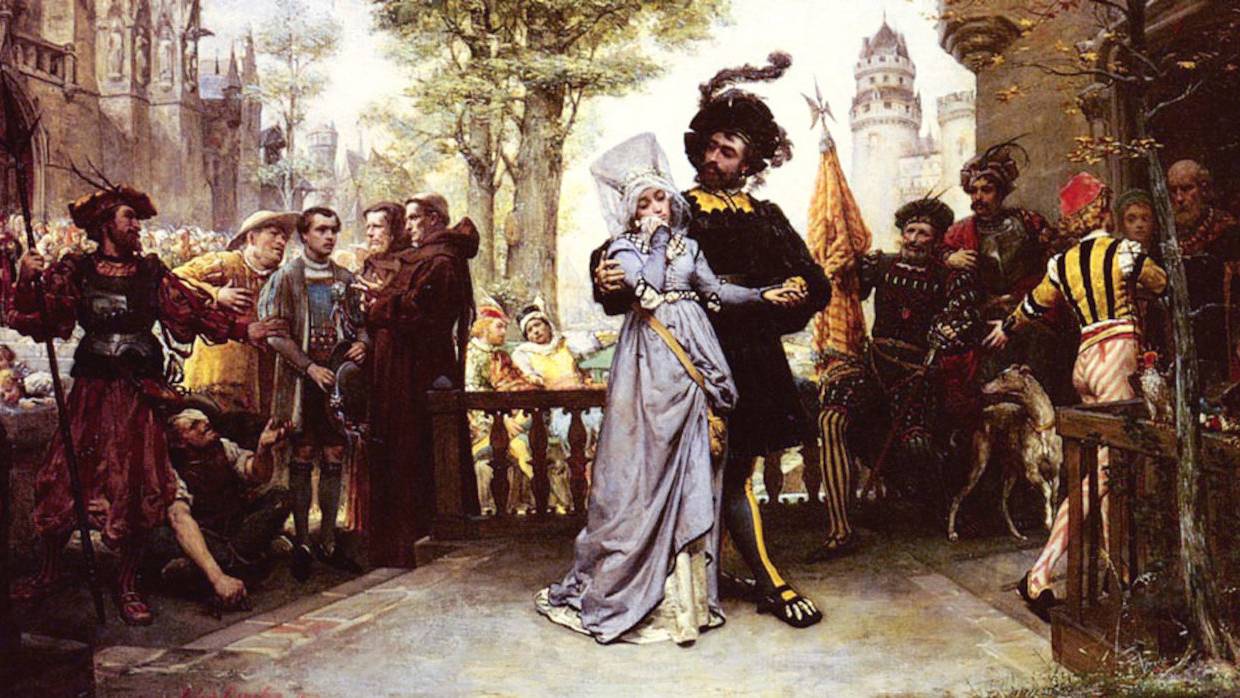
Featured image by Jules Arsene Garnier







Kudos to the author on a well-written and well-researched article. Love Jewish history and this was really well-done and helpful.
I could be right it was Yehudit not Chana the name of the Macbees sister
So why do they mention Judith in the Chanukah story, I thought there is a story with Chana and 7 sons, I did not know the Macbees sister was a Chana too
Good question!
Hopefully this clears it up:
Judith/Yehudit was completely different in a different scenario than the one presented here with Chana.
Please see Judith/Yehudit's story here:
https://aish.com/48959951/
Two different albeit heroic Jewish women in two different situations.
Is there a contradiction between the gemara in M. Shab vs. M. Kethub? In Kethuboth 1st night rights did not happen to every bride. Why the contradiction? Aren't they talking about the same period? Maybe M. Shab was only bethuloth?
Thank you.
It is easy to realize Chanah's assertion is applicable today.
People are fearing to do as they should; yet, what they should to is the antidote to their fear and harm.
To the current causes, if they could but see the enemy is indeed one: The Adversary of humanity, entering into the souls of non-Jewish persons, and to push back on his darkness by doing mitzvot that bring light; would you find it as hard to kindle your chanukiah and put it on display?
Excellent article! Let's we never forget.
Excellent article!
Enlightening!
The name of the woman is YEHUDIS and you can fact check this. Chana was the story of Chana and her 7 sons
Some say YEHUDIS was a daughter of a kohain and a widow at the time of this story. Please fact check b4 going to print
Ty
yes that is the way I heard it also...Yehudis, the daughter of a cohen and a widow went to the camp of general Holofernes. she risked her life and modesty simply by walking through the streets unaccompanied. she plied Holofernes with cheese and wine after which he fell asleep. she beheaded him with his own sword and displayed her "trophy" to his troops. this was the beginning of the maccabean revolt. (I think)
on a lighter note...many have the custom of eating dairy on hanukkah,
possibly because of the cheese that yehudis fed to holofernes.
Miriam you are correct referencing confusion or names. (יהודית is correct)
Hopefully, the following can clarify things:
The article above refers to a completely different woman and situation.
Chana's story above is completely different than the story of Yehudis.
Please see the Chanukah story of Yehudis here:
https://aish.com/48959951/
Two different albeit heroic Jewish women in two different situations.
Well, three different albeit heroic Jewish women, if you count the Chana with the 7 sons, as mentioned by Miriam Yehudis Sherr.
So 2 Chanas and 1 Yehudis.
This powerful article can have many takeaways. To anyone aware of and attuned to the enormous spiritual and mystical importance Torah Judaism places on total marital fidelity (for both women and men), and indeed pre-marital chastity, the nature of the decree can only curdle one's blood and turn one's stomach. Giving it a fancy Latin name does nothing to attenuate its moral barbarity. Chana's 'shock treatment' (multiply its effect a million-fold to our overexposed contemporary reaction), was an act of incredible heroism – sacrificing her own dignity to protest a horrible indignity being perpetrated upon all women and the very essence of Jewish spirituality.
Right
Excellently researched and documented article. A woman's role is a welcome addition to learning the story of Hanukkah.
hanukkah is rich with heroic women. more than most people are aware of.
Great article!