







 Debunking Viral Claim About the Talmud and Minors



12 min read


Defying the Inquisition, converso Jews of Portugal were conducted to safety through a secret escape network.
When King Ferdinand and Queen Isabella of Spain exiled the Spanish Jews in 1492, King John II of the neighboring Portugal saw an opportunity for profit. At the time, Portugal was waging a military campaign against Muslims in Africa, and King John II was struggling to finance the campaign. Though the king’s advisory council had initially objected to admitting Spanish Jews into Portugal, King John II convinced them by arguing that by charging Jews money in exchange for a temporary stay in Portugal they could cover their military expenses without overburdening the local taxpayers1.
A contemporary Italian Jew wrote2:
One hundred and twenty thousand [Spanish Jews] went to Portugal, according to a compact which a prominent man, Don Vidal bar Benveniste del Cavalleria, had made with the King of Portugal, and they paid one ducat for every soul, and the fourth part of all the merchandise they had carried thither; and he allowed them to stay in his country six months.
Other sources say that the Jews were allowed to stay for eight months once they paid the demanded amount, charged at five customs stations the king had set up especially for the exiled Jews. The possession of a receipt from these customs entitled the Jews to enter Portugal3.
Those Jews whose professions could be helpful to the war effort, such as metal workers and armorers, were given a discount – they only had to pay half. The 600 families of wealthier Jews, who were willing to pay almost eight times as much, were granted permanent residence in Portugal4.
King John II had promised the temporary Jewish residents that at the end of the allotted time he would arrange their passage to their next destination, for an additional payment. But, having extorted as much money as he could, the king was in no hurry to fulfill his promise. The Italian Jew continues his account5:
The King acted much worse toward them than the King of Spain, and after the six months had elapsed he made slaves of all those that remained in his country, and banished seven hundred children to a remote island to settle it.
The children – other sources mention that there were 2,000 of them – were torn away from their parents’ arms, forcibly baptized, and shipped off to the crocodile-infested island of Sao Tome off the west coast of Africa. Most of them perished.
The adults remained enslaved until the next king of Portugal, King Manuel, freed them in 1495 upon ascending to the throne.
Tajador judeo-Spanish s.XIV. Plate (vessel) for cutting and serving meat at the table. Milartino, Wikimedia Commons
But King Manuel’s benevolence was short-lived. To strengthen his rule, he married Princess Isabella of Aragon, the daughter of King Ferdinand and Queen Isabella of Spain. A precondition to the marriage was extending the expulsion decree to Portugal. In 1496, King Manuel issued an expulsion decree, giving the Portuguese Jews ten months to either convert to Christianity or leave the country.
Even before the designated date of departure, the king, like his predecessor, decreed that those Jewish families who refuse to convert should have their children forcibly taken away, baptized, and handed over to Christian institutions. Many parents succumbed to the pressure and converted to Christianity in order to keep their children.
Those who clung to their faith gathered at the port of Lisbon, as it was declared the only permitted point of departure from Portugal. They waited in vain for ships to show up and take them away from their persecutors.
Professor H. V. Livermore wrote6:
[T]hey were told that they should have left before, and must now consider themselves the king’s slaves. Every attempt was made to convert the twenty thousand Jews who were assembled in Lisbon by threats, promises and forcible conversion. The handful who resisted this treatment, including the king’s mathematician and astrologer Abraao Zacuto, and a doctor, Abraao Saba, were at last allowed to depart. The rest, on conversion, were promised protection.
Thus, thousands of Jews remained in Portugal as conversos, outwardly Christian but practicing Judaism in secret.
Having achieved his goal of converting the Jews of Portugal, King Manuel was now afraid that his “new Christians” would want to leave Portugal in order to return to their religion. Not wanting to lose so many productive and tax-paying subjects, he issued an order to close the borders to them. Professor Livermore wrote7, “No ex-Jew was allowed to leave the country without a special permit, which was only granted for commercial purposes and provided that his wife and children remain in Portugal.”
Stuck in Portugal, the conversos maintained their Judaism as best they could while the government looked the other way. A new threat appeared on the horizon in 1536, when the Office of Inquisition was officially established in Portugal.
Fully aware of the Inquisition’s activities in Spain, the Portuguese conversos understood the danger they were about to face. They began devising desperate plans for leaving Portugal.
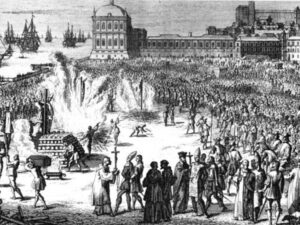
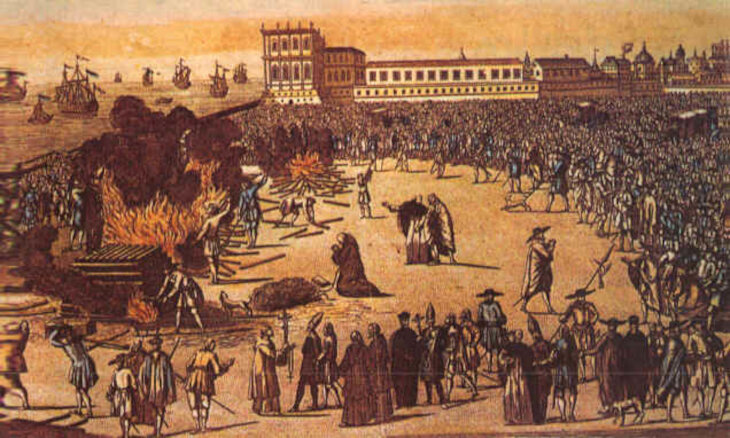 Burning of Crypto-Jews in Lisbon, Portugal in 1497, Museum of Portuguese Jewish History
Conversos who had managed to make their way to Antwerp and London extended help to their brethren who remained in Portugal. Professor Aron Di Leone Leoni wrote8, “A complex rescue organization was set up to plan and finance the flight of conversos from the Iberian Peninsula to London and Antwerp, where some of them found shelter while others continued their journey to Italy and the Levant.”
Historian Simon Schama offers a dramatic description of the escape9:
Always it began in darkness, in the hours between midnight and dawn, when the last dockside patrols had ended… Like small night animals emerging from burrows, whispering cloaked figures would come to the quays on the Tagus River carrying only what they needed for the two-week voyage to Antwerp: a cooking pot, a mattress, hard biscuits, a little oil, a chest of clothes.
The route, writes Schama, was10:
a transcontinental highway of escape: a chain of ships, river ferries, lodgings, wagons, drivers and riders extending from the Portuguese Atlantic coast to the English ports, then on across the Channel to Flanders, down through France and the Rhineland, over the Alpine passes, into the Po Valley. If they then eluded the guards posted in Lombardy expressly to detect, arrest, and deal violently with them, they might be able to reach the safety of Ferrara. Some might stop there; others move on through the Apennines to Pesaro and Ancona, then over the Adriatic to Ragusa (now Dubrovnik), and finally into the realm of Suleyman the Magnificent where they would at last be free…
The escape was fraught with danger at every step. Professor Schama explains11:
Even at the Tagus dockside some were betrayed and dragged away. To evade the police on the city wharves, many of the fugitives loaded themselves and their belongings into small boats further upstream, and were rowed, as quietly as could be managed, towards the Flanders-bound ships moored at the mouth of the river.
Those who managed to leave Portugal encountered people knowns as “the Conductors,” who led them to homes that served as waystations, where the escapees could rest and recharge before embarking on the next leg of their journey.
In Flanders, the Conductors gave the refugees food and lodging and even invited them to a secret synagogue, with a strict warning to keep quiet and avoid anything that would attract attention.
Once rested, the refugees continued their journey on covered wagons. The Conductors provided them with detailed instructions about their route and the next waystation, where, if all went well, they would meet their next Conductor and have another chance to rest.
Not everyone managed to complete the journey. Some unfortunates were intercepted by the Inquisition. It was the Inquisition that preserved a copy of the Conductors’ instructions that were confiscated from the refugees. From this copy we know about one of the escape routes.
The instructions directed the refugees to travel from Antwerp south to Cologne, Germany. In Cologne, they were to find the Inn of the Vier Escara, where they would meet their Conductor, Pero Tonnellero. Pero would assist them in obtaining boats, which they take upriver along the Rhine River to Maintz. In Maintz, they were to find the inn with the sign of the fish and meet their next Conductor, who would help them acquire wagons for the land route southeast along the Swiss lakes to the Alps. The next Conductor would hire muleteers and horse handlers who would take them across the Alps, over the snowy summits, and down into the Po Valley.
Not everyone survived the harsh weather and the steep ascents and descents of the Alpine crossings. Those who did had to be careful to avoid the roadblocks posted at the descents from the mountain passes for the sole purpose of catching runaway “new Christians.”
If caught, the unfortunate refugees would be robbed of all of their possessions and tortured in order to force them to reveal the identities of the Conductors. Anyone found guilty of abetting their escape would be sentenced to death.
Professor Schama concludes12:
The fact that we know all this from the Inquisition archives means that many failed to reach Ferrara or the Adriatic. The miracle, one wrought by the Antwerp Rescuers, is that many did survive and moved on towards the Adriatic ships.
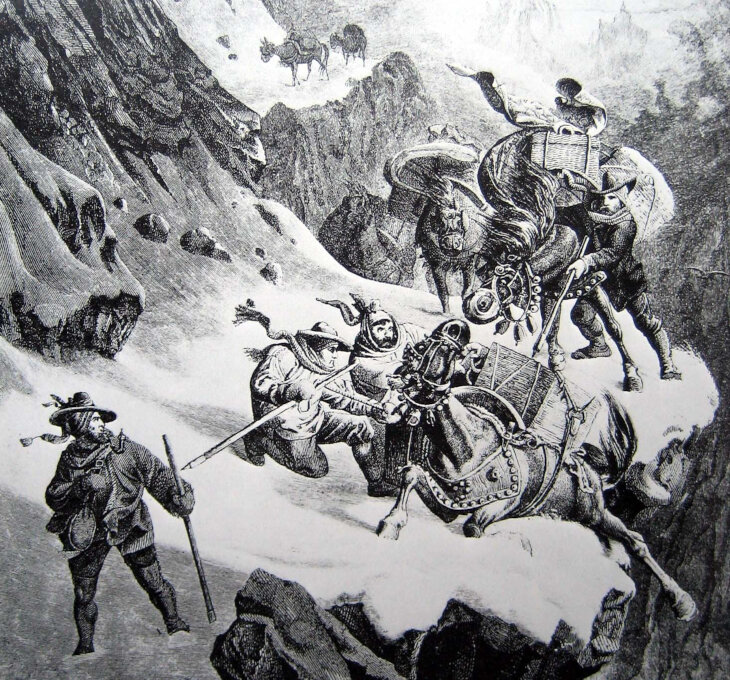 Muleteers at the Gotthard Pass, crossing the Alps. Upload by Adrian Michael, Public domain, via Wikimedia Commons
Due to the secret nature of the operation, not much is known about the rescuers’ identities. Only some of their names are preserved by history.
Among the main organizers and financiers of the escape network was Diogo Mendes, a Spanish-born converso and the older brother of Francisco Mendes, the husband of the famous philanthropist Dona Gracia Nasi. Diogo and his partner, GianCarlo Affaitati, owned a successful pepper and spice trading business. Their tax payments served as a reliable source of revenue for the king, who in return turned a blind eye to Diogo’s “Judaizing” activities.
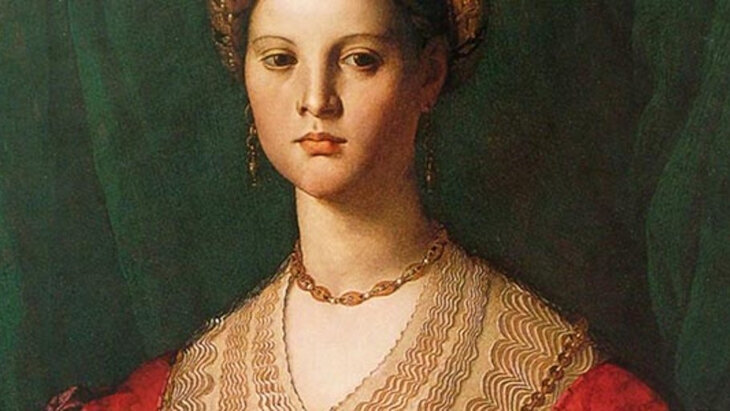 Dona Gracia Nasi
In 1532, under the pressure of the Inquisition, the king agreed to a search of Diogo’s house. A Hebrew book of Psalms was discovered and Diogo was arrested. Among the charges was abetting the escape of conversos to the Ottoman Empire. Fortunately for Diogo, the royal family did not want to lose their source of revenue. They agreed to release Diogo in exchange for 50,000 gold ducats.
Another known rescuer was the one-eyed rabbi merchant Antonio de la Ronha. He was also arrested and subsequently released in 1532. After his release, he escaped from Antwerp to London, where he continued assisting the Portuguese refugees.
In London, de la Ronha worked together with Cristoforo Fernandez. When Antwerp became too dangerous a destination, Fernandez would go to the English ports to meet the refugees and warn them against continuing on to Antwerp. Instead, the rescuers provided shelter for the refugees in London.
In 1540, one of the Conductors, Gaspar Lopes, a relative of Diogo, was caught by the Inquisition. Under torture, he divulged sensitive information about the escape network. Again, the royal need for money saved the leaders of the network from arrest and worse.
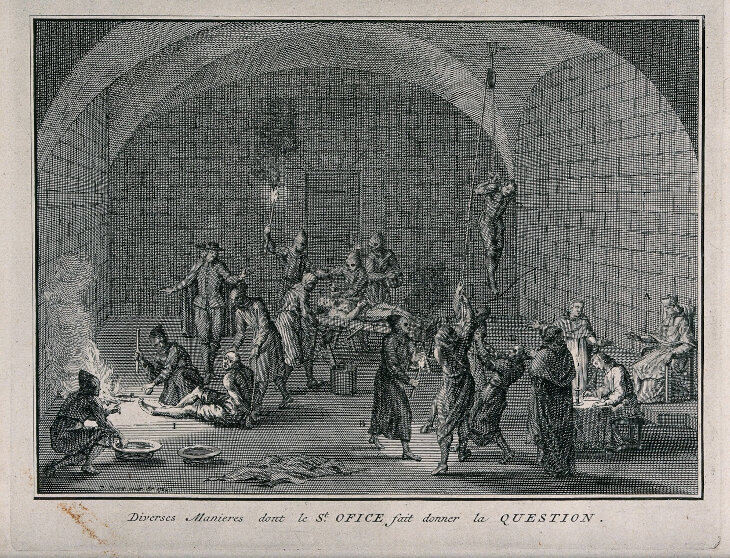 A torture chamber of the Spanish Inquisition with suspected heretics having their feet burned or being suspended with a rope from a pulley while scribes note down confessions. Engraving by B. Picart, 1722. Wikimedia Commons
As shown above, the kings and rulers of the time were more often motivated by financial rather than religious considerations. Even solid evidence of “Judaizing” could be dismissed for a large enough payment. In fact, writes Professor Leoni13:
The accusations of heresy and apostasy were often used as a pretext for imprisonment of some rich merchant who would eventually be released on payment of a large sum. The prosecution of heresy was turned into a financial tool for the benefit of the Emperor.
In contrast, the conversos demonstrated their sincere commitment to Judaism. Tremendous self-sacrifice was required from both the rescuers and the rescued at every step of the escape network. Too many conversos lost their lives in the process. Professor Leoni continues14:
I am convinced that only a strong leaning towards Judaism could have swayed so many people to adopt such a risky and otherwise unimaginable step, as a flight from the remote regions of Portugal to London and Antwerp and the subsequent hazardous caminho (journey) from there to Ferrara using secondary routes and hidden path through the Alps.
Both the refugees and their rescuers, who, writes Professor Leoni15, “dedicated a large part of their resources to help their persecuted brethren” deserve our respect and appreciation.
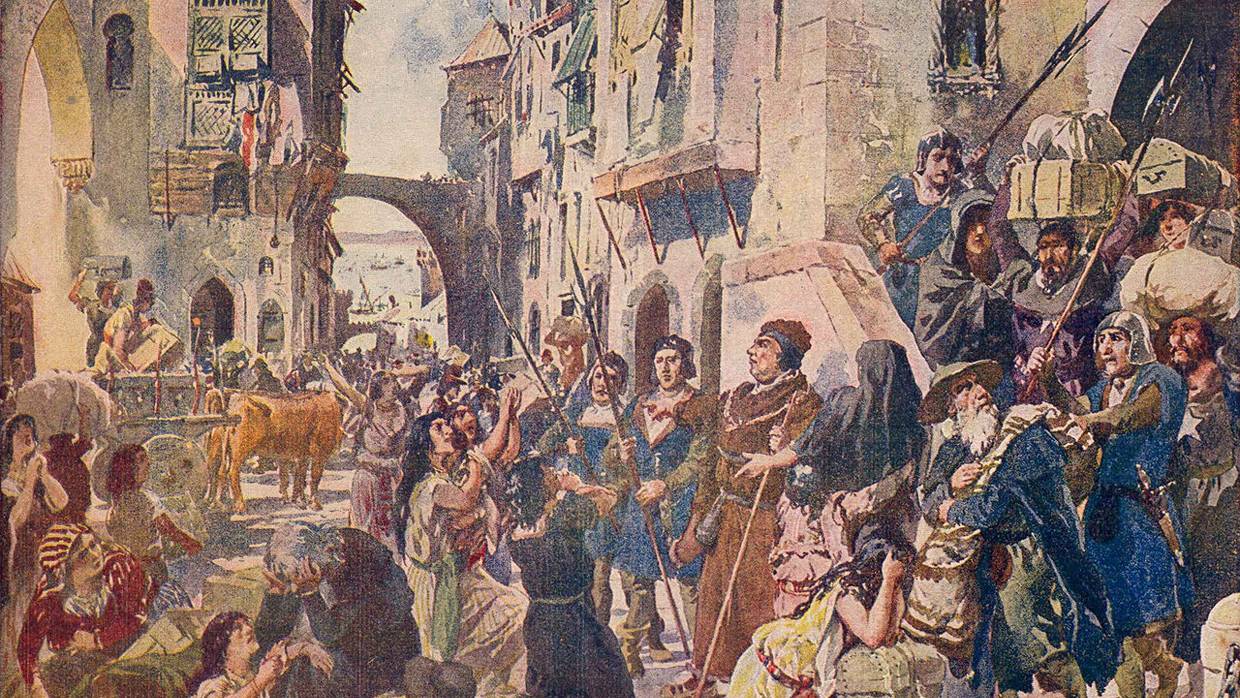
Featured Image: "The Banishment of the Jews", by Roque Gameiro, in Quadros da História de Portugal ("Pictures of the History of Portugal", 1917). Public domain, via Wikimedia Commons






Wonderful article and pictures. I am just this Fall semester Sept 2025 starting to teach a class on crypto Jews and their awakening to their Jewish roots after 500 years in hiding. And amazing and prophetic story. Thanks!!!
There is an old Jewish book called "The boys from Crocodile Island." I forgot the author.
Yes, Exiles of Crocodile Island by Henye Meyer: https://www.artscroll.com/Books/9780899067728.html?srsltid=AfmBOor-zNQM3KlJQJDZOrnE7xC8k93NWiTM2dBHK6o3kn7FHSRj9Hwx. A classic! Generations of Jewish children grew up with this book.
It's based on the true story of children taken away from their parents, forcibly converted to Chrisitianity, and sent to Sao Tome. There is a documentary being made about it: https://www.israelnationalnews.com/news/401467
Excellent article by a very talented writer! Thank you!
Fascinating article. I knew a little about the Portuguese Jews and their desperate situation back then, but not so much about the underground railroad. So much imagery and detail. Incredible research. Absolutely loved the article
Thank you for publishing this article. Lots of great information and really personalizes the Inquisition by offering names of those who acted as rescuers to the Jews who faced expulsion.
There is today a Crypto-Jewish (or Bnei Anousim in Hebrew) RETURN Movement that has been going on for anywhere between 30-50 years. Not much is written about it ... because there are some in the Jewish Establishment who are against them. They're called Crypto-Jewish deniers! Similar to Holocaust Deniers outside of the Jewish world - they are Jews who deny that there ever were Crypto-Jews. The majority of the Crypto-Jews of today are in Latin American countries - where the Inquisition authorities followed them there and had managed inquisition courts (torture & execution at the stake murders) for over 300 years.