







 Debunking Viral Claim About the Talmud and Minors
Jewish Geography
Jewish Geography



8 min read


For over four centuries, Amsterdam served as a safe haven for Jews escaping persecution.
In 1492, Spain presented its Jews with a difficult choice: expulsion or conversion to Christianity. Leaving Spain entailed many dangers, from pirates to starvation. Many Spanish Jews chose to remain in Spain, publicly converting to Christianity but secretly remaining faithful to their Jewish heritage. They became known as conversos.
However, living as secret Jews in Spain proved no less dangerous. The infamous Spanish Inquisition hunted down “new Christians” suspected of practicing Judaism, tortured them, and burned them at the stake. The wealthier conversos were especially at risk, as the Church sought to accuse them of “Judaizing” under any pretext in order to confiscate their money and possessions.
Seeking physical safety and opportunities to provide for their families, some Spanish secret Jews moved to Amsterdam, a growing port city that offered commercial opportunities. At the time, practicing Jews were not welcome in Amsterdam. However, the long arm of the Inquisition did not quite reach there. Therefore, the conversos continued to keep their beliefs and practices hidden even as they built a community.
In 1496, Portugal followed Spain in expelling and forcibly converting their Jews, among them those who’d come to Portugal after they were expelled from Spain. Some Jews from Portugal also found Amsterdam to be a safe haven, even if they still were unable to practice their religion openly.
In the 16th century, the Dutch fought for their independence from Spain. Though the war lasted for eighty years, ending in 1648, by the turn of the 17th century the Dutch Republic was already recognized as an independent country by its neighbors. Over the course of the 17th century, the Dutch Republic entered its Golden Age, becoming the world’s financial and trade center.
Once no longer under Spanish influence, the Dutch Republic became increasingly more accepting towards Jews. In 1619, new statues about religious tolerance were issued, which allowed each city to institute their own policies regarding Jews. Amsterdam leaders welcomed Jews, though not as equal citizens. Restricted in their commercial and political rights, Jews were nevertheless finally permitted to practice their religion freely.
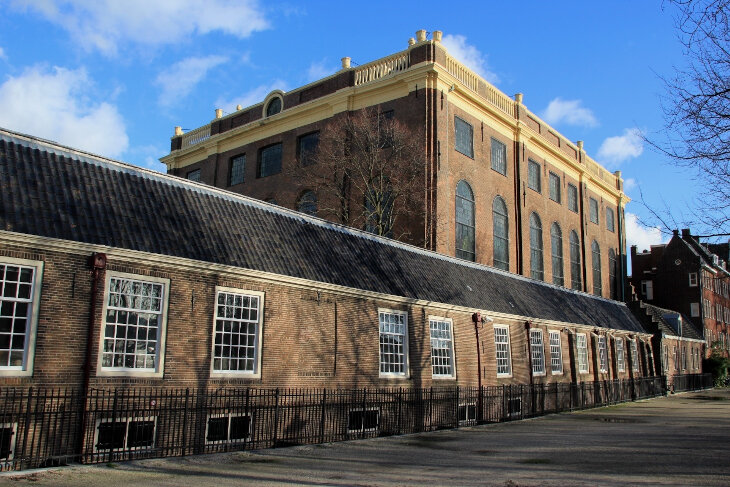 The exterior of the Portuguese Synagogue in Amsterdam. A.A.W.J. Rietman, Wikimedia Commons
Even before 1619, conversos from Spain and Portugal had been slowly coming out of hiding. The first synagogue, Beth Jacob, was established in Amsterdam in 1602.
Amsterdam’s first chief rabbi, Rabbi Uri Halevi, came from the city of Emden in today’s Germany. A boat carrying a group of conversos escaping from Spain went off course. The conversos found themselves in Emden. Seeing a Hebrew inscription on one of the local houses, they realized that Jews lived in Emden. They made their way to a local rabbi, Rabbi Uri Halevi, and begged him to teach them about Judaism.
Rabbi Halevi agreed to their heartfelt pleas. He suggested that they settle in Amsterdam. Rabbi Halevi and his family joined the group in Amsterdam, where they founded a synagogue. Rabbi Halevi served as the rabbi, teaching the congregants the basics of Judaism and performing circumcisions. His son, Aaron, served as the cantor in the new synagogue. Thus, an Ashkenazic rabbi played a crucial role in the development of Amsterdam’s Sephardic community.
Lack of Jewish education was the main challenge of Amsterdam’s fledging Jewish community. The conversos were eager to return to Judaism but they knew very little about Jewish law and practices. When the first Jewish school, Talmud Torah, was established at the beginning of the 17th century, it offered not only conventional Jewish studies but also classes in the basics of Judaism for those who needed to catch up. The teachers used Spanish translations of Jewish texts to assist the students.
The community placed a high value on Jewish education. A scholarship fund was established for students who struggled financially. Children from poor families were also provided with phylacteries and prayer shawls, as well as basic necessities, such as food and clothes.
In 1639, three Sephardic synagogues in Amsterdam merged into one, Kahal Kadosh Talmud Torah. To this day, it is known as the Portuguese Jewish community. Though many of its members came from Spain rather than Portugal, they decided to omit any mention of Spain due to the ongoing war between the Dutch Republic and Spain.
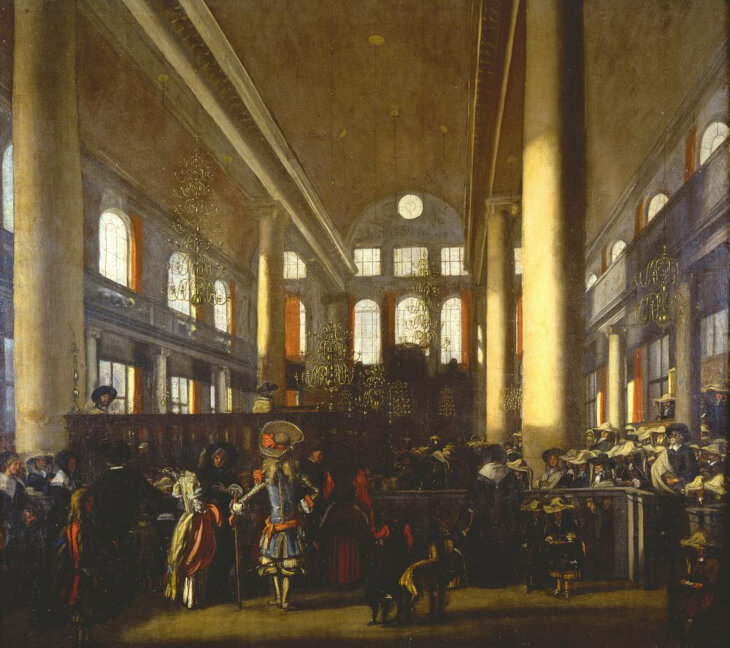 Interior of the Portuguese Synagogue in Amsterdam, by Witte, Emanuel, de (1616/17-1692).
The spoken language in the community was Portuguese but Spanish was used in writing. Initially, parts of the service were conducted in Portuguese, for the benefit of the conversos who were still learning Hebrew. Later, the services switched to Hebrew, but announcements are made in Portuguese to this day.
The community brought its first rabbis and cantors from Italy, Thessaloniki, and even Morocco, but as Jewish scholarship grew in Amsterdam, the graduates of the local Yeshiva Eitz Chaim began to serve as rabbis and religious leaders. The yeshiva’s extensive library is still considered one of the most prominent Jewish libraries in the world.
The Sephardic community grew not only in its religious observance but also in wealth and influence. With their extensive experience in commerce, the conversos took part in Amsterdam’s growing trade and economic expansion. They became especially prominent in the diamond industry.
As the community became more established, they embarked on a building campaign resulting in a magnificent synagogue building. Called Esnoga – “synagogue” in Portuguese, it is still in use today. Completed in 1675, Esnoga is one of the oldest functioning synagogues in the world.
The community continues to adhere to its beloved Sephardic tradition. The cantor leads the services from the tebah – a platform located at the entrance rather than at the center. The synagogue’s floor is covered with sand to soften the sound of footsteps and keep the floors clean. The prayers are said slowly, with the traditional Spanish and Portuguese tunes.
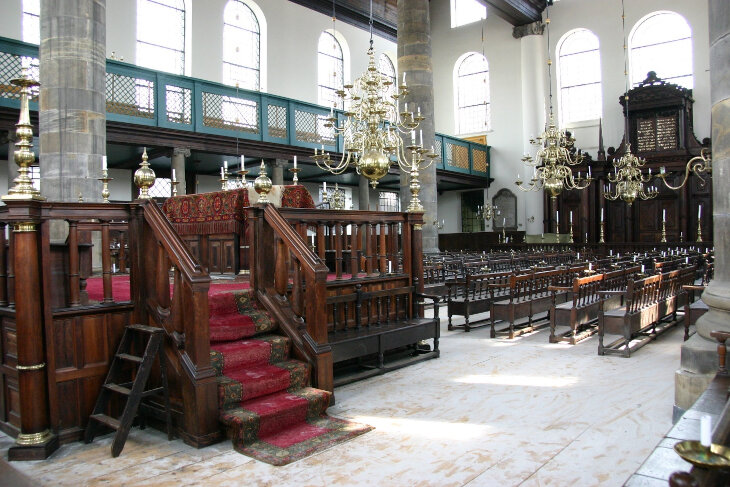 The interior of the Portuguese Synagogue in Amsterdam. Gerd Eichmann, Wikimedia Commons
As Amsterdam’s reputation as a safe haven for Jews grew, Ashkenazic Jews escaping from persecution in Europe also made their way to Amsterdam. The first Ashkenazic Jews came to Amsterdam from Germany in 1620 and joined the Sephardic community. By 1635, there were enough Ashkenazic Jews to establish a synagogue in the Ashkenazic tradition.
After the Chmielnicki massacres in Ukraine and Poland in 1648-1649, a new wave of Ashkenazic immigration came to Amsterdam. At first, they established their own synagogue, but in 1673, they merged with the German community.
Eventually, the Ashkenazic Jews outnumbered the Sephardic Jews. They built the Great Ashkenazi Synagogue, completed in 1671. The building currently houses Amsterdam’s Jewish Historical Museum.
Though the Sephardic and the Ashkenazic communities had their inevitable conflicts, they mostly collaborated on communal and religious issues. Both communities hired prominent rabbis and printed Hebrew texts.
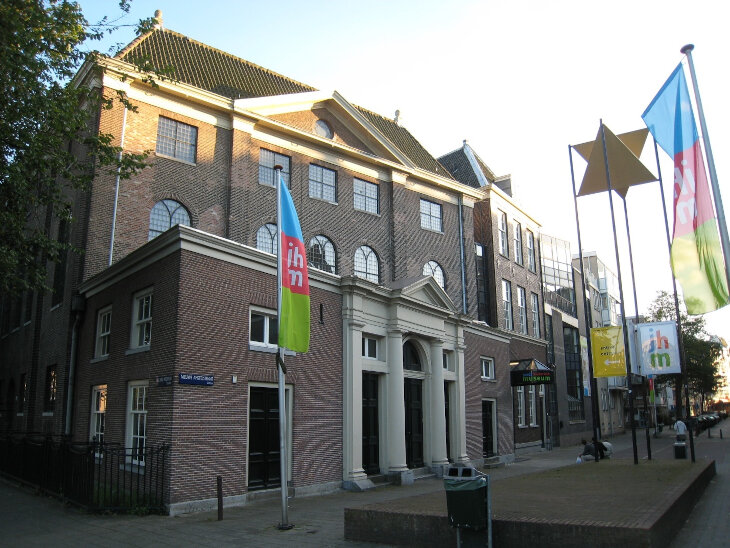 The Amsterdam Jewish Historical Museum, located in the former Great Ashkenazi Synagogue. S Sepp, Wikimedia Commons
Over the course of the 18th, 19th, and first half of the 20th centuries, the Jewish population of Amsterdam continued to grow. In the 1930s, Amsterdam again became a safe haven for German Jews, now escaping from the Nazi persecution.
By 1941, the Jewish community of Amsterdam numbered 79,000. The Nazis began deporting Jews of Amsterdam to concentration camps in February 1941. While some of the locals collaborated with the Nazis, others hid Jews and tried to save their lives. About 25,000 Jews were hidden by the Dutch. Unfortunately, about a third of them were discovered and deported, among them Anne Frank and her family. Today, Anne Frank’s house serves as a museum.
Only 20% of Dutch Jews survived the Holocaust. The majority were murdered in various concentration camps.
In May 1945, Canadian forces liberated Amsterdam. Four days after liberation, services resumed at the Esnoga synagogue, which survived the Nazi destruction. The Amsterdam Jewish community began to rebuild.
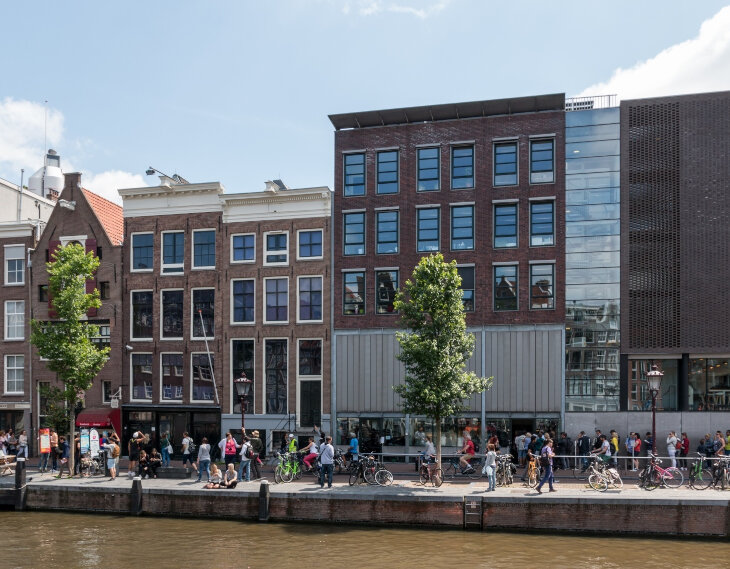 Anne Frank's House museum in Amsterdam. Dietmar Rabich / Wikimedia Commons
Today, Amsterdam is home to a vibrant Jewish community, consisting of about 15,000 people. There are over a dozen synagogues, as well as three Jewish schools, several kosher restaurants, and a Jewish retirement home. Just like in the past, both Sephardic and Ashkenazic Jews live side by side in Amsterdam, conducting joint community events and coming together for common causes. But the strong winds of antisemitism have recently blown in – the topic of the next about the Jews of Amsterdam that will be featured this week.
Sources:













The Truth is that these follower of Islam are not only against Jews, they are also against those of the Christian faith. The Jews are just the "canary in the coal mine". I have Christian and Jewish ancestors and it was actually my Christian ancestor's that successfully drove the Musliums out of their country, which was called Wachovia but is now called Romania. Not all Musliums are intolerant of other religions, but the ones that are intolerant of other religions, are NOT Just against Jews. . Christian/Muslium conflicts have been going on for years. IN addition Buddahist/Muslium conflicts have also been going on for years in certain Asian countries. If you take the conflicts around the world, the conflicts among Musliums and Christians and Buddahists affect millions more people.
The Dutch were not as friendly towards the Jews as this article seems to suggest. During the Second World War the Dutch Fascist Party, the NSB, took control of many of the smaller towns and, in conjunction with local people, rounded up Jewish citizens, stole all their property and transferred the Jews to the five concentration camps that operated in the Netherlands. From these, most of the Jews were then deported to death camps in Poland using the Dutch railways. Many Dutch people appear to have been quite enthusiastic about getting rid of the Jews and stealing their property and revealing where Jews were hiding, including the Dutch police. The Holocaust museums in Amsterdam try to blame the Germans for this and appear unwilling to admit to widescale involvement of Dutch citizens.
Thank you very much, interesting article. In 1621 King Christian IV of Denmark, send a invitation to the Portugise Jewish communite to settle in Denmark; Lübeck, Altona, and Fredericia. He guarantied freedom of Religion, Jewish printing press, and freedom of TAX. The kings Portugise doctor in 1636, Rav Benjamin Mussaphia, mechaber mussaf sefer Haoruch, served later as chief rabbi of Amsterdam. His son in-law Gavriel Milan served as governor of the Vestindian Islands a Danish Colony. Eventually Denmark had the most influential Beth Din in Europe, largest yeshiwah and great gedolei hador; Rav Jonathan Eybeshitz, Rav Jakob Ettlinger Oruch Lener, Rav Yaacov Emden, Rav Jechezkel Katznellebogen etc.The Portugise Jews, developed the stock exchange and the major institutions of banking in Denmark
after Shoah Dutch Jewry never Rebuilt . 30,000 survivors. Today no kosher butcher anymore. Chief rabbi lives in NEW YORK I think. Sure you have a couple of kosher rest in Amsterdam, but in the mediene? all gone. Most Dutch people have never seen a Jew. Assimilation is absolute. Orthodox Jew in Amsterdam are mostly not even Dutch. The Jewish life of the Netherlands will be gone in one more generation.
It will be interesting to read the of 'the strong winds of antisemitism recently blown in'. Is this a growing problem due to immigration, or particular to the soccer match incidents...?
Muslims entering Europe in droves, Ann Frank and her family ran away from Austria and came to Amsterdam because they thought it was safe for Jews, 86 years ago Europe wasn't save for Jews, now once again Muslim and also some Europeans have a problem with Jews, if they do then they will be stuck with Muslims, because the Jews will leave
yeah- well- so they chased the Jews and beat them up and later blamed the Jews for having started it. it is an old story. starting with "you killed Jesus" all the way to the "jews are our misfortune and a problem, let us solve it" and they found a cool final solution. what else is new? I was born in the Netherlands- and live in Israel now. 55 years!
Jews didn't kill Jesus the Romans did, he had a Passover Seder" The Last Supper" was actually a Seder even if Christians want to deny this fact, Jesus was a mamzer and the Christians worship a Jew but they hate Jews, this doesn't make sense to me, in fact the Jews took him off the cross and helped him escape to another country, I think I heard about this fact someplace, if he was dead Jews bury their dead, the Christians leave out the true facts, to be able to scape goat Jews
Esau hates Jacob. From our Torah.
What kind of painting is that?! It looks like a private moment!!!!
het joodse bruidje (the Jewish Bride) by Rembrandt - you can see it in the Rijksmuseum. Quite beautiful.
Actually, Rembrandt was friendly with the Jews, and liked to paint Jewish themed pictures, that is what I read
Rembrandt lived in the Jewish Quarter and was the first artist to use Jewish people as models for Biblical subjects. His house still stands there as a museum, right on Jodenbreestraat - "Jewish Wide Street."
It’s all fine and dandy that a well known artist painted it ( I read the comments below) but it’s NOT something that should be shown to religious people.
They should replace the picture with something more neutral.
Looking forward to your next article
Thank you. Very nice article.
Can you tell me about the Jews of Vietnam please