







 Debunking Viral Claim About the Talmud and Minors




13 min read


How the 18th century movement transformed the Jewish world and ultimately proved essential to Jewish survival.
Hasidic Judaism is a Jewish faith community that dates back to the mid-1700s. It started in Medzhybizh, in what is today western Ukraine, and, with its emphasis on prayer, meditation, closeness to God, and kabbalistic teachings, ushered in a spiritual awakening that swept the Jewish world. By the early 1800s, more than half of Eastern Europe’s Jews identified as Hasidic Jews.
Various Hasidic communities—named after the city or town where the rebbe, or Hasidic spiritual leader, was based—dominated Eastern European Jewry throughout the 19th and early 20th centuries. The Holocaust brought that to an abrupt end, and much of the Hasidic world was destroyed. Since that time, they have rebuilt, and most Hasidic communities today are based in different cities in Israel, the New York metropolitan area, and other places like Antwerp and Montreal.
Despite Hasidic Judaism’s many meaningful traditions and beliefs, most outsiders only know them, at best, from their tight-knit communities, large families, and distinctive dress.
A Hasidic Jew is a member of a Hasidic Jewish community, which is centered around a rebbe, or Hasidic community leader, and is named after the city or town where that rebbe first gained prominence. Many of those original places—like Belz, Satmar, Vizhnitz, and others—were destroyed in the Holocaust, although some of those communities were rebuilt after World War II in Israel and New York, and retained their original names.
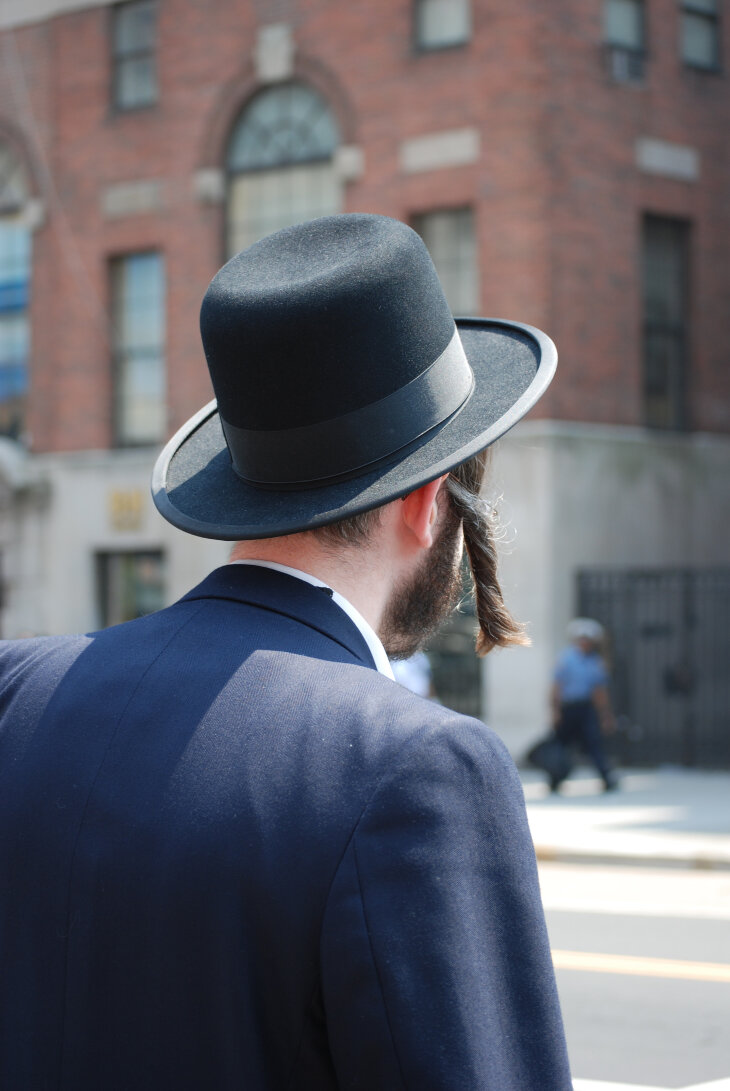 A Hasid in New York
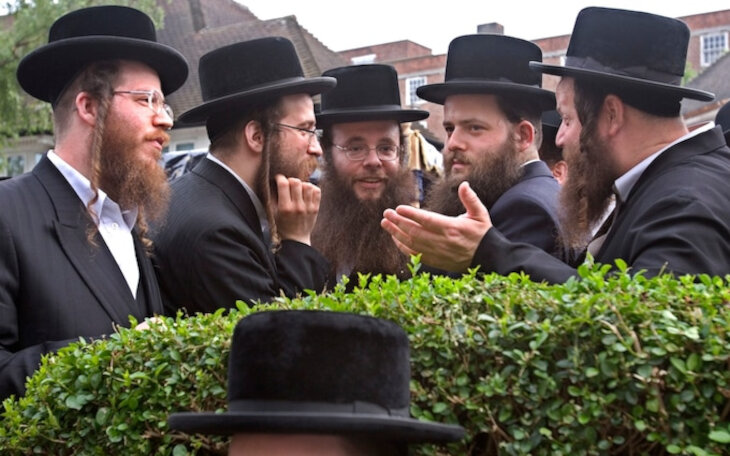
Hasidic communities are often tight-knit and insular; maintain specific customs that impact many aspects of life including the language of prayer, dress, song, Sabbath and holiday observance, education, and the like; and live together in small communities, usually walking distance from a central synagogue or community center.
The history of Hasidic Judaism starts in about 1740, after a century of turmoil and tragedy that rocked the Jewish world. Some of the traumatic events of that period include the excesses and ravages of the Chmielnicki Uprising (1648-1657), which, in addition to being a Cossack rebellion against Polish-Lithuanian rule—Bogdan Chmielnicki, who led the rebellion, is still considered a Ukrainian hero today—was a focused attack on the region’s sizable and prosperous Jewish community. The anti-Jewish pogroms were, in effect, an attempted genocide, which ended with the murder of as many as one third of Europe’s Jews. The survivors were left impoverished and Jewish scholarship became unattainable for many, aside for a handful of elite scholars.
Also amongst the era’s challenges was the false messianic movement of Shabbetai Tzvi (1648-1666), which, in the wake of the Chmielnicki Uprising, ushered in a period of anticipation and hope, only to be crushed when Shabbetai Tzvi—the movement’s leader and supposed messiah—converted to Islam. Despite his apostasy, his followers, called Sabbateans, didn’t lose faith, and that led to decades of mistrust, witch hunts aimed at exposing supposed Sabbateans, and wild accusations and fights between rabbinic leaders.
The 18th century was also the time of the Enlightenment, or Age of Reason, which, in some cases, granted Jews unprecedented freedoms, but also posed new challenges regarding identity and faith.
Into that world arose Rabbi Israel ben Eliezer (1698-1760), better known as the Baal Shem Tov (Master of the Good Name), the founder of Hasidic Judaism. The Baal Shem Tov was a member of a secret society of mystics called the Nistarim, and became the group’s leader in 1734. Prior to that time, he immersed himself in Jewish wisdom, which included seven years of meditation and seclusion in a small town in the Carpathian Mountains. He also studied kabbalah and different teachings handed down from the previous leaders of the Nistarim. He settled in Medzhybizh in about 1740, and it was there that his fame started to spread, and where he attracted his primary disciples.
The Baal Shem Tov’s teachings, which are the foundations of Hasidic thought, emphasize a concept called devekut, or “clinging to God,” which involves striving to feel God’s presence in every aspect of life. He also taught a “way of prayer” that involves using the standard prayer service—and in particular, the “Standing Prayer,” or “Amidah”—as a meditative tool.1 Hasidic teachings are also steeped in Kabbalah, and as a result many mystical texts were first printed under the aegis of the movement. “Where Kabbalah had previously been the province of only the greatest scholars, it had now become part of the popular folklore, and even the simplest individuals had become familiar with its terminology.”2
The Baal Shem Tov died in 1760, and by the early 1800s more than half of Eastern Europe’s Jews identified as Hasidic Jews. Given the tenor of the times, his teachings were a breath of fresh air, which explains their mass appeal. His disciples and the people he influenced launched a spiritual revival that emphasized—in addition to having a personal relationship with God—the centrality of community, and the importance of a rebbe, or spiritual leader; and was integral in preserving Jewish values and practice in the face of modernity, as well as the horrors of the 20th century.
Hasidic Jews are Torah observant Jews. Similar to other observant Jews, they keep the Torah’s commandments in the manner in which they are clarified in the Talmud and encoded in the Code of Jewish Law. Hasidic thought does emphasize a number of important ideas—like closeness to God, joy, meditation, prayer, community, and kabbalah—although it’s not like those are Hasidic innovations. Rather Hasidic Judaism emphasizes them in a way that’s distinct from other observant communities.
The Hasidic liturgy, or prayer service, is unique in that it’s a mixture of Ashkenazi and Sefardic traditions. It was developed in order to incorporate the teachings of the great 16th century Kabbalist, Rabbi Isaac Luria (known as the Ari) into the Ashkenazi prayers, although customs do vary between different Hasidic groups.
Other customs particular to Hasidic Jews include almost daily immersion in a mikvah (for men), growing a long beard and side-curls (see below), singing wordless meditative melodies (called nigunim), eating the Sabbath meals with the rebbe, or community leader (the meal is called a tisch, which is Yiddish for table), special customs observed at weddings and other significant events, and others.
Hasidic clothing is varied and often differs depending on the community. Many Hasidic men wear a rekel during the week, which is a long, frock-style coat; and on the Sabbath wear a fancier, higher quality version of the same garment, called a bekishe.
Jewish women are required to cover their hair after marriage as it indicates a higher station in life, and Hasidic women cover their hair in a number of different ways including a sheitel (or wig), shpitzel (a type of turban), a tichel (or scarf), and a sheitel and hat combination. Customs vary depending on the community.
The Hasidic fur hat that many Hasidic Jews wear is called a “shtreimel” (some non-Hasidic Jewish men wear one as well). The shtreimel is worn on the Sabbath, holidays, and for special occasions (like a wedding); and is generally only worn after marriage. The origins of the shtreimel are unclear. One theory is that an unnamed ruler decreed that Jewish men had to wear a tail on their heads every Sabbath. The shtreimel is the workaround that not only fulfilled the decree, but also embraced the mockery, and turned it into a badge of honor. Another theory is that the shtreimel was the winter hat of Russian and Polish nobility, and as such, the perfect hat to wear in order to emphasize the importance and beauty of the Jewish Sabbath.
Some Hasidic groups who trace their roots to Poland wear a spodik in place of a shtreimel, which is a much taller type of round fur hat.
Other hats Hasidic Jews wear include the Platchige Biber hat, which is a flat, hard beaver hat that many Hasidic men wear during the week (while the shtreimel is worn on the Sabbath), as well as the Kashket hat, which is a type of cap that many Hasidic boys wear.
Many Hasidic men grow long hair curls, or sidelocks, which are called "peyot," and they come from a biblical injunction against "rounding the corners of your head" (corners in Hebrew is "peyot," see Leviticus 19:27). Specifically, those corners include the hair in front of the ears, and extend to underneath the cheekbone, which is the area level with the nose.
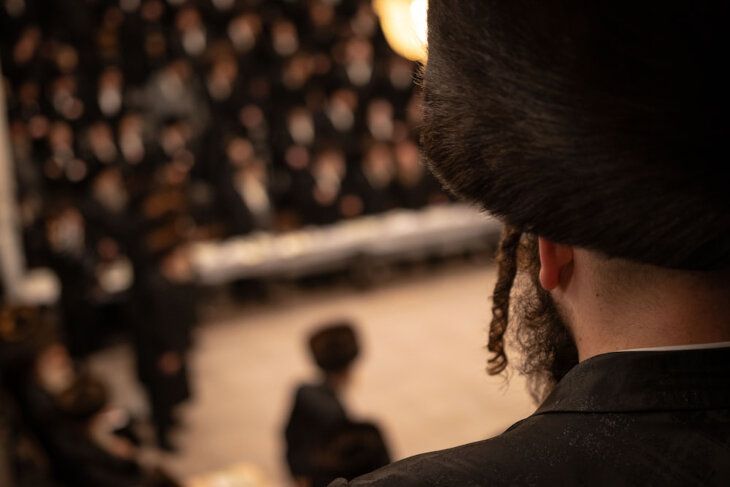 A Hasidic Jew with streimel and peyot. (Image: Unsplash.com, Aharon Luria)
That hair, on each side of the head, can't be shaved off, and should be long enough to pull or fold over. But that's just the minimum, you can grow them as long as you want, and some Hasidic Jews—often depending on the particular group they're associated with—choose to grow them long, or curl them, or tuck them behind their ears.
Many Hasidic men also grow long beards (as do many non-Hasidic Jewish men). The reason is that the Torah (also Leviticus 19:27) says, "Don't destroy the corners of your beard," which is understood to mean the "five corners" of the beard. Those corners are two points on each cheek, plus the chin. But opinions vary, and therefore most men don't shave any of it.
On a mystical level, the beard represents "God's attributes of mercy," which is an important spiritual concept. Growing a beard parallels that esoteric ideal, and, it's said, helps connect you to the benefits that come from God's compassion. Hopefully, having a beard will remind you to be more compassionate as well. Some also consider beards a sign of wisdom. The Jewish ideal is to grow out the wisdom until it covers the heart, to teach you to lead with what you know, and to make your passions subservient to that.
Nigunim, or wordless melodies, are powerful melodic songs usually associated with the Hasidic movement. Nigunim (singular, nigun) are often simple and repetitive, and help the singer reach an elevated, transcendent state. Some nigunim are slow and brooding, while others are raucous and lively, and, depending on the situation, can be sung for a very long time.
Some nigunim are associated with specific Hasidic groups. Some rebbes also compose original nigunim, and some Hasidic groups even have designated composers. These nigunim are then sung at the rebbe's tisch (Yiddish for table) or at a farbrengen (joyous gathering), on the Sabbath, holidays, and other important gatherings.
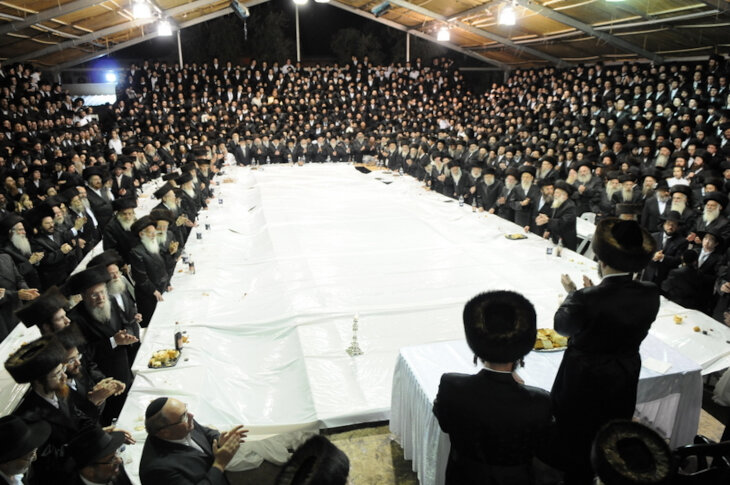 A tish of the Boyan Hasidic dynasty in Jerusalem, holiday of Sukkot, 2009 (Wiki)
A Mitzvah Tantz is a dance that happens at the end of a Hasidic wedding, when the rebbe and other men from the community "dance" with the bride.
At Hasidic weddings, men and women dance separately. But for the Mitzvah Tantz, the bride holds onto a gartel—a type of belt worn during prayer—while her partner holds the other end and dances before her. Some dances last for an hour, others go until morning.
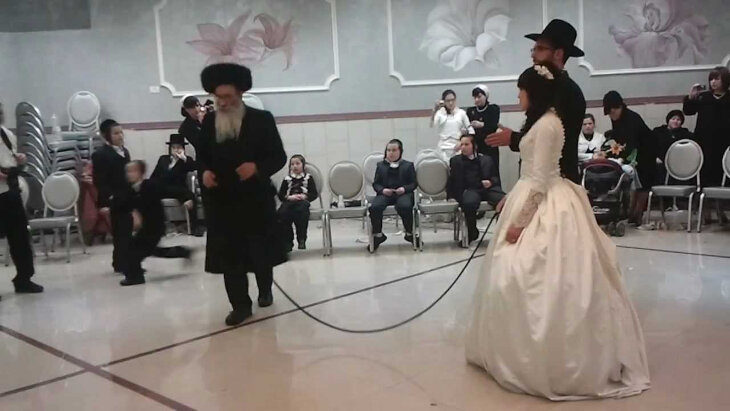 A Mitzvah Tantz
The Mitzvah Tantz also has deep, spiritual significance. In Hasidic thought, the masculine and feminine attributes of God need to be unified in some way, and a Jewish wedding symbolizes that concept. On a mystical level, the Mitzvah Tantz represents that spiritual unification.
A Hasidic dynasty is a Hasidic group or “court” established around a rebbe, or Hasidic spiritual leader. Following the rebbe’s death, leadership of the group is usually passed down to his son, sons, or son-in-law. Although in some instances, the Hasidic group continues even when no successor has been appointed to take the place of the deceased previous rebbe. A Hasidic rebbe is also known as an Admor, which is an acronym for “our master, teacher, and rabbi” (אדמו׳ר).
Chabad-Lubavitch was founded in 1775 by Rabbi Shneur Zalman of Liadi, the movement’s first rebbe (known as the Alter Rebbe). The movement’s second rebbe, Rabbi Dov Ber Schneuri (known as the Mitteler, or Middle Rebbe), moved his court to the town of Lubavitch, which was where they were based until World War I. The movement’s name, Chabad, is an acronym of the Hebrew words for wisdom, understanding, and knowledge (חב׳ד), which is indicative of their basic kabbalistic philosophy.
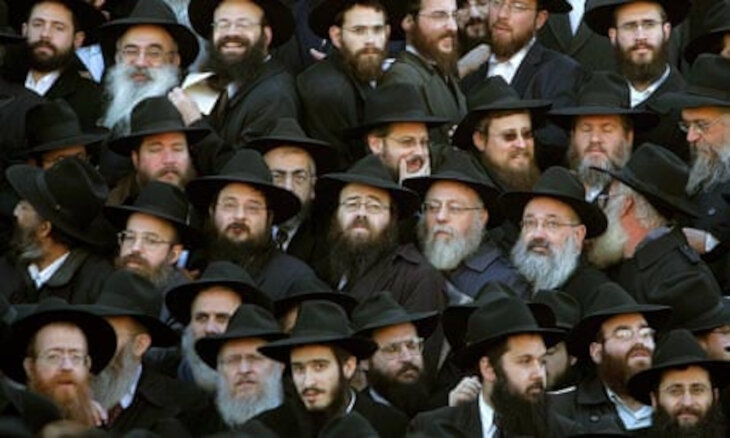 A group of Chabad Hasidim
Chabad-Lubavitch has been based in Crown Heights, Brooklyn since 1940, and did not appoint a new leader following the death of the seventh Lubavitcher Rebbe, Rabbi Menachem Mendel Schneerson, in 1994.
Satmar was founded in 1905 by Rabbi Joel Teitelbaum, in Szatmárnémeti, Hungary (it is now called Satu Mare, and has been a part of Romania since the end of World War I). Following World War II, the group rebuilt in the United States, and today is based in Williamsburg, Brooklyn, and Kiryas Joel in Monroe, New York. It is today one of the largest Hasidic groups, with over 100,000 followers worldwide.
Belz Hasidim was founded in 1817 by Rabbi Shalom Rokeach in what is today the Ukrainian city of Belz (Белз). During World War II, Rabbi Aharon Rokeach, the fourth Belzer Rebbe, managed to escape the Nazis and resettled—and rebuilt—the movement in Israel.
Hasidic Judaism dates back to the mid-18th century. Its founder is Rabbi Israel ben Eliezer, better known as the Baal Shem Tov, who began teaching in Medzhybizh, in what is today western Ukraine, in about 1740. Hasidic thought emphasizes prayer, meditation, closeness to God, and kabbalistic teachings, and—in the wake of the horrors of the preceding century—ushered in a spiritual awakening that swept the Jewish world. By the early 1800s, more than half of Eastern Europe’s Jews identified as Hasidic Jews. Hasidic Jewry suffered staggering losses in the Holocaust, and some of its communities have been rebuilt in Israel, New York, and other places. Hasidic Jews are known for their tight-knit communities, distinctive dress, nigunim (or wordless melodies), kabbalistic teachings, and meditative approach to prayer.
The word Hasid (חסיד) is Hebrew for “pious,” and was originally applied to the Baal Shem Tov and his disciples, but over time came to refer to the movement he founded.
The number of Hasidic Jews in the world is estimated at about 500,000.
Hasidic Jews speak Yiddish, although dialects and pronunciation vary from sect to sect.
Hasidic Jews are Torah observant Jews, and while they have different approaches to prayer, kabbalah, community, and other customs, are, in general, indistinguishable from other groups of Torah observant Jews.












The Hasidim were by no means the first to discover the "spiritual" response to the practices of prayer, meditation, chanting, singing, dancing, etc. In fact, we can find expert practitioners of these in some form in nearly ever culture.
We should not confuse the neural-biological responses to these activities as some sort of "closeness to God" even though the presence of these chemicals in the brain do create a detachment from reality and which may open the mind to "transcendental" thoughts.
Like all human pleasures, moderation is the key and we should not obsessively pursue this "spiritual awakening" or become addicted to it.
On another note, I would never surrender myself to a single teacher. That is the basis of a cult and can go terribly wrong.
I'd never notices that both Chmielnicki's Uprising & Shabbethai Tzevi shared DATES! The first wrecked Polish Jewry PHYSICALLY, while the second wrecked WORLD Jewry SPIRITUALLY! Cleaving to G-d was taught through R. Abul'afiyah & R. Chananiyah HaQana as well, this was NOT a chassidic innovation. BEFORE the Roman Exile, all of Israel meditated WAY beyond the 'amidhah. Chassidism is big on...COMMUNITY! PLENTY of Eastern Jews do daily immersions, unconnected to chassidism. Long peyoth certainly did NOT originate with chassidim! It was in Eastern Europe, Yemenite & even Cochin, India! Nigunim, tisch, mitzva tance, aristocratic dress are exterior trademarks of chassidim. They accomplish much through whole communities following one leader.
A pity that not all of the Hasidim support Israel's right to exist.
A pity that from all of the positive things you COULD have said, you chose to say something negative. Which chassidic Jews oppose Israel's right to exist? Neturei Karta, for example, are NOT chassidic. Satmar opposes ZIONISM, but of what consequence is that? This is especially so since they have hundreds of thousands of followers in Israel. Which is preferable, an anti-Zionist in Israel or a Zionist living abroad?
Thanks for a very interesting and informative article.
One thing I would like to know is why they speak Yiddish?
There's actually a Talmudic concept of trying to be as much as one's father as possible. That's interesting because that means all Jews everywhere should therefore be very similar, but actually DRESS decrees had an impact. Slobodka, a non-chassidic, Lithuanian orthodox group, dresses quite modern for about 80 years ago. Chassidic Jews have in general been quite conservative about preserving their forefathers' tongue of Yiddish. Compare that to most Oriental/Eastern Jews who've LOST their Jewish tongues. The Jewish People were redeemed from Egypt for not changing their Jewish names, Jewish language & Jewish dress.
CHABAD has an amazing website accessible to the public, no paywall, and they are raising up a bunch of Chabad Christians who read widely in the tradition and import it to our Sunday schools, with obvious distortions and adaptations. No small number of Muslims and Eastern religions haunt the site also. We keep our own identity, you won't spot us on the street, but loving and meditating on your God is contagious.
What on earth are 'Chabad Christians'? Never heard That one before.
"Chabad-admiring Christians" would probably be more appropriate, as Chabad is a religious Jewish organization and hence by definition not Christian.
An amusing story is told of a rebbe who, when asked why he grew his peyot so long, likened them to the antennae of a radio and said the length gave good [spiritual] reception. When asked why, by contrast, the hair in back of his head was so short, the rebbe replied “to cut down on static!”
Chassidim has become synonymous with the clothing but this is not the essence. The outfits are the wrapping, and some chassidim - Breslov jn particular, are not particular about this. Chassidim place a high emphasis on prayer, ritual immersions, and cultivating a strong sense of community, and above all, placing yourself until the guidance of the Rebbe - their spiritual leader. I once asked a leading Rebbe how could one become a chossid of his. He told me you have to be willing to totally surrender your will to my will for me to be able to help you. This is a tall order for anyone brought up in a Western country.
Very nice but chassidim feel strongly about their clothing as its a serious part of their identity for eg in the U.K we have military parades in London and the different uniforms signify status,rank etc....
Chasidim feel similarly.And it's not small potatoes anymore.Many chassidus's number in the tens of thousands and their 'uniforms' are Big business in the Jewish world.
What you say does reflect the reality to some extent, but even though many do emphasize the identify the outfits provide, I do not see this as the essence of the movement. For example, to dress as a Grenadier Guard does not make you part of the regiment. And when he is at home or on vacation and not in his uniform, he is still a member of the regiment. So, I continue to see chassidus as primarily focusing n loyalty to a rebbe - their leader, and a certain style of prayer, eating together with the rebbe, daily immersions etc. This is a way of life much more than a clothes fashion.