






 Debunking Viral Claim About the Talmud and Minors

4 min read


10 min read


On a day marked by so much death, the only proper response is to birth a better version of ourselves and our people.
Simchat Torah, October 7, will forever be etched in our hearts and minds as the day of the greatest massacre of our people since the Holocaust. The brutal, cold-blooded murder of innocent men, women and children, young and old, entire families, over 1,200 people, and the horrific kidnapping of 250 people, rocked our worlds, broke our hearts, and shattered our collective illusion of safety.
The events of that day launched a war in which our people have sustained even more casualties, more parents bereft of children, children orphaned from parents. For over a year, we have been a nation in a perpetual state of grief, mourning, and sorrow.
Any look back at a year ago, and all the days since then, begins with honoring the memory of the fallen, learning each of their unique and individual stories, gaining an appreciation for who and what was taken from us. Simchat Torah, heretofore one of the happiest and most joyful days on our calendar, is now forever complicated by the competing feelings of sadness and loss.
Beyond the unimaginable loss of life, many of our ideas and assumptions died as well. We lost more than 1,200 irreplaceable lives, but we also lost our innocence, in some cases our confidence, our optimistic view of the Jewish condition in America and the world, and for some, communities of association or identification. A year ago, so much died.
But a year later, as we reflect, we can look back and see that on Simchat Torah, October 7 of last year, so much was also born. On the brink of a civil war over judicial reform and religious differences, overnight a sense of unity, togetherness, and shared destiny was reborn.
From the resolve of the devastated communities on the Gaza border, driven by displaced families from the north and the south, powered by a record response to the IDF call up, the determined, tenacious nation of eternity was reborn. From the ashes of the Gaza communities, an unprecedented effort to provide for soldiers, support families of reservists, comfort mourners, visit displaced families and provide provisions was born, with leadership and participation from diverse communities literally around the world.
A spiritual awakening, a Jewish pride burst forth in people who had never experienced their Jewish soul before or in whom it had been dormant for a long time. Throughout this year, I have regularly been “bageled,” approached by Jews simply signaling their Jewishness to a fellow Jew (and signaling their desire to signal that Jewishness) in airports and on airplanes, in supermarkets and at stores, at a baseball game and even in a bathroom. Jews are returning to study, practice, proudly display their identity. The Jewish people are alive, reborn, proud, practicing, growing and united.
To be sure, things are far from perfect. There are important differences and disagreements and there are forces seeking to divide us again. The war continues to rage, our heroic soldiers are still fighting on multiple fronts, and our precious hostages are still not home.
But with all the problems and challenges, with all the lives that were prematurely and tragically snuffed out, so much has come alive. Moshe Naaman, a soldier in the IDF, wrote the following inspiring story (translated from Hebrew):
Two weeks ago, we were called up by Order 8 to the northern border. Today, we had the privilege of holding Yom Kippur prayers at Kibbutz Beit Zera. For 93 years, the kibbutz existed without agreeing to have a Yom Kippur minyan. But we, as soldiers, set one up in the company area at the kibbutz.
There were 12 religious soldiers among us. We sent a casual WhatsApp invitation to the kibbutz members. When the holiday started, we were shocked—dozens of members came for Kol Nidrei and Maariv. In the morning, elderly members came for Yizkor. The climax came with many dozens of people, including children, women, and toddlers, arriving for the closing Neilah service and shofar. People were moved to tears.
What can I say? I never imagined this would happen. The verse “Master of Wars, Sower of Righteousness” took on a new meaning for me today. Two weeks ago, I never imagined I wouldn’t be in the beit midrash for the High Holidays. I found myself as the shofar blower, gabbai, cantor, and speaker… The members kept thanking us after Yom Kippur and tearfully asked us to return next year…
Last year, I had tears of pain and sorrow at the end of Yom Kippur, but this year, those tears turned into excitement and joy.
“And seal all Your people for a good life.”
Moshe Naaman - גדוד הבוקע 5035
To mark the year since October 7, Danny Wise of Ami Magazine conducted 38 interviews focusing on the rebuilding efforts of the Israeli communities in the Gaza envelope. Among his interviews, he met with a woman named Dafnah from Kibbuz Re’im. She had been the cultural director of the kibbutz and was one of the organizers of the Nova Festival.
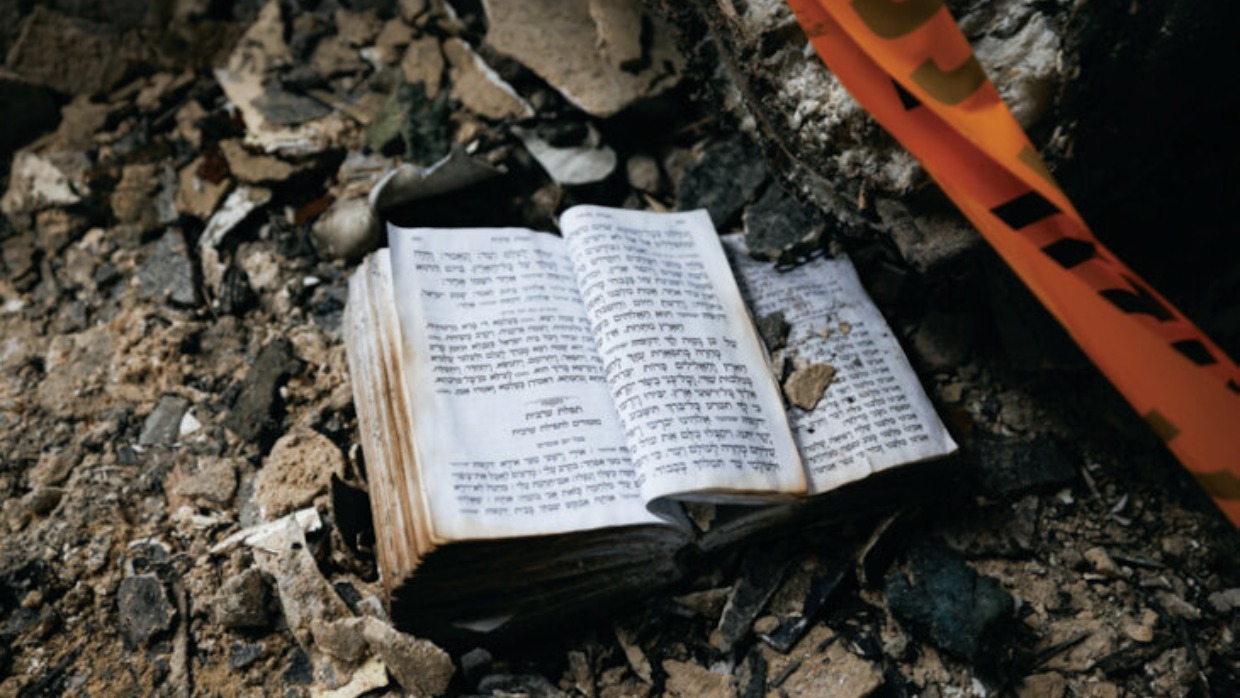
Touring the kibbutz, she showed him her charred house and the room in which her mother and children, Shira and Meir, were found murdered together. She is the lone survivor of her family. Wise writes that throughout the conversation he thought of Kristallnacht and the destroyed shuls. He asked her if the terrorists destroyed any shuls in the communities along the Gaza envelope.
Dafnah responded, "Of course not. Not a single synagogue was damaged in all 21 Gaza kibbutzim." Wise didn’t understand, how could no shul have been attacked, no Torah Scroll burned?
She explained, "It wasn't a miracle. How could they damage something that doesn't exist?”
Most of the communities didn’t have designated or active shuls. Dafnah explained, "If you want to understand the day after, you have to understand the day before.”
Wise writes:
Rabbi Shlomo Raanan runs an organization called Ayelet Hashachar which seeks to bring outreach to irreligious kibbutzim. He came up with the idea of a basketball game between yeshivah students and the kibbutzniks of Reim. The game was set to take place on Sukkot Chol Hamoed, October 2, just days before the massacre. Dafnah had led the charge to cancel the game. To her, the match wasn't just a friendly contest; it was a Trojan horse, a way for religious influence to creep into the kibbutz.
"I was furious," she told me. "This was outrageous. We didn't need outsiders telling us who a good Jew is," she said, pulling out her phone and scrolling through old messages. She showed me the texts she had sent to Rabbi Raanan, warning him not to bring his religious mission to her doorstep. "Cancel this game immediately," she wrote. "If you don't, we'll all block the entrance with our bodies."
In the spirit of peace, Rabbi Raanan canceled the game.
Five days later, the massacre came. Just over the border, in the tunnels of Gaza, Dafna found herself held hostage, face to face with the forces that had torn her world apart. "I said to an older guard in Arabic, why do you torture me? For 20 years, I've made programs for Arabs and Jews. The Jews are your cousins." As she pleaded in the darkness for some recognition of their shared humanity, she was met not with empathy but with a cold dismissal.
"You are not a descendent of Ibrahim! You are not a Jew!" he spat. "You are a European colonialist who stole our land! It was in that moment, Dafnah said, that something broke. Or perhaps, something began to be repaired. The accusation hit hard. Like many in the kibbutz movement, Dafnah had spent her life defining herself more as an Israeli than a Jew, and more dedicated to reconciling Arabs and Israelis than healing the divides between different groups of Jews.
Religion had always been secondary to her identity. But now, in the depths of that tunnel, being denied her Jewishness by a Hamas fighter, she experienced a crisis of self. "I started screaming, Ana Yahudiun, Ana Yahudiun, I am a Jew I am a Jew!" The guards restrained her, taping her mouth. But for Dafnah, the internal shift had already occurred.
"For the first time in my life I saw my soul; I saw that I am a Jew. All my life," Dafnah reflected, "I've been part of this community. We didn't see ourselves as Jews, in the traditional sense. When I traveled overseas and someone asked if I was Jewish, I'd correct them. ‘No, I'm Israeli,’ I'd say.
“But when he called me a colonialist, it hit me. He didn't see me as a Jew because I didn't see myself as a Jew.”
Dafnah paused for a moment, her eyes wandering over the ruined landscape. "Every Arab village has a mosque. Christian settlements build churches. And here, we have nothing. Nothing to say that we are Jews. And in that moment, I realized that if we were going to rebuild, we needed to reclaim our identity. I will tell you," Dafnah said, "I took upon myself the new beit knesset (synagogue) project. When we rebuild, our beit knesset will be the most beautiful structure on the kibbutz.”
On Simchat Torah, Dafnah lost her family, but she found herself. They died, and her Jewish identity was born.
The holiday and festivities of Simchas Torah are unusual in their origins. They are not mentioned in the Torah or in the Talmud. It was never enacted as a full rabbinic holiday like Purim or Hanukkah. Rabbi Lord Jonathan Sacks z”l writes:
On Simchat Torah, without being commanded by any verse in the Torah or any decree of the Rabbis, Jews throughout the world sang and danced and recited poems in honor of the Torah, exactly as if they were dancing in the courtyard of the Temple at the Simchas Beis HaSho’evah, or as if they were King Dovid bringing the Ark to Jerusalem. They were determined to show God, and the world, that they could still be ach same’ach, as the Torah said about Sukkot: wholly, totally, given over to joy. It would be hard to find a parallel in the entire history of the human spirit of a people capable of such joy at a time when they were being massacred in the name of the God of love and compassion.
A people that can walk through the valley of the shadow of death and still rejoice is a people that cannot be defeated by any force or any fear…Simchat Torah was born when Jews had lost everything else, but they never lost their capacity to rejoice… A people whose capacity for joy cannot be destroyed is itself indestructible.
The year since Simchat Torah has been a fulfillment of the saying, “They tried to bury us; they did not know we were seeds.” Simchat Torah was born against a backdrop of hate and tragedy. A year ago, we lost so many, we buried heroes of our people. But over this year, we birthed a new era, a new chapter for our people. It is still being written and we determine what it will say next.
How can we honor all those who died? On a day marked by so much death, the only proper response is to birth a better version of ourselves and our people.
Featured Image: By Ziv Koren, from his book The October 7 War.







Religion poisons everything... Jewish is much more
Why are you making this statement? Were you once very religious and dropped everything? Did something happen to you that made you feel this way? I had my own issues with a certain school and I changed schools and stayed religious, it is people that are the culprits not religion
Dafna from Kibbuts Reim?
I can’t find her name amongst hostages released .I would like to believe that what is written is not all made up
From what I've read, people in Israel also asked the same question. Seemingly the story is true, but her name isn't Dafna.
yes her name was changed, but i interviewed rabbi shlomo raanan and he told me the story is true.
Wonderful article and so helpful to read before the holiday. TYSM
The movement to stifle religious observance is an attack not only on religion but also on democracy. For democracy to have true “freedom of religion” the answer “yes” to religious observances must be as acceptable as the answer “no”. Hopefully this will now be realized.
Stand for your rights as a Jew in America. All of the constitution, every letter of it!
Beautiful! Thank you so much!
Great article
Can you explain more about Simchat Torah not being Torah or Rabbinicallly prescribed?
Super moving and hopeful. Thank you