







 Debunking Viral Claim About the Talmud and Minors

28 min read
17 min view



8 min read


A deeper look into why the Jewish People are referred to as Israel.
In the Torah, and throughout the books of the Hebrew Bible, the Jewish people are called “Israel,” and the “Children of Israel.” Those names refer to the Jews’ descent from the biblical patriarch, Jacob—considered the father of the Jewish people—whom God renamed “Israel” in Genesis 32:29.
The Jewish people are Jacob’s direct descendents, and therefore his “children”—in modern times, Jews from far flung corners of the Jewish diaspora may even share similar, if not identical, genetic profiles—and the Torah, when mandating particular ordinances and laws, often implores Jews to see each other as “brothers.”1
As will be explored below, in addition to demonstrating a familial link amongst Jews, the name “Israel” also teaches something about the purpose and nature of living a Jewish life.
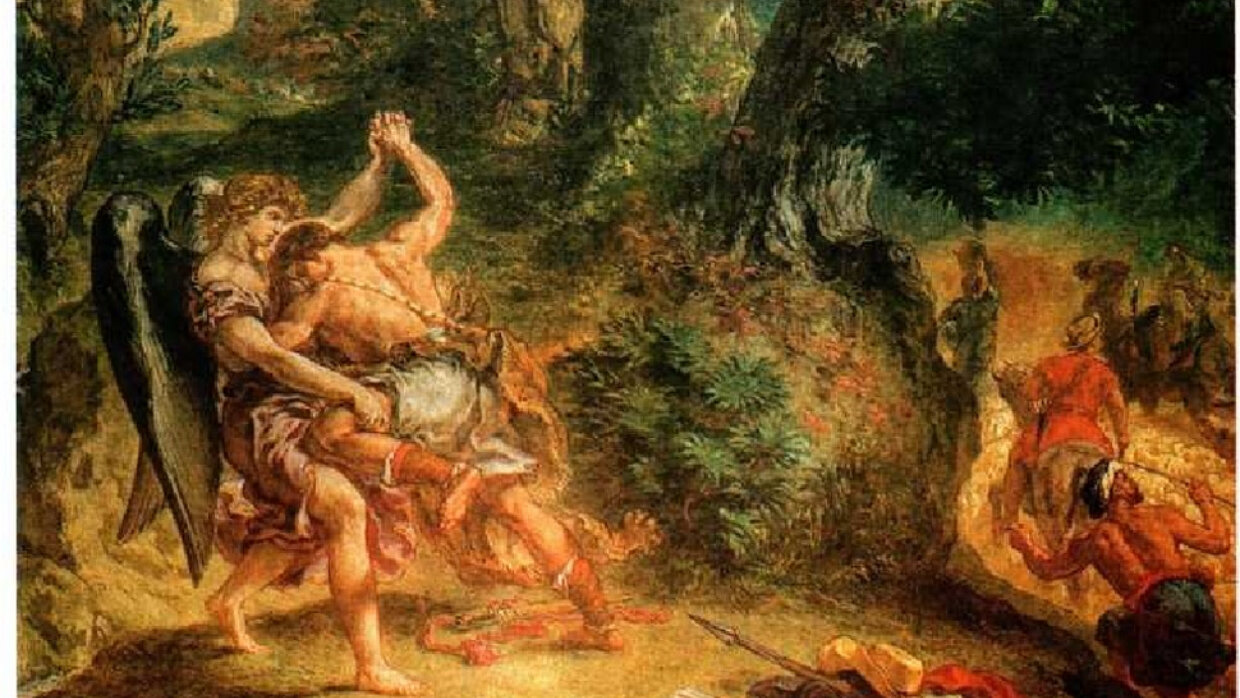
The name “Israel” first appears in Genesis 32:29, where, after Jacob wrestles with an angelic spiritual force—called a malach (מלאך)2 in Hebrew—he is told: “Your name will no longer be said to be Jacob, but Israel (Yisra’el). You have become great (sar) before God and man. You have won.”
Examining how “Israel” (which looks like this: ישראל, in Hebrew) is used in context helps explain the word’s etymology and meaning. Israel, or Yisra’el, is a contraction of the Hebrew words, yisar (ישר)—from the root, sarah (שרה)—which means to prevail, or to become great (and, as used here, is in the future tense), and God’s name, El (אל). In this context, the name therefore means, “He who will become great before God,” or “He who will struggle with the divine.”3
Israel could also come from the word, sar (שׂר), which means a minister or prince, giving the verse the meaning, “You have become a prince before God and man.”
On a deeper level, Jacob was given the name “Israel” after wrestling with—according to the great medieval biblical commentator, Rashi (Rabbi Shlomo Yizchaki 1040-1105)—the spiritual force that oversaw his brother, Esau. According to some biblical commentators, that spiritual force represents evil, or the Yetzer Hara (יצר הרע), which is the anthropomorphic term used to describe the evil inclination, or that voice, when you're making a decision that tries to encourage you to do the wrong thing.
In Genesis 25:26, which describes Jacob and Esau’s birth (they were twins), Jacob was born second, and grabbed onto his brother’s heel. His name, Jacob (יעקב), comes from the Hebrew word for heel, aikev (עקב). In a sense, Jacob’s birth symbolizes the human condition: he was born, so to speak, at the heel of his instincts and desires.
The point of living a Jewish life is to overcome your base, physical desires, and to recognize the divine, ideally seeing God’s hand in your life.
From that perspective, when Jacob overcame his physical nature, as represented by Esau’s spiritual force—or the evil inclination that he wrestled with—his name was changed to Israel, which could also be read, Yashar El (ישר אל), or “straight to God.”4
In rabbinical writings, Esau is often described as a failure, a description that’s hinted at in his name as well. In Hebrew, Esau is Aisav (עשו), which comes from the word for “made” or “complete.”5 Unlike Jacob, who overcame his physical nature and lived with an awareness of God’s omnipotence (and hence the name, Israel, or “straight to God”), Esau was born the person he died, never overcoming his obstacles or challenges, and never discovering God as the ultimate source of reality.
Throughout Jacob’s life, as described in the book of Genesis, the Torah uses both names, Jacob and Israel, interchangeably. After his death, starting with the book of Exodus, his descendants, the Jewish people, are referred to as the Children of Israel, or sometimes just Israel, like in Exodus 4:22, “You [Moses] must say to pharaoh, ‘This is what God says, Israel is my son, my first born.’”
That trend continues throughout the Hebrew Bible. For example, the book of Isaiah refers to Israel in the singular, particularly in chapter 53, which refers to the Jewish people as the "suffering servant," "bruised, crushed and as sheep brought to slaughter" at the hands of the nations of the world.
Israel is mentioned thousands of times throughout the Hebrew Bible, in reference to Jacob, the Jewish people, as well as the land of Israel.
In addition to Israel, the Hebrew Bible also refers to the Jewish people as:
Jeshurun is a poetic name for Israel, and first appears in Deuteronomy 32:15 “Jeshurun thus became fat and rebelled.” According to some, the term is derived from the word Yashar (ישר), which means straight or upright.6
In Exodus 19:3, Israel is called the “House of Jacob (בית יעקב),” “God called to [Moses] from the mountain and said, ‘This is what you must say to the house of Jacob, and tell the Israelites…” According to some, the house of Jacob refers to Jewish women,7 while the Israelites in this context refers to Jewish men.
The Jewish people are also called “Hebrews.” Hebrew comes from the word Ivri (עברי), the term used to describe the biblical patriarch, Abraham, and it means "from the other side." That is both geographic, in that from the perspective of the land of Canaan (modern day Israel), Abraham emigrated from the “other side of the river” (be that the Jordan or the Euphrates); as well as ideological, reflecting Abraham’s radical and different understanding of God. Ivri also derives from Ever (עבר), the biblical figure Abraham descended from.
The name “Jew” is first used to describe a person of Israelite descent in the book of Esther 2:5 where Mordechai, who is from the tribe of Benjamin, is referred to as “Mordecai the Jew.” The terms “Jewish” and “Jew” refer to the “people from the land of Judea”—modern day Israel—as the area was known in biblical times and throughout the classical era.
Jerusalem is the focal point of Jewish life, both physically, as well as conceptually:
The name Jerusalem means "city of peace." Peace is more than the absence of conflict; it is the harmony of humanity embracing a common vision, and Jerusalem is the symbol of that perfected world.
The simple reason Jewish people are called Jews is because they come from a place called “Judea," which had various boundaries in what is now modern-day Israel. In ancient times, the Jewish nation was divided into 12 tribes—Judah, and their territory, Judea, being one of the 12—but subsequent division, conquest, and dispersal confused the issue, and the name, eventually, came to refer to all Jewish people.
A deeper answer is that the original name, Judah, comes from the Hebrew word “to thank” or “to admit.” Being Jewish, in essence, means to live with a sense of appreciation or gratitude, which may explain the resilience of the Jewish spirit.












I learned that Jacob wrestled the angel of Esau and then got the second name of "Israel", before that Jacob ran away after the name change Jacob was strong and fought back, not only spirtually but physically, and the article explains more about the different names of the Jewish people, also Hashem chose Jews to be his people when Hashem gave us the Torah, the 10 commandments the written and oral Torah, I hope must people know the history about this subject
Great!