







 Debunking Viral Claim About the Talmud and Minors

4 min read
4 min read


6 min read


Aren’t they cute?
Most people play it safe when naming their babies, even when naming their children after a relative or loved one.
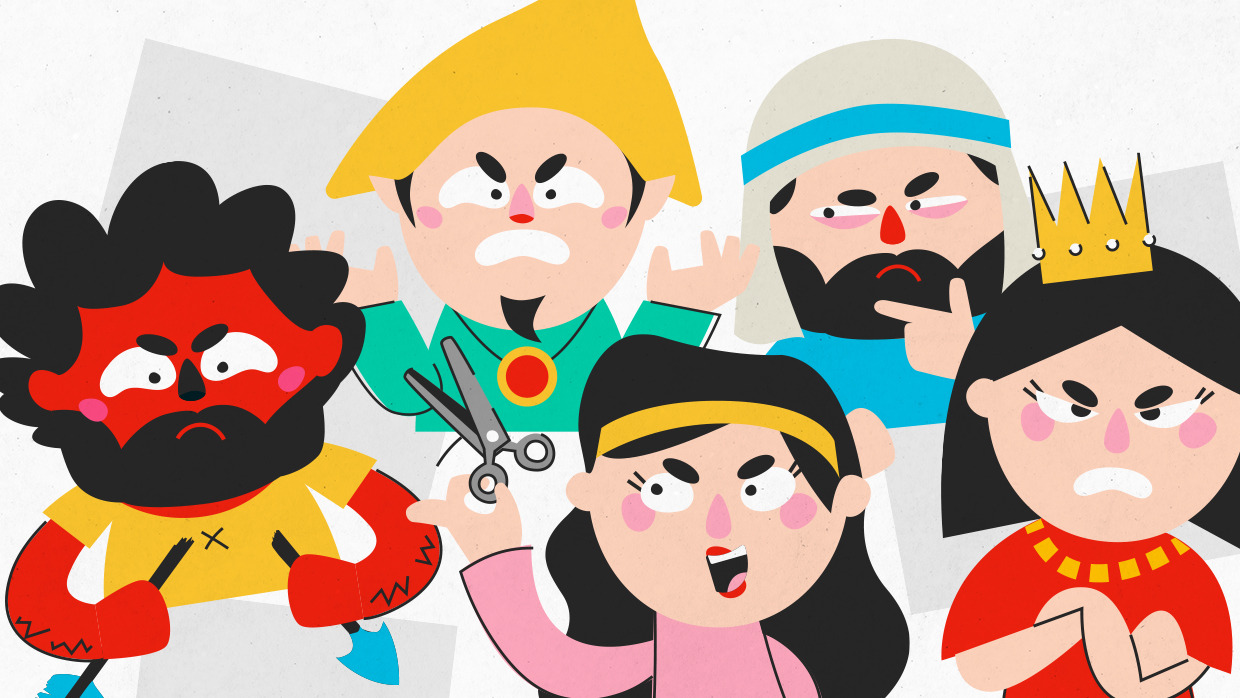
But that’s not always the case. Some parents—those with a little flare, or a taste for danger—opt to name their babies after villains.
And not just any villains. These parents want epic villains whose names conjure up biblical levels of evil.
Here are some of the most popular biblical villain names from around the world, with a few insights into these characters’ personalities and the major events in their lives. Learn how to pronounce these names because in 15 or 20 years you may be hanging out with these babies at parties.
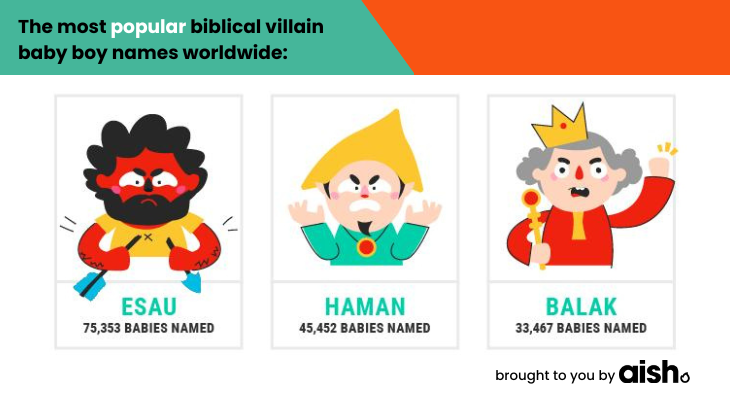
Esau, or Eisav (עשו), in Hebrew, is the twin brother of the biblical patriarch, Jacob, and he’s first mentioned in Genesis 25:25. Esau is the most tragic of the Bible’s villains. Born with incredible gifts, natural charm, and charisma—to the extent that his father, Isaac, recognized his potential, and even considered blessing him with considerable powers—he couldn’t overcome his inherent bad character and died, as far as Jewish tradition is concerned, a spiritual failure.
The secret’s in his name, which derives from the Hebrew word for “made” or “complete.” Esau was born as the person he died, never growing or becoming the person he had the potential to be.
Haman is the genocidal, egotistical maniac from Purim’s Book of Esther. Although Haman possessed considerable political skills—working his way up and establishing himself as Persia’s second most powerful figure, with significant influence and autonomy—he was also petty, self-centered, and lusted for ever-more glory and power, and that was, ultimately, his undoing.
Haman attempted to annihilate the Jews of Persia, except that his plans were thwarted and in the end he was hung on the gallows he built to execute his nemesis, the Jewish leader, Mordechai.
Balak is the Moabite king mentioned in the Book of Numbers. He considered the nascent Jewish nation an existential threat and hired the evil prophet, Balaam to curse them. Although the pair made three attempts to destroy the Jewish people via mystical means, Balaam’s abilities were limited, and instead of cursing the Jews, he blessed them. Ironically, the last of Balaam’s blessings (Numbers 24:5) was later incorporated into the daily Jewish liturgy.
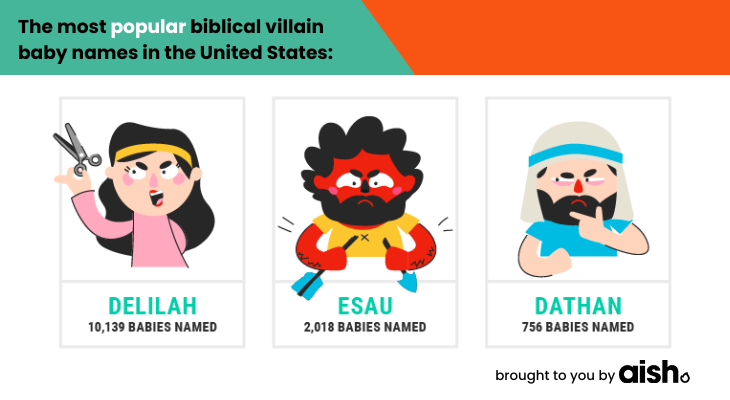
Delilah, first mentioned in the book of Judges, 16:4, is the Philistine woman who discovered the secret of Sampson’s strength—his hair, which he never cut, based on instructions God had given his parents from before he was born. She shaved his head and handed him over to the authorities. Sampson was blinded and held captive in Gaza, where, at the time of his death, he managed to kill thousands of his enemies as well by tearing down the pillars of the Temple of the Philistine god, Dagan.
In addition to being a popular baby name, Delilah is also a common name used for barber shops and beauty salons.
Esau, see above, is from Genesis 25:25.
Dathan, from the Book of Numbers, was one of the leaders of an attempted coup against Moses. According to rabbinic tradition, Dathan, along with his co-conspirator, Abiram, were the two Israelites Moses tried to stop from fighting in Exodus 2:13, when the Jewish people were still slaves in Egypt. Dathan, for his role in the rebellion, was swallowed up by the ground and buried alive. In popular culture, Cecil B. DeMill’s film, the Ten Commandments, portrays Dathan’s unusual death in the wrong context, and as divine punishment for the nation's mistake with Golden Calf.
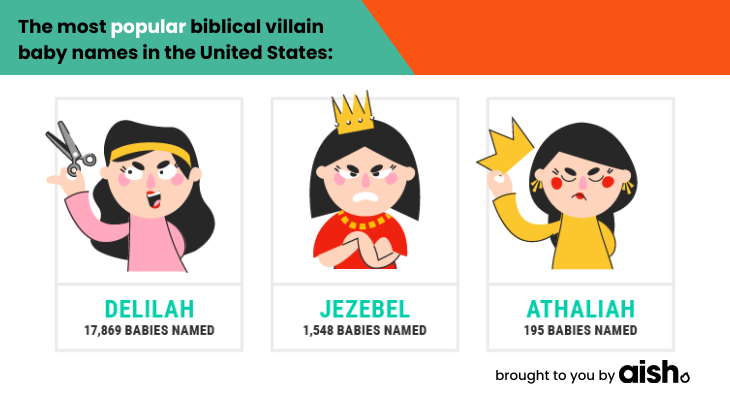
Delilah, see above, is Sampson’s infamous barber from the book of Judges.
Jezebel, is the evil queen from Kings I and the wife of the Israelite King, Ahab. Jezebel is known for her treachery and brutality—including the murder of hundreds of prophets—and her threats against the prophet, Elijah. In Kings II, 9:33-37, she was pushed from a window, died, and her body was eaten by dogs.
Athaliah is descended from Jezebel, and married Jehoram, the king of Judah. When she learned that her son, the Judean king Ahaziah, had died, she attempted to seize the throne for herself, and even ordered the deaths of her grandchildren. She was later deposed and executed in Kings II 11:16.
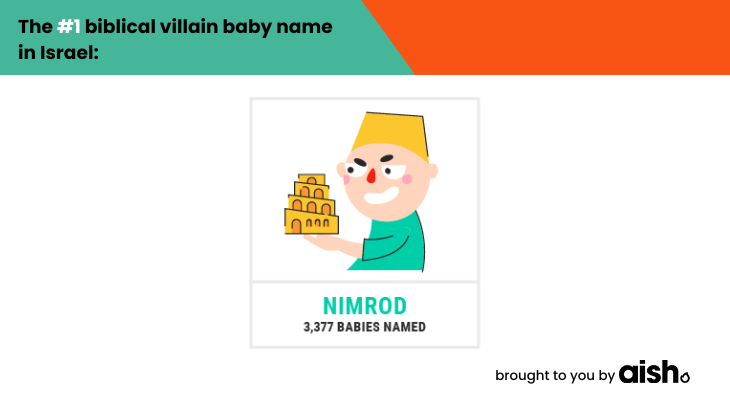
Nimrod is mentioned in Genesis 10:8-9, “Cush was the father of Nimrod, who was the first to amass power in the world. He was a mighty trapper before God.” According to rabbinic tradition, he is considered the first Babylonian king and the builder of the Tower of Babel. According to the great medieval commentator, Rashi (Rabbi Shlomo Yitzchaki 1040-1105), his name is from the Hebrew word, marad (מרד), which means to “rebel,” because he caused “the world to rebel against God.” According to some, Nimrod is a biblical reference to the Akkadian king, Sargon the Great.
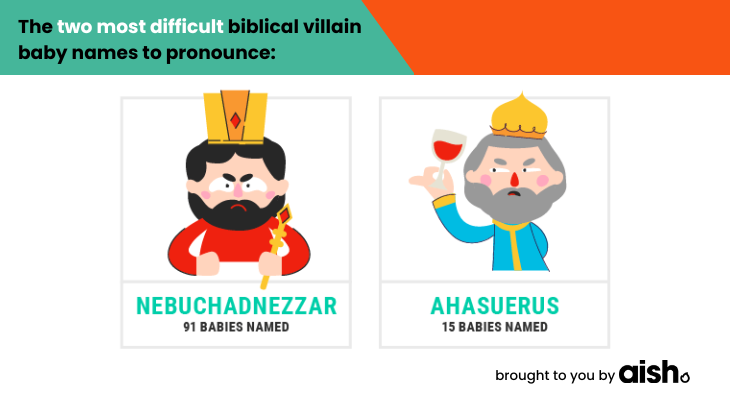
Nebuchadnezzar is the Babylonian king mentioned near the end of Kings II and credited with sacking Jerusalem and destroying Solomon’s Temple.
Ahasuerus is the Persian king in the book of Esther who elevated Haman to power, married the story’s heroine, Esther, and was eventually convinced to annul Haman’s decree and allow his nation’s Jewish population to fight a war for survival.
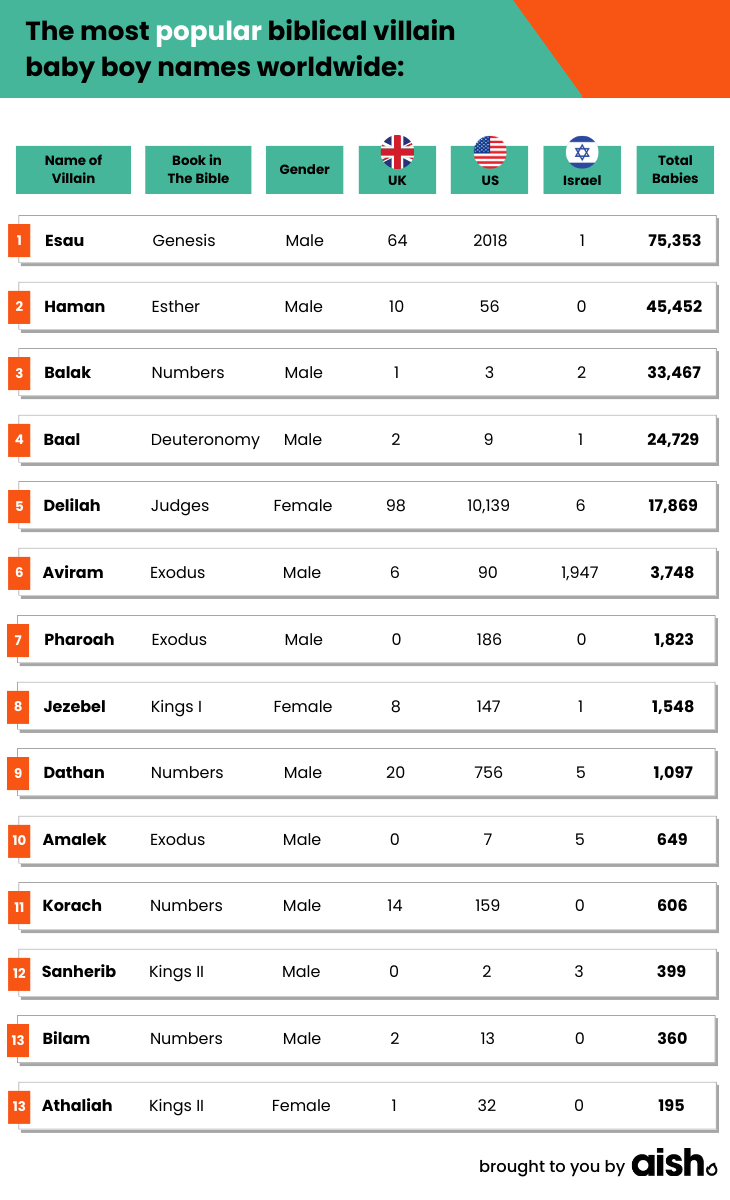
Aish.com compiled a list of 30 of the most popular biblical villains found in the Hebrew Bible. Our team then analyzed data from the over 4 billion people across 236 jurisdictions using the forebears.io database (more detail on the source data can be found here), which revealed the most popular biblical villain-inspired names for boys and girls in the United States, Israel, and across the world.









I may be stupid, but why would you name your children after a villian??
I agree why name your child after a villian, a parent should name their child after a righteous individual, it is sad that in Israel they name children after villians, vashti is a villian and also orpah(the mother of giant) was a villian, from the book of Ruth, why would a Jewish person name their child after a villian, a parent should name children after good people, I don't get the logic behind this trend, it does not make sense to me
My mother told me that she almost named me Bathsheba but she changed her mind when my aunt named me Linda Louise. I am thankful that my aunt was there .
Don't forget BIlaam Harasha whose name is used by Hispanics.
40 years ago, Nimrod was an insult: “Don’t act like a Nimrod”. Btw, I have met a couple of women named Vashtii.
I remember the part about Nimrod but not Vashti
Yes, true, we had a cleaning lady once named Vashti, lol
Poor kids!