







 Debunking Viral Claim About the Talmud and Minors

28 min read
17 min view


7 min read


What is Kabbalah and what are its origins?
What did Sir Isaac Newton, the great 18th century scholar the Vilna Gaon, and the Lubavitcher Rebbe have in common? All of these remarkable figures studied Kabbalah, the ancient Jewish mystical tradition. The Oxford Dictionary1 defines mysticism as “spiritually allegorical; occult, esoteric; of hidden meaning, mysterious and awe-inspiring” — apt descriptions of Kabbalah. Yet to understand Kabbalah fully, it helps to consider how Judaism itself views this profound tradition.
Kabbalah is not red wrist bands, misspelled Hebrew tattoos, sweat lodges or celebrity endorsements. Kabbalah, which means "received," signifies a wisdom passed down through generations, tracing back to Moses at Mount Sinai.2
It is also known as sod, meaning "secret," or sitrei Torah, "the secrets of the Torah." These mysteries delve into realities beyond the physical and linguistic realm, a domain that cannot be entirely articulated. Hence, Kabbalah remains a "secret" or "code," even as it is shared and studied.
Kabbalah offers a vision of total reality—one that is primarily spiritual—contrasting with science, which seeks to explain the physical, observable world. A core teaching in Kabbalah is that what we perceive with our senses represents only a partial truth. True reality, in Kabbalistic thought, is Divine reality, present here and now but often unnoticed. Kabbalah strives to help practitioners connect to this higher reality, enriching and aligning our lives with a more comprehensive truth. Such knowledge cannot rely solely on sensory experience or logic; it requires revealed wisdom.
Given its complexity and depth, Kabbalah is traditionally studied by mature individuals with strong moral character and foundational Torah knowledge. Its study involves understanding the spiritual fabric of existence, the nature of God’s relationship with the world, and our place within this relationship. Errors in understanding Kabbalistic teachings can have serious spiritual consequences, underscoring the importance of preparedness and ethical maturity in its study. 3
Kabbalah is part of the Jewish Oral Tradition, believed to have been conveyed by God to Moses on Mount Sinai and during the subsequent journey through the Sinai desert. References to its wisdom appear throughout Jewish history under various terms, and over time, different aspects have been progressively revealed.
One of the earliest Kabbalistic texts is Sefer Yetzirah ("The Book of Formation"), traditionally attributed to the patriarch Abraham or great Talmudic sage Rabbi Akiva.Another significant work is Sefer HaBahir ("The Book of Illumination"), attributed to Rabbi Nechunya ben HaKanah of the first century CE.
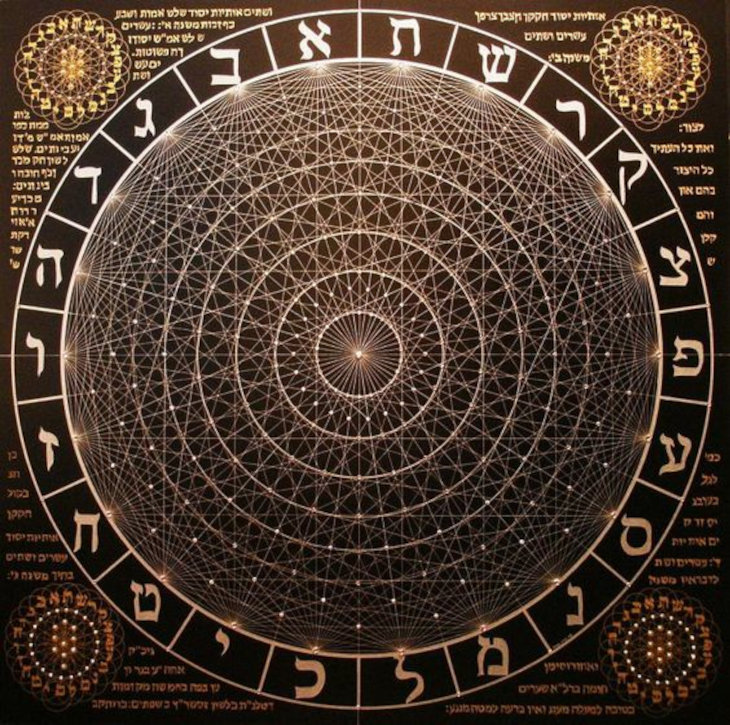 Sefer Yetzirah Wheel with Tree of Life and Hebrew letters
The most influential text of Kabbalah is the Zohar ("Book of Splendor"), written by Rabbi Shimon bar Yochai and his students and composed around 200 CE. Written in Aramaic, the Zohar spans thousands of pages, largely formatted as a mystical commentary on the Torah and other biblical books, including sections like the Tikkunei Zohar, which offers 70 (!) interpretations of the Torah’s first word, "Bereshit" ("In the beginning").
Among the great Kabbalistic sages were Rabbi Moses Cordovero, Rabbi Isaac Luria (the "Ari"), and Rabbi Chaim Vital, all of whom lived in Safed in the 16th century. Later figures included Rabbi Moshe Chaim Luzzatto (Italy, 18th century), the Gaon of Vilna (Lithuania, 18th century), and Rabbi Shneur Zalman of Liadi (founder of the Chabad Chassidic movement, Lithuania, 18th century).
Kabbalah encompasses five primary areas of study, which sometimes overlap:
One of the foundational concepts in Kabbalah is the notion of the Sephirot. The Ten Sephirot represent God’s revealed creative energies through which all existence is sustained and through which the universe operates. These ten attributes are not God Himself but rather expressions of His creative power within a finite reality. As divine energy manifests in the world, it does so in these ten distinct modalities, or Sephirot.10
A vivid example of this can be seen in the relationship between two specific Sephirot: Chesed (loving-kindness) and Gevurah (judgment). Chesed is characterized by expansiveness and generosity, while Gevurah embodies restraint, discernment, and limitation. These qualities are akin to green and red traffic lights—if all lights were green, there would be chaos; if all were red, movement would cease.11
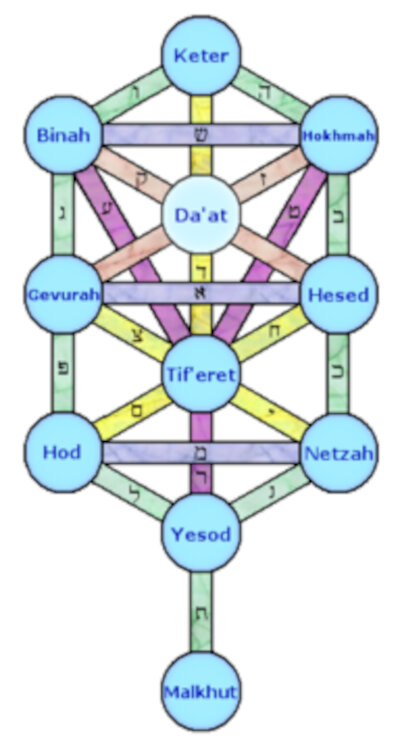 The Ten Sephirot
The harmonious blend of these two forces gives rise to the Sephira of Tiferet, which represents balance, beauty, and splendor. While God may sometimes act with pure kindness or strict judgment, He generally directs the world with a balanced measure of the two, known as Tiferet or Rachamim (compassion).
Kabbalists also delve into the layered nature of the human soul,12 the stages of creation,13 and the various names of God in the Torah, referring to Him primarily as Ein Sof, or “the Infinite.”
The Zohar, a central Kabbalistic text, connects the Sephirot to prominent figures in the Torah: Abraham embodies Chesed, Isaac represents Gevurah, and Jacob stands for Tiferet. Since humanity is intended to serve as a bridge to the Divine, even the human body reflects this Sephirotic structure. Jewish practice often favors the right hand in fulfilling commandments, symbolizing the Sephira of Chesed and emphasizing kindness as an attribute to prioritize over Gevurah, represented by the left.
One of the most influential figures in Kabbalistic history was Rabbi Isaac Luria, known as the Ari, an acronym that also means “Lion.” Growing up in Cairo, he later moved to Safed in northern Israel in the 16th century, where, despite his short life—he died at only 38—he transformed the study of Kabbalah. His revolutionary teachings introduced concepts and structures that would shape Jewish mysticism profoundly. His student, Rabbi Chaim Vital, recorded many of the Ari’s teachings in a multi-volume work, helping to preserve and disseminate them. Other figures who furthered his ideas include Rabbi Yisrael Sarug, Rabbi Moshe Chaim Luzzatto (Italy), Rabbi Shalom Sharabi (Yemen and Jerusalem), and the Gaon of Vilna (Lithuania).
 The grave of Rabbi Isaac Luria in Safed
Authentic Kabbalah offers a lens through which each moment, object, and action is infused with meaning and purpose. It brings sanctity to the ordinary and guides us toward the ultimate goal of unity: unity in thought, speech, and deed; unity between individuals; and unity between all of creation and God.
Featured Image above: Painting by Yoram Raanan, Day 7. Click here to visit the artist’s website.












The GR"A, the Gaon of Vilna, is usually noted for his studies and glosses on the Gemara, however, he did indeed, spend most of his life delving into Kabbalah. With this in mind, for such a supreme mind as his, his contributions to the study of Kabbalah are minute, and he is hardly ever quoted.
I do not trust anyone who says they are spiritual unless they have taken the time to understand and study creation. Being spiritual is being in conversation with G-d. The physical is the table at which we converse with G-d. I am into the physical because G-d has been into the physical for 13.5 Billion Years. Torah comes first. Why does Torah come first? Because it conditions one self not to confuse the mental health problem with the Spiritual. Anything in Kabbalah that disagrees with Torah needs to be tossed aside. I was raised in a New Age Cult within the United States and I understand very well how Eastern Religion concepts and Gnostism have seeped into Kabbalah. The Spirituality of Torah is that it coaches you on how to walk through the park hand in hand with G-d.
Our spirituality is a gift from G-d - part of His Creation. How G-d chooses to lead us down this path of physicality is not for you not I to say. Open your eyes and you will encounter much spirituality in this world.
Lastly, it was my spirituality that led me to Kabbalah which then led me to Torah.
Liked the article and although it doesn’t say it directly , I got the veiled references to The Kabbalah Centre. As a student of the Centre for many years , I can tell you that all the hype about the “red string” is just that: hype. Created by the media and people like in this article, who just repeat and repeat what they read somewhere else.
As far as it being authentic the teachings of the Centre are based on the Zohar, the Ari and Rav Yehuda Halevi Ashlag , the Baal HaSulam. Now , if that is not “authentic Kabbalah” , I do not know what is. Maybe it would be a good idea that the Rav visits the website and takes some of the advanced classes.
As far as celebrities go, don’t understand what is the issue . There are many Jewish celebrities, does that mean Judaism is less significant?
I was not referring to any specific group, not sure how you concluded "veiled reference..." Just saying that those things are not Kabbalah. No need to get defensive. 🙂
So clearly written - this is wonderful!
Thank you
Right, I agree
Thank you for writing about the basics of Kabbalah.
I hope there will be a subsequent article about why people without proper background shouldn't attempt to delve into it, especially since according to today's (Hollywood style -- i.e., fake) trend, unqualified people "teach" it superficially and incorrectly.
Good idea, may do that.