







 Debunking Viral Claim About the Talmud and Minors

28 min read
17 min view


10 min read


Exploring the mystical significance of this iconic Jewish emblem.
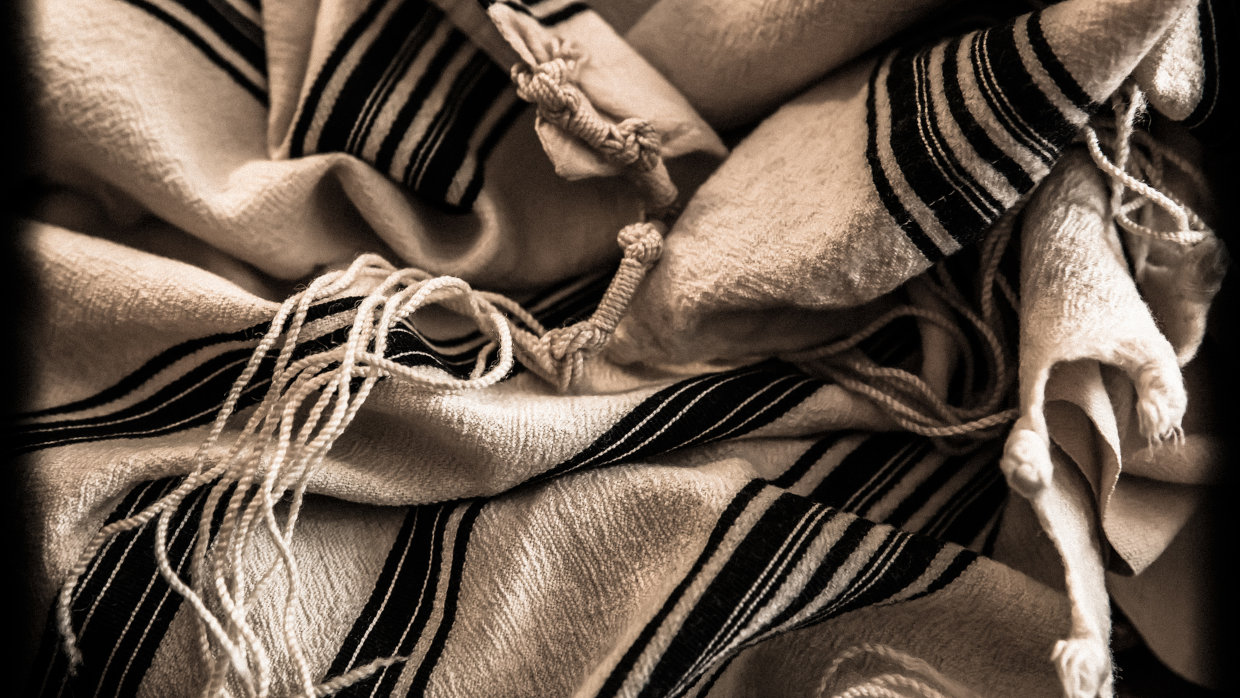
The Jewish prayer shawl, tallit in Hebrew, is one of the most iconic Jewish objects. When we think of Jewish prayer, we think of people praying wrapped in their tallit. Many works of art depict the devout Jew praying and studying, enveloped in it. Many use the tallit as a huppah at their wedding. The tallit is so symbolic of Judaism, the founders of the State of Israel based the design of the Israeli flag on it.
The tallit is a woven piece of cloth with square corners. On each corner are tassels, called tzitzit. The Torah writes1 that blue strings should be included in the fringe, which the Talmud says must come from a specific sea creature called the chilazon, a type of snail.2 The identity of this creature was lost for centuries, which is why only white strings were used in the tzitzit tassel. Much effort has been made in recent years to correctly identify this animal, and some people have once again started to wear white and blue tassels.
Every element of the tallit is rich with deeper symbolism. Mysteriously, the cloth is used as a metaphor for creation. The verse in Psalms3 writes, “You (God) cover with light as with a garment; stretch out the heavens as a carpet.” The Midrash4 comments that God, so to speak, wrapped Himself as one does with a garment during the act of creating the world and allowed the shine of His splendor to fill the world. What is the meaning of this metaphor?
To answer, let’s continue with another, equally puzzling teaching. The Talmud5 writes when God created the world, existence was expanding and growing like a cloth being woven on a loom, until God stopped this growth. The great Talmudic sage Reish Lakish taught, “This is the meaning of the name of God Sha-dai, from the Hebrew word dai, or enough. For God had told the world enough.” This is another reference to cloth being used as an allusion to the creation of the world. What is its deeper meaning, and what are the limits God imposed on creation that the text indicates are so fundamental that the word “enough” becomes a name for God Himself?
Clothing conceals but also allows the shape of the person to be discernible.
The meaning of these sources is as follows.6 Clothing is used to conceal one's body and provide modesty. However, because of its non-rigidity, clothing also allows the shape of the person to be discernible.
God created His world in a manner in which He is concealed and His presence isn't obvious. If God’s existence were to be too obvious, human beings would have no choice but to follow God’s dictates. This would uproot free will, condemning man to a meaningless, robotic existence. By masking His existence, God creates the space for human beings to have moral choice, to build an ethical and Godly life. The opportunity to choose good, rather than being compelled to do so, engenders the immeasurable satisfaction of self-discovery and self-development and allows man to resemble God Who is wholly free and unhindered.
Therefore, the Midrash uses the metaphor of clothing to describe the “shine of God's splendor,” meaning the conspicuousness of his presence, because although one can see the form of the person wearing the clothing if one chooses to, it is concealed from a perfunctory glance. Similarly, one can ignore the reality of God, but this reality is visible if one puts in the effort to see it.
The Talmud’s description of God halting the expansion of the fabric of existence with the command of “Enough!” means God's presence was becoming more and more obvious in existence until God limited the realization of His presence to those looking for it. This signifies the creation of free will, which grants humanity the ability to create one’s spiritual self. In essence God left the world incomplete, making the human being His partner in completing the goal of creation. This act of God limiting His prominence is so fundamental to our existence that the Torah uses the Hebrew word Sha-dai – Enough – as a Name describing our relationship with God.
Let’s now see how this idea is connected to the tallit. When wrapped in a tallit, one is enveloped by a large piece of cloth. The cloth represents the reality of our existence, with God somewhat obscured behind the contours of the fabric of creation.
This cloth has tzitzit tassels tied onto all four corners. These tassels are made by inserting four strings through a hole near each corner. These strings are tied with a series of knots near the hole, and the remainder hangs loose.7 The knots represent a partial completion, the loose strings represent the remainder of a task. This describes the world we live in, a world infused with spirituality by God, improved upon by previous generations, and with much work left for us to do. The tassels on the corners of the tzitzit remind us of our responsibility to improve the world and make it a better place. They are the unfinished part of creation that we will do our best to complete.
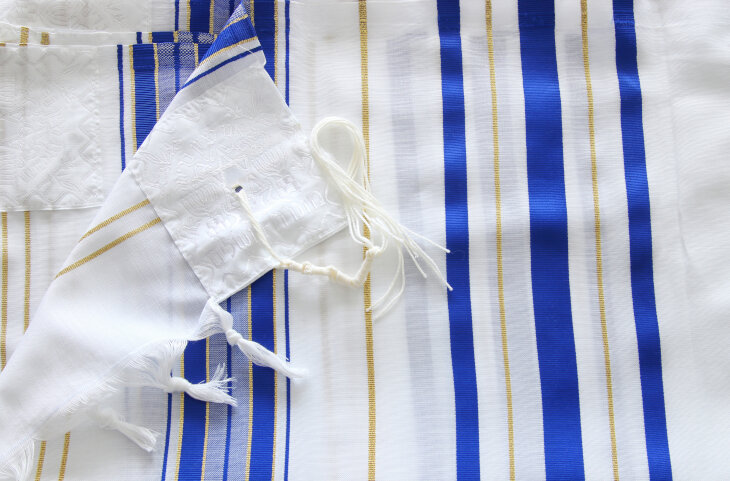
The corners of the garment are squared, which represents human achievement, because as the Talmud8 states, “The square shape is not of nature.” The right angle is almost always something created by a human being. Natural forces typically produce objects with rounded shapes and edges. If one were to find a cube or item with squared corners (like the monolith in 2001: A Space Odyssey), people would naturally assume it was manufactured, not randomly made.
Wrapping oneself in a tallit reminds one to recognize his responsibilities to make the world a better place, as indicated by the tassels, and apply one’s human ingenuity to modify and manipulate existence, as indicated by the square corners of the garment.
The word tzitzit itself indicates this theme. The Hebrew word maytzit means to peer. This means God is watching us through the fabric of creation, and we can feel this reality if we choose to do so.9
The white and blue colors of the tzitzit strings are also significant. Every individual has responsibilities and opportunities to make a positive impact on society. The color white, which indicates purity of intent, sets the tone for this idea.

Just as important, one needs to refrain from doing that which is incorrect and immoral. The Talmud writes10 that the dye extracted from the chilazon sea creature looks like the blue of the sea. The blue of the sea faces the blue of the sky, which draws our attention heavenward to God. Using this as an analogy to train ourselves to constantly see that everything ultimately leads to God, we will have the presence of mind to take note of the repercussions of our actions and hopefully attain the self-discipline to not engage in destructive behavior.11
Another approach to the allegorical representation of the colors blue and white is offered by Rabbi Meir Leibush (1804-1879),12 known as the Malbim. White light, which is the combination of all color wavelengths, represents the comprehensive positive energy needed to accomplish good deeds. The color black would then indicate a cessation of energy, representing total repression of impulsive and instinctive desires. However, because Judaism frowns upon ascetic behavior, which the color black would represent, we pull into the color spectrum for our discipline metaphor and use the color blue. This tells us that while self-control of instinctive desires is necessary, abstinence and withdrawal from pleasure are not.
All the symbolisms mentioned above are broad, universal ideas of human ability and responsibility. Yet for an individual to lead an impactful life they must find a way to express their unique talents and personality in their spiritual accomplishments. This additional component is seen in the Torah’s stated goal for one wearing a tallit: “These shall be your tzitzit, and when you see them, you shall remember God's commandments. You will then not explore after your heart and eyes, which in the past have led you to immorality” (Numbers 15:39).
The Sifrei13 offers the following explanation for the admonition to “not explore after your heart and eyes” which would seem to refer to someone acting lustfully or impulsively.
The verse in Ecclesiastes14 states, “Rejoice, young man, in your childhood, follow the path of your heart and the sight of your eyes.” In this verse the phrase “following the heart and eyes” is clearly being used in a positive connotation. The message is that a young person, seeking to discover their personal identity and focus in life, needs to follow the calling of their heart. There is no cookie cutter definition of the perfect Jew. The best person that you can be is the best version of you. To find out the life mission best suited to oneself, one must see what calling talks to their heart and their perspective with the clearest and truest meaning. The Jewish people needs scholars, activists, and leaders. Just as importantly, simple, ethical, and honest individuals.
However, when seeking a lifestyle that will allow for individual expression, the Torah gives certain parameters. When expressing the goal of the tallit the Torah writes “remember God's commandments” and then you won't “explore after your heart and eyes” to the point of immorality. By following the moral guidelines of the Torah one can safely discover their uniqueness, which is the meaning of “exploring after one’s heart and eyes,” without fear of crossing an ethical red line. Observing the Torah can be done without any compromise towards one’s individuality. This foundational message expresses to the wearer of a tallit that the complete actualization of a desire to improve the world will take place only after a journey of self-discovery.
The message of the tallit, which defines our responsibility to improve the world, the means of accomplishing this by energetically pursuing positive goals and developing the discipline to avoid negative behavior, and lastly the message that an individual can truly express their inner selves through their Judaism, is certainly impactful enough to be an emblem of Judaism itself.














This excellent explanation of the tallit misses an important question: why are they not to be worn by women? I have heard reasons such as that they are a man’s garment (although they are a man’s garment only because women do not wear them) and that that they are a positive time bound mitzvah. I would be very interested in the halachic reason for women not to perform this mitzvah.
Rashi's daughters and Bruriah did!
The reason I was given is that this is a time-bound mitzvah. Women are not forbidden to wear the tallit, but there is no obligation and this is not one of the mitzvot that women generally take on themselves (such as hearing the Shofar or the Megilah on Purim).
What is the reason for the stripes at the sides of the tallit? They are often black but I have seen many other colours including white.
Excellent article. I learned a lot
Wow, elucidating!
I was told that the tzitzit are names of our LORD. Is this true because I heard it once but that is all. Shalom
Some Sefardim wrap theirs to spell the Four-Letter Name of HaShem. 10/5/6/5