







 Debunking Viral Claim About the Talmud and Minors

5 min read
4 min read
3 min read


5 min read


While Nike celebrates athletics at its worst, let’s remember that the most inspiring of all competitors are those who don’t forget that winning is not the only thing.
Nike hired Willem Dafoe to narrate its latest commercial, which it launched to coincide with the Paris Olympics. The spot shows video clips of around 20 modern athletic superstars, including LeBron James, Kylian Mbappé, Sha'Carri Richardson, Cristiano Ronaldo, and Serena Williams, as Dafoe delivers the company's message in malevolent Green Goblin style.
Am I a bad person? Tell me. Am I?
I'm single minded. I'm deceptive. I'm obsessive. I'm selfish.
Does that make me a bad person?
The video, which has been viewed millions of times, continues in this vein for a minute and a half.
I have no empathy. I don't respect you. I'm never satisfied.
I have an obsession with power. I'm irrational. I have zero remorse. I have no sense of compassion.
Accompanying the video is music drawn from the final movement of Beethoven's Ninth Symphony, famous for its "Ode to Joy." For two centuries, that soaring hymn has betokened hope and unity, an uplifting vision of humanity in which "all men become brothers." Nike's commercial mocks that aspiration. Its toxic narrative is that world-class athletes achieve glory not by striving to be their best, but by reveling in their worst, darkest, and most ruthless impulses.
I want to take what's yours and never give it back. What's mine is mine and what's yours is mine.
Am I a bad person?
There is nothing subtle about Nike's meaning. Nike is preaching a gospel of winning at any cost, of suppressing every instinct for decency and magnanimity. It is hard to imagine a message more hostile to good sportsmanship and the Olympic spirit.
Some of the greatest moments in Olympic history exemplify the values Nike mocks.
At the 1936 Summer Games in Berlin, Jesse Owens became the first American to win gold medals in four events — the 100-meter and 200-meter dashes, the 4x100-meter relay, and the long jump. The prowess of the Black track and field star from Cleveland discredited Adolf Hitler's racial theories and the Nazi dictator left the stadium rather than shake hands with the Games' most successful athlete.
Yet Owens would have collected only three gold medals had it not been for a different German. Luz Long was a tall, blond Olympian from Leipzig, the seeming personification of everything the Nazis believed about the Aryan "master race." As the holder of the European long jump record, Long looked forward to competing against Owens, the American record-holder. During the preliminary round, Long performed splendidly, setting a new record. But Owens fouled on his first two attempts. A third foul would have eliminated him.
It was at that moment, as Owens later recounted, that Long advised his most formidable competitor to mark a spot a few inches before the takeoff board and time his jump accordingly. Owens heeded Long's suggestion, advanced to the final, and went on to win the gold. Long finished with the silver medal.
With no hint of resentment, Long was the first to congratulate Owens. In a scene captured on film, the white German and the Black American walked from the stadium arm in arm. It was an open repudiation of the Nazi ideology and a singular show of political courage on Long's part. The two men formed a friendship that day that endured until Long's death in 1943, when he was fatally wounded during World War II.
The story of Owens and Long perfectly embodies the Olympic ideals that Nike goes to such lengths to denigrate. There have been many other such stories. Here are two:
At the Sochi Games in 2014, Russian skier Anton Gafarov crashed as he rounded a corner, breaking his ski and hobbling himself — whereupon the coach of the Canadian cross-country team, Justin Wadsworth, dashed onto the track, replaced the Russian's damaged ski, and enabled him to finish the race.
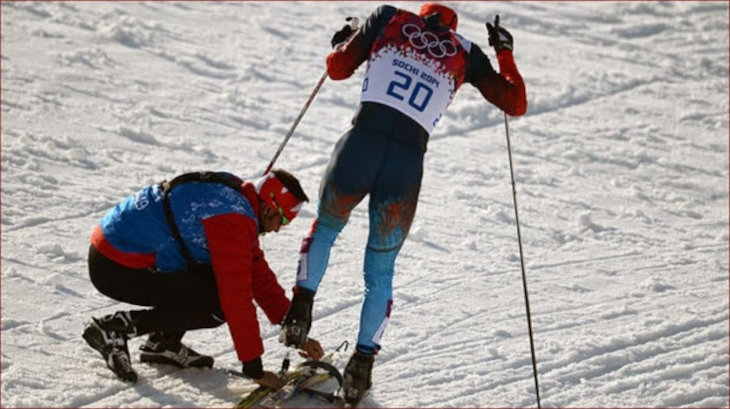 When Russian cross-country racer Anton Gafarov broke a ski at the Sochi Games in 2014, the coach of the Canadian team, Justin Wadsworth, dashed onto the track to replace the Russian's damaged ski, enabling him to finish the race.
Two years later, during the women's 5,000-meter heat in Rio de Janeiro, New Zealander Nikki Hamblin stumbled and fell, causing Abbey D'Agostino of the United States to stumble and fall as well. D'Agostino was quickly back on her feet, but rather than race off, she stayed to help Hamblin get up. The women resumed running, but D'Agostino, who had been injured, fell again — and this time it was Hamblin who turned back to aid her rival. The double mishap put both runners out of medal contention, but their demonstration of selflessness and compassion captured the hearts of viewers worldwide.
While Nike glorifies athletes who triumph through an arrogant and pitiless unconcern for others, the most inspiring of all competitors are those who never forget that winning is not the only thing. Nike's new commercial may help sell more sneakers, but it will do nothing to encourage true athletic greatness.
This op-ed originally appeared in The Boston Globe.













Possibly multiple dimensions to Nike's message here. Firstly, who implied that having all these traits as an athlete made him/her a "bad person"? Can an athlete have these traits in their indviidual disciplines yet not in their day-to-day lives? Secondly, any athlete who endorses Nike knowing full well how they exploit workers in 3rd world countries is as unethical as the company they represent.
After seeing this rather jarring ad, I do not believe the commercial was a celebration of avarice. Instead, it sounded like a carefully--for lack of a better description--satire of the state of the world, not that Nike endorses it. And if I may be permitted a personal observation, it sounded more like a dressing down of a certain former president. It hardly suggests that people should believe all this is worthy and should/will be stocking up on Nike gear.
In 1936 when the Olympics were in Germany, the American team had a Jewish person to run in the race, but the Jewish person find out he couldn't run because he was a Jew in Nazi(may their name be erased) Germany, and Jewish person said" let the black person run instead of me" , the Germans let this happen, because they never thought a black person would win the race and not a "Aryan", and Jess Owen won the race, this is a true fact that I heard and maybe saw and people should maybe boycott Nike, the Nike's have no values to bring up the 1936 games when the Nazis(may their name be erased), first insulted the Jewish person, and then the black person(that the "Aryan Race" is better than Jesse Owen) I wonder if anyway else heard this very sad and prejudice fact in Olympic history
The ad implies that psychopaths are more likely to succeed, in sport or anything else, and exalts psychopathic characteristics as something to admire. The truth of the claim is dubious, and the antisocial values it seems to praise are deplorable. Nike is not a person; but persons affiliated with it have approved, bought, and aired this repulsive screed. I would not want to reward them by purchasing their products.
This is nothing new in Nike's history if they are a German company, because in 1936 the Olympics were in Nazi(may their name be erased) Germany, and first didn't let the Jew on the American team run, so instead the black person ran Jesse Owen ran and won the race, the Nazis(may their name be erased) were horrified a "Aryan"(German race) didn't win the race, so their ad is nothing new to me some old hatred and evil from the past in 1930s/1940s and it is now 2024
Is there a presumption here that if someone is a successful athlete, achieving fame or wealth through their sports performance, they should also possess top-notch ethical values? In reality, their accomplishments are a result of their natural talent, hard work, and sometimes their flair for showmanship—none of which are directly related to their moral character.
Jewish wisdom teaches us that the talents we receive are a gift from God, whereas our ethical choices represent the true realm of free will. This means that while we might admire an athlete's skills and achievements, it’s unrealistic to expect them to also be paragons of ethical behavior just because they’re celebrated in the world of sports.
Still I think the article was well taken, as a global company like Nike doesn't need to revel and rejoice in these horrible ethical values.
Noone expects a paragon but basic decency IS required, on and off the field. This character proudly boasts the lack of any decency.
Am I a bad person? I'd rather enjoy the ad. It even embraced disability I think that we need to lighten up and realize that they are targeting people who want to see themselves as winners, and seeing these Olympians paired with their determined attitude is going to sell more sneakers. Remember selling Sneakers and other Nike products is there Primary goal. I'm sure they are market research has determined that pairing their message with the visuals is found to be favorable with their demographic. Please, let's not rely on Nike to Take a high moral road. Their goal is to leave the person watching the ad with a desire to go out and buy Nike.
I think it’s meant to sell Nike gear and to be provocative. I don’t care for the voiceover, but showing video of the focus required in moments of competition is appropriate.
Nike, in answer your question: YES, you are VERY BAD person! And unless you change, you will remain so no matter how many medals you win. In the end, they will be meaningless.
Nike is a giant corporation. It’s not a person, and it has a fiduciary duty to shareholders.
Dvirah likely knows that! Her point is that what you call "fiduciary duty" is hardly the highest calling; besides, there's no need for big business to stoop to lowlife 'values' in their ads: to be successful, good old-fashioned quality of the merchandise being sold should speak for itself.
Thank you, Barb!
My reply is to the fictional character in the ad - which character will serve as a role model to those watching the ad. The values a individual brings to a sports competition will ultimately be the same values brought to everyday life, and there is a vast difference between determination to do well and indifference to all but one's own desires. My reply stands.
And incidentally, in approving such an ad the Nike company is saying something about it's own values, also. I will think twice before buying their products again.
I remember watching, years ago, the last match of men's tennis at Wimbledon. It was between a Spaniard and an Englishman. (I don't remember their names.) The Spaniard won the match; I was not surprised, as he had played the better. Both men were interviewed after the game. The Englishman said that he was not surprised that he lost - the Spaniard had played better than he had. The Spaniard said that he was very surprised that he had won - the Englishman had played so well.
Sportsmanship at its best, on and off the court.
In Jewish spirituality, there's a belief that when we pass on, our consciousness continues in what's called 'the world of truth.' It's there we'll finally see how this world was filled with lies and twisted morals—where the things celebrated should have been shunned, and vice versa. This latest Nike ad campaign feels like another clear example of that upside-down world. It's tough to avoid the constant push of these distorted values, but being aware of the propaganda gives us a shot at keeping our perspective clear.
Thank you for bringing up this significant point.
You are 100% right what you said