







 Debunking Viral Claim About the Talmud and Minors

10 min read



14 min read


The great playwright embraced his Jewishness later in life and became a passionate voice against rising antisemitism.
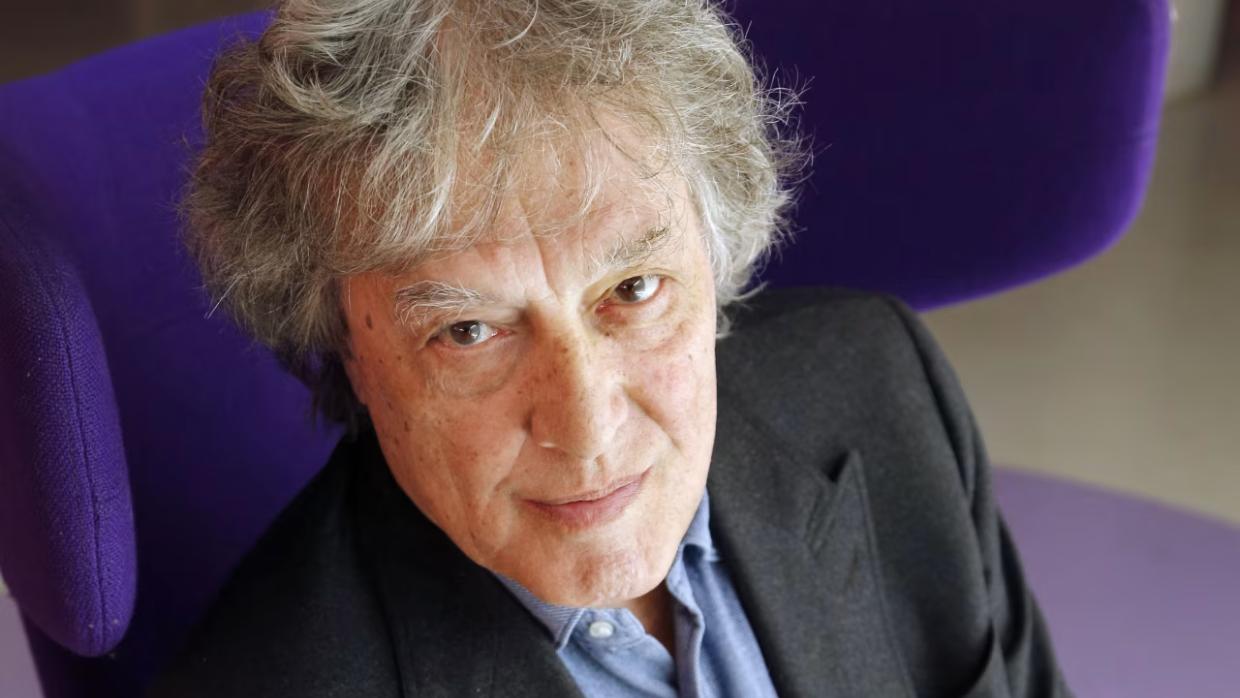
Tom Stoppard, who has died at the age of 88, was the greatest playwright of his generation. The only writer to win five Tony Awards, he gained fame for modern classics like Rosencrantz and Guildenstern are Dead, Travesties, The Real Thing, The Coast of Utopia, and Leopoldstadt (all of which won Tonys), Arcadia, Jumpers, The Invention of Love and many others. His brilliant plays often include multiple timelines, surprising parallels between time and space, and include erudite discussions on philosophy, math, and the nature of love and fate.
Movie aficionados might be more familiar with Stoppard’s screenplays. He wrote the 1998 hit film Shakespeare in Love, the 1987 Steven Spielberg-directed movie Empire of the Sun, and others. He also worked as an uncredited “script doctor” for numerous films, adding polish to The Bourne Ultimatum, Star Wars Episode III: Revenge of the Sith, Schindler’s List, Indiana Jones and the Last Crusade, and many others.
For many fans, Stoppard was the quintessential Englishman. Yet far from being the archetypal English artist, Stoppard was Jewish and a refugee. Though he suppressed this identity for much of his life, Stoppard eventually embraced his Jewishness in later life, addressing it directly in his final masterpiece, the epic 2020 drama Leopoldstadt, which won both the Olivier Award in England and the Tony Award in the US.
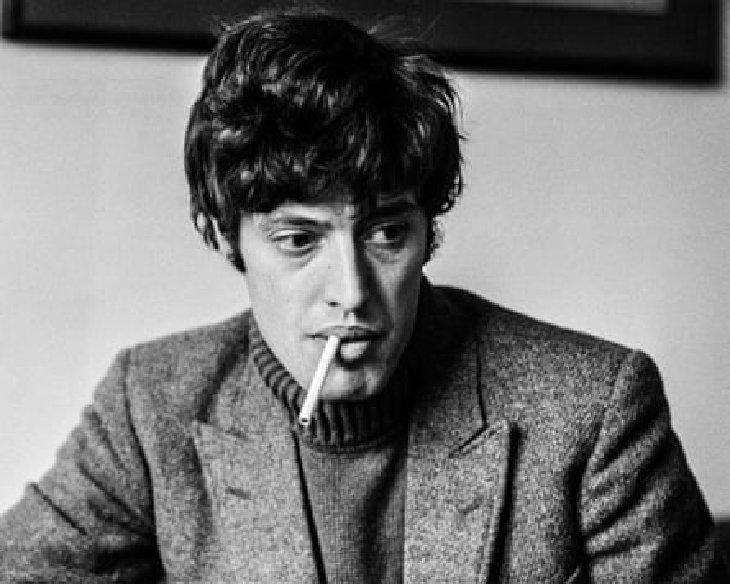
“It would be misleading to see me as somebody who blithely and innocently, at the age of 40-something, thought ‘Oh, my goodness, I had no idea I was a member of a Jewish family,’” Stoppard once explained. “Of course I knew, but I didn’t know who they were. And I didn’t feel I had to find out in order to live my own life. But that wasn’t really true.”
Learning about his family and his Jewish history, Stoppard finally felt whole and complete.
Before he was Tom Stoppard, he was Tomas Straussler, born in 1937 into a Jewish family in the town of Zlin, in Czechoslovakia. Stoppard lived with his parents, Eugen and Martha, and his older brother Petr in a comfortable house, surrounded by their very large family and a warm Jewish community. His family was highly assimilated; Stoppard later estimated that half of his Jewish relatives married non-Jewish spouses.
Stoppard’s father Eugen was a doctor, working in a hospital owned by the town’s largest employer, the Bata shoe factory, a fact that would save young Stoppard’s life. When Stoppard was just 18 months old, German troops stood poised, ready to invade Czechoslovakia. Recognizing the dangers posed to the Bata shoe company’s Jewish workers, CEO Jan Antonin Bata transferred about 80 Jewish employees to offices overseas. Stoppard’s family embraced the opportunity, selecting Bata’s factory in Singapore as their destination.
Two years later, Stoppard’s family was once again caught up in war’s grip. By late 1941, Japanese soldiers were poised to invade Singapore and Stoppard’s mother, Martha, fled the city with young Petr and Tomas, leaving Eugen behind to participate in Singapore’s defense. (Stoppard recreated their desperate flight years later in his magnificent screenplay for the movie Empire of the Sun, which tells the story of a British family in Singapore during the Japanese invasion.)
Stoppard, his brother and mother caught a boat to India. Unbeknownst to them, Eugen evacuated Singapore after Japan’s invasion in February 1942 and died when his boat was sunk by a Japanese torpedo. For years, his family didn’t know precisely how he perished. Stoppard reflected that his father’s fate was very different from that of his many Jewish relatives who were murdered by the Nazis: “For the Japanese were a different story. They killed my father and did their best to sink the ship that got the rest of us to India, but it wasn’t personal, we weren’t on a list, it was simply the war and being in the wrong place at the wrong time.”
Tomas, Petr and their mother remained in British-controlled India for five years. Stoppard later recalled speaking only Czech for much of that time. In 1946, his mother married Kenneth Stoppard, a Major in the British Army, and moved with him to England. To facilitate their visas, Kenneth Stoppard adopted his new stepsons. Overnight, Tomas became Thomas; Petr became Peter; both changed their last name to Stoppard.
His step-father was antisemitic, and it was an unspoken rule that the family had to bury any vestige of their Jewishness.
Tom was eight years old when he moved to England. He later described adapting as quickly as he could to his new home: I “put on Englishness like a coat,” he later described. Stoppard’s new stepfather was generous to his adopted children, but was also small-minded and antisemitic. It was an unspoken rule that the family had to bury any vestige of their Jewishness.
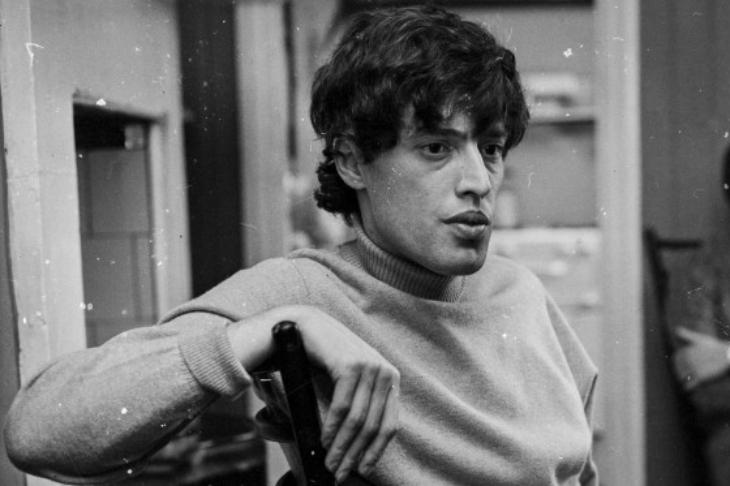
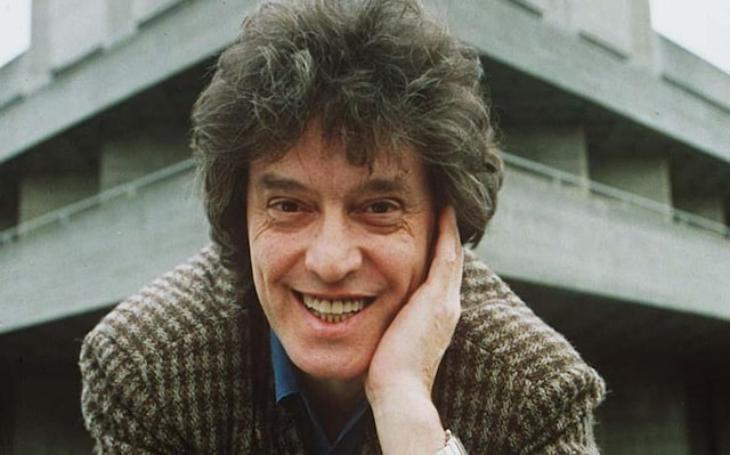
Stoppard’s mother went on to have three more children in England; Tom and his brother attended prestigious English private schools. When he graduated high school at 17, Stoppard began working as a journalist in the southwestern English city of Bristol and wrote theatre reviews for a London magazine on the side. Stoppard began writing radio and television plays, and found fame in 1966 when Rosenkrantz and Guildenstern Are Dead, a play he wrote for the Edinburgh Fringe Festival, garnered rave reviews and transferred to Britain’s prestigious National Theatre, directed by Laurence Olivier.
The play tells the story of Hamlet from the point of view of two minor characters in the play; though they try to stop the tragedy that is taking place, they fail, providing a powerful commentary on the futility of trying to change our fates. Stoppard, at the age of 29, was suddenly one of England’s hottest new playwrights.
He went on to write hit after hit, including The Real Inspector Hound in 1968, a genre-bending sendup of murder mysteries that manages to be a profound commentary on the limits of human ability; Jumpers in 1972, a comedy addressing moral dilemmas; Travesties, in 1974, an original play about early 20th century philosophers; and Every Good Boy Deserves Favour in 1974, a blistering attack on Soviet human rights abuses.
While Stoppard’s work was beginning to be concerned with political themes and with Eastern Europe, Stoppard himself remained firmly ensconced in his English persona. He gradually forgot Czech and “felt about as English as you could get.”
Even in August 1968, when Soviet forces invaded Czechoslovakia and brutally ended the reforms of “Prague Spring,” Stoppard didn’t feel much at all. “In August 1968, when the armies of the Warsaw Pact put down the movement for reform in Czechoslovakia, my then wife was firstly incredulous and secondly infuriated that I didn’t get worked up about it as a Czech. It was true. I had no special feeling other than the general English one of impotent condemnation, tinged with that complacency one feels when the ogres of one’s personal demonology behaved true to form. I knew I was - used to be Czech, but didn’t feel Czech.” (Stoppard was married three times and had four children.)
In the 1970s and 1980s, Stoppard began to speak out on human rights issues affecting Soviet Jews, Czechs, and other Eastern Europeans, though he took great pains to disassociate himself from the people he used his growing fame to help.
In 1977, Stoppard traveled to Moscow and Leningrad to investigate refuseniks, Soviet Jews who’d applied to emigrate to Israel or elsewhere and were refused then persecuted. Stoppard wrote movingly about their torture in Soviet psychiatric hospitals where they were drugged, given electroshocks or insulin-induced seizures, and imprisoned for years. His 1977 play Every Good Boy Deserves Favour depicted this brutality and helped draw attention to the Soviet’s barbarity towards Jews and dissidents.
 Daniel Radcliffe and Joshua McGuire as Rosencrantz and Guildenstern in a London revival
On February 17, 1986, Stoppard gathered a group of A-list celebrities and politicians on the stairs of the National Theatre in London where they read the names of refuseniks who’d applied to leave the Soviet Union. The “Roll Call” as he called it lasted 24 hours and helped draw attention in Britain to the plight of Soviet Jews. Though Stoppard did feel connected to the Soviet Jews he championed – he recognized that his family was Jewish, and if they hadn’t escaped in 1939 it could very well be him sitting in a Soviet jail cell – Stoppard continued to feel he was somehow not an “authentic” Jew.
“As a result (of the ‘Roll Call’) I received letters thanking me as a Jew,” he described, “and I remember that once or twice, feeling obscurely that I was receiving credit under false pretenses, I replied that I was not Jewish or at any rate not really Jewish. I had become habituated to the unexamined idea that although - obviously - there was some Jewish blood in me [my father’s father’s?], enough to make me more interesting to myself and to have risked attention from the Nazis, it was not really enough to connect me with the Jews who died in the camps and those who didn’t.”
Stoppard knew his mother corresponded with a few relatives in Czechoslovakia and elsewhere, but he didn’t inquire much about his family. The fact that his mother Martha was very reticent about her life before she moved to England helped give him an excuse not to probe into family history. Yet with the fall of Communism, it became easier for Czechs to travel and see relatives abroad. One day in 1993, a woman Stoppard has only identified by her first name, Sarka, wrote to Martha: she was a cousin of Martha’s first husband. Now that Communism had ended, she was living in Germany and wanted to travel to England to meet her long-lost family.
Martha was “slightly panicked because (her husband) Ken would not have been receptive to this sort of thing and could not be relied on to behave gracefully.” An inveterate antisemite, it was a given in the Stoppard family that he would be enraged by meeting a Jewish relative. Martha suggested that they meet at a restaurant in London near the National Theatre, where Stoppard was working. Stoppard, his sister, his niece, and his mother all gathered to meet Sarka. Towards the end of the meal, Sarka pulled out a pen and paper and sketched out their large family’s entire family tree. Stoppard later recalled the conversation he had with her. Ever the playwright, he recorded it like a play:
“Sarka, we were Jewish?”
“What do you mean?”
I adjusted.
“I mean, how Jewish were we?”
“You were Jewish.”
“Yes, I know we were Jewish, my father’s family….”
“You were completely Jewish.”
I looked at the family tree. I went left to right.
“What happened to Wilma?” (Stoppard’s aunt)
“She died in Auschwitz.”
“Berta?” (Another aunt)
“Auschwitz.”
“Amy?” (A third aunt)
“She died in a different camp. I don’t know where.”
“Ota?” (Stoppard’s uncle)
“He survived.”
Stoppard was flabbergasted. Aunts, uncles, cousins, friends – plus all four of his grandparents – were murdered in Nazi concentration camps. He realized that while he and his brother and mother were living in India in the 1940s, nearly all of his close relatives were being brutalized and murdered.
The following year, Stoppard traveled to Czechoslovakia for a literary gathering; when he returned to his hotel room in Prague at about two in the morning, he found a young man waiting for him in the hotel lobby. “He couldn't speak much English, and I couldn’t work out what he was trying to tell me,” Stoppard recalled. “He had an old photograph album that he put on the hotel counter and opened. There was a photograph of me and my brother Peter with the family spaniel I discovered in the garden of our first house in England.”
The young man was named Alexandr and was a cousin of Stoppard’s. He’d read about the visit of the famous English playwright to his country and traveled from his home to the hotel to make a connection. Suddenly, for the first time, Stoppard saw photos of his relatives. He connected with other relatives and even went back to Zlin with cousins he once played with in that town as a young child, nearly a lifetime ago. In a sudden rush, Stoppard felt Jewish. Thinking of all the years when he respected his mother’s silence and failed to ask questions about their family, he felt a “form of self-reproach.”
Stoppard’s mother Martha died in 1996. A few days later, Kenneth Stoppard wrote to Tom demanding that he give up the last name “Stoppard.” He “wrote…to say that he had been concerned for some time about my ‘tribalization’ by which he meant mainly my association, 10 years earlier, with the cause of Russian Jews, and he asked me to stop using ‘Stoppard’ as my name.”
Tom Stoppard replied dryly to his stepfather in a letter “that this was not practical.”
“I know what made Major Stoppard, himself the father of two (biological) half-Jewish children, so angry,” Stoppard considered. Despite being an antisemite, his stepfather was not overtly racist to other groups. That was because, Stoppard posited, so many other groups of people he’d come across seemed pleased and honored to move to England and adopt English mores and values. People from Africa, from India, from other places, were “grateful to adopt English ways and modes of thought.” When they moved to England they received “honorary membership in the club” of Englishness.
But Jews, Tom Stoppard realized, were different. His stepfather gave Tom and Peter what he thought was the ultimate gift - becoming English - and yet Tom had continued to identify, against all odds, as a Jew. The persistence of Tom’s Jewish pride enraged him.
Stoppard finished his final play, Leopoldstadt, at the age of 83. It debuted in 2020 in London then later transferred to Broadway, to rave reviews. Stoppard no longer felt nervous before his plays opened, yet when Leopoldstadt opened on Broadway, Stoppard said he felt butterflies in his stomach for the first time in years. The title refers to Vienna’s Jewish district Leopoldstadt and is intensely personal: “I knew I wanted to write a kind of oblique version of my family background,” Stoppard told The New Yorker. At the same time, he realized his play tells the story of “tens of thousands” of other people as well. Writing it felt like a great responsibility.
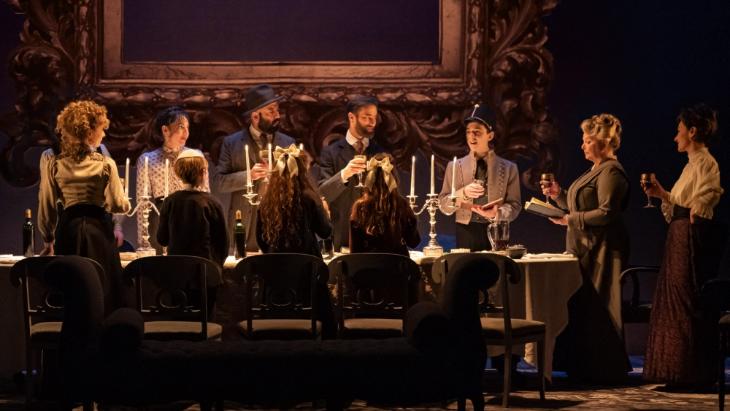 A scene from Leopoldstadt
Leopoldstadt traces the fortunes of one Jewish family from 1899 to 1955 as the flames of persecution rise up around them. Stoppard is represented in the final 20 minutes of the play by Leo, a hapless character who escaped from Vienna as a young child and moved to England. When he gathers together with his Viennese relatives in the 1950s, Leo has little to no memory of their shared life; everything he says sounds foolish. “My mother didn’t want me to go to school with a German name. I was Leonard Chamberlain from when I was eight….” Leo blathers to his Austrian relatives in the play. “She didn’t want me to have Jewish relatives in case Hitler won. She wanted me to be an English boy. I didn’t mind. I was pleased.”
He was finally able to call out anti-Jewish prejudice not as a concerned outsider, but as a Jew
At the end of the play, the clueless Leo asks his surviving relatives about each member of their once-large family. This haunting finale echoes Stoppard’s real-life conversation with his cousin Sarka years before:
Ernst.
Auschwitz.
Hannah.
Auschwitz.
Kurt.
Dachau, 1938.
Zacharia.
Death march. Nowhere.
Sally.
Auschwitz.
Mimi.
Auschwitz.
Bella.
Auschwitz….
The scene goes on and on, listing the ways their Jewish relatives were slain, speaking for Jewish families everywhere.
Leopoldstadt finally gave Tom Stoppard a sense of Jewish identity and belonging that had eluded him his whole life. In a 2022 interview with The New York Times, Stoppard noted that as he worked on his final play, “my personal experience over the last three, four years has made me feel much more part of the world of the Jews. I’ve never lived in it, but working with the British and the American company of actors, many of whom are Jewish, I felt part of that community.”
 Winning a Tony award for Leopoldstadt
At the end of his life, Stoppard warned against rising antisemitism, noting that he was shocked at the virulent Jew-hate he saw coming from both right-wing and left-wing extremes. Finally, he was able to call out anti-Jewish prejudice not as a concerned outsider, but as a Jew, drawing on his own family’s rich Jewish history to give weight to his warnings.











Very interesting article. I wonder why, though, he kept Stoppard as his last name since his step-father was son against it. Wonder if it was a bit of revenge - "Now your name is associated with a Jew. And you can do nothing about it."
He was legally adopted by his stepfather. Most adoptees keep their adoptive name, and he was known as Tom Stoppard from his arrival in the UK. Straussner would have been perceived as German, and Germans were not popular in Allied countries after the war.
Tom kept the name as it was his name now ..he was known as Stoppard .
I don’t think it was revenge at all.
I don’t think he felt so strongly about it ( revenge )
THANK YOU DR. MILLER.
From what I’ve read, Stoppard’s adoptive father was xenophobic. He thought that Britain and the Empire were the best. He didn’t want to know about his wife’s family not because they were Jewish, but because they were from Eastern Europe, then under Communism. He felt that he had bestowed a tremendous gift— Britishness— on his adopted sons. I’m not sure antisemitic is the right categorization, since he married a Jewish widow and adopted her children. And Tom had a very good British lifestyle that would not have been likely had he been perceived as a foreign playwright.
I’m glad that he eventually reckoned with his complete heritage towards the end of his life. He was the greatest playwright of his time.
I wonder if the play Leopstadt had been produced and presented after Oct. 7 if it would have won a Tony award or even been nominated
Unfortunately, probably not.
What a fascinating story, and so well-written.
As always, I am grateful for this thoughtful and comprehensive missive of yours! I did not know most of it.
It’s such a shame that all he got in the end was Jewish tragedy and not Jewish joy
Tom had much joy in his life though
When read Stoppard's "Rosencrantz and Guildenstern are Dead" at Bar Ilan University in Israel, much after Malamud's "Magic Barrel." "Barrel's" Leo takes HUGE risks for emotional, spiritual, redemption. R & G are strangely stuck, on the outside, seeing, but not jumping in. And despite Stoppard's detachment from the fray that Malamud relished, I felt an odd Jewish sensibility in Stoppard that made no sense since (at that time) I knew he wasn't Jewish until he wrote "Waking Up Jewish," & it felt like a massive chandelier had crashed, sending beautiful sparks heavenwards. Now you've sewn all the patches of Humpty Dumpty's gorgeous tapestried suit back together again. One ex- was Jewish as was his partner upon death. His two Jewish sons married out.
Sooooo interesting, and revealing. I wonder how many fellow Jews of that generation, who were eager to cast off any vestige of Jewishness, have finally had to come to terms with, and embrace their true identity. Post Oct 7th this must be particularly true
My Holocaust survivor in-laws have not. After what they went through, it’s sad but understandable.
Dr. Yvette Alt Miller has done a fantastic job of tracing Tom Stoppard's journey to his Jewish identity. The best obit of the famous playwright! Thank you.
Stoppard’s odyssey into his adoption of his heritage as a Jew is beautifully described and gives so much meaning to second and third generations of Holocaust survivors.
If I may correct a technical mistake, Stoppard's stepfather's children from Stoppard's Jewish mother were not "half-Jewish" because the children of a Jewish mother are halachically (according to Jewish law) considered full-fledged Jews.
That would've been a bone in Kenneth! Stoppard's throat
I really don’t think that Mr. Stoppard thought about that or even knew about that .
Wonderful, detailed reporting of this talented writer. What a travesty that he wasn’t allowed to embrace his Judaism until later in life but at least he finally did. May his memory be a blessing.
The Jewish Shakespeare!
Assuming Shakespeare was not!
No.
Shakespeare was not a Jew.
I’m not sure that would have been possible. Jews had been expelled from England centuries before Shakespeare, and he never traveled outside of England. He just had a remarkable imagination.