







 Debunking Viral Claim About the Talmud and Minors



12 min read


The Hanukkah miracle sparked a century of Jewish sovereignty—and a princess whose marriage to Herod turned glory into tragedy. Miriam’s life is the Hasmonean dynasty’s final flame.
When we think of Hanukkah, we picture the triumphant highlights: Judah the Maccabee’s victories, the rededication of the Temple, the miracle of the oil. But Hanukkah wasn’t the end of the story. What followed was a turbulent century of guerrilla warfare and political intrigue, foreign alliances and hard-won conquests, as the Hasmonean family forged a Jewish state in the Land of Israel. For the first time since the ancient kingdoms of Israel and Judah, the Jewish people regained sovereignty. Hasmonean rulers—priests (kohanim) descended from Aaron—united religious and political authority, expanded Judea’s borders, fortified Jewish institutions, and nurtured an era of stability and growth that lasted 103 years.
Miriam’s life plays out like a Greek tragedy in Hebrew letters: heroic, dramatic, and ultimately heartbreaking
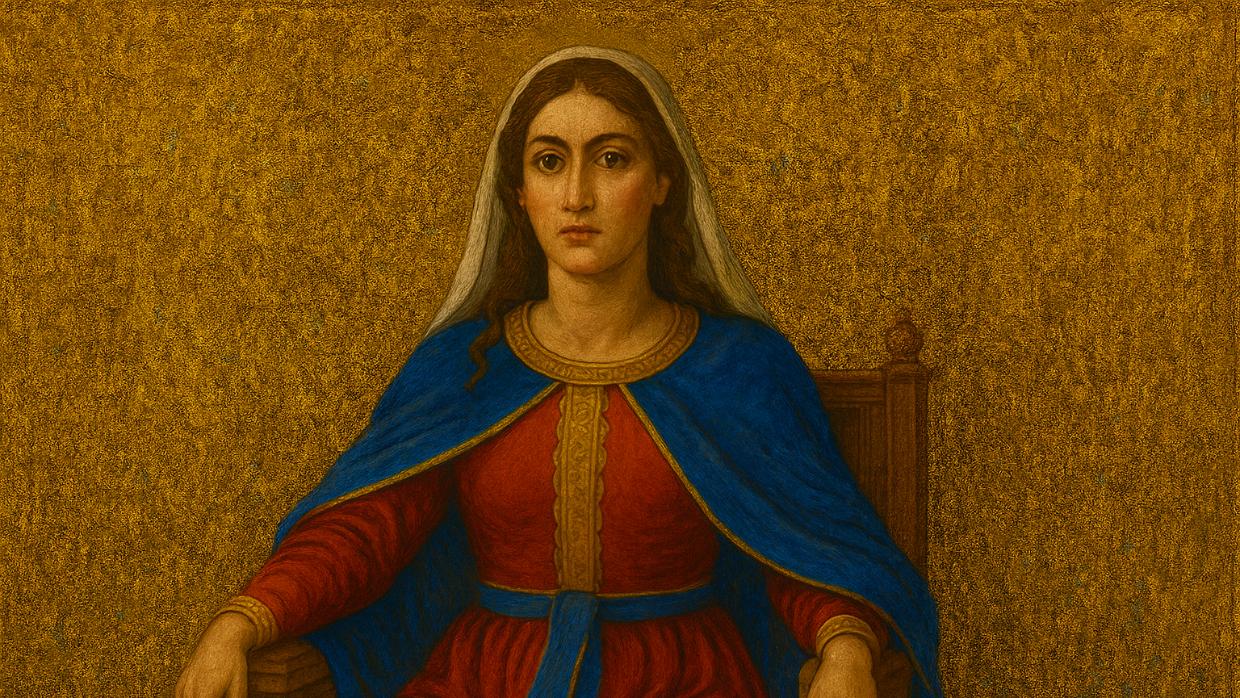
At the very end of that dynasty stood one extraordinary woman: Miriam, the last Jewish princess, the crown jewel of Judean royalty. Her life plays out like a Greek tragedy in Hebrew letters: heroic, dramatic, and ultimately heartbreaking, a portrait of Jewish dignity caught between the fading glory of the Hasmoneans and the rising shadow of Herod the Great.
Born sometime around 57–55 BCE, more than a century after Judah Maccabee’s revolt, Miriam came of age during the reign of her grandfather Hyrcanus II. Her parents were cousins, so Hasmonean royalty ran through both branches of her family. She traced her line to the original Maccabean brothers (through Simon), and her great-grandmother Shlomtzion (Salome Alexandra) had been the only woman to rule Judea in her own right. Miriam was the daughter of Alexandra, Hyrcanus’s only surviving child, which made her the highest-ranking Hasmonean of her generation—and the heir to the throne. The future of the Jewish kingdom rested, in many eyes, on the young princess.
But the world she inherited was coming apart. The Hasmonean dynasty was unravelling from within as relatives fought bitter civil wars over power. Rival factions invited foreign forces—first the Nabateans, then Rome—to intervene. By the time Miriam was a toddler, Judea had already been reduced to a Roman client kingdom. Rome controlled foreign policy and military decisions, while still allowing Hyrcanus to serve as nominal ethnarch and High Priest, preserving the façade of independence even as real authority slipped away. Miriam’s childhood likely blended royal privilege with constant tension, her family’s survival hinging on fragile alliances.
Miriam embodied the public’s yearning for a return to the purity, dignity, and spiritual courage of the first Maccabees.
In this fractured landscape, Miriam stood out not only for her bloodline, but for what it symbolized. She embodied the public’s yearning for a return to the purity, dignity, and spiritual courage of the first Maccabees. The Hasmonean name still meant legitimacy, leadership, and holiness—and Miriam grew up knowing that her lineage was both a blessing and a danger. The name was so powerful that anyone who married into it could claim Judea’s throne, a fact Rome—and a young Idumean officer named Herod—understood all too well.
Herod the Great was not born into royalty, but he was no stranger to the Hasmonean court. He was the son of Antipater, a Jew of Idumean origin (from ancient Edom), who served as Hyrcanus II’s chief adviser and de facto administrator of Judea. In practice Antipater acted as a Roman-aligned “prime minister,” the real power behind the throne, while the Hasmonean ruler remained largely a symbolic figurehead. Herod likely accompanied his father to Jerusalem, learning politics firsthand and cultivating early ties with the royal family. Even then, seeing Miriam as a young girl, he fixed his attention on her. Sources suggest he was struck by her beauty and presence, but politically, he also had ulterior motives.
Herod lacked what the Jewish masses cared about most: legitimate lineage.
Herod was brilliant, ambitious, and favored by Rome—an obvious heir to his father’s influence. Yet he lacked what the Jewish masses cared about most: legitimate lineage. For centuries Jewish kings traced themselves to David; the Hasmoneans, though not Davidic, still commanded loyalty through their priestly descent from Aaron, their military heroism, and their defense of Torah. Herod had none of that. He wasn’t even Israelite by blood: paternally Idumean, maternally Nabatean, culturally Roman, and with a contested Jewish status because of his grandfather’s conversion. Miriam embodied everything he needed—royal dignity, Maccabean blood, and the emotional authority of the Hasmonean name. Herod understood that without marrying into that legacy, his claim to rule would always be fragile.
Miriam, as the last Hasmonean princess, was wary from the start. She feared his ambition and his lack of royal roots. Herod, however, pressed his case with flattery, promises, and public displays of loyalty, presenting himself as a guardian of the Hasmonean heritage. Her mother, Alexandra, accepted the match, hoping it would restore some measure of their influence and stabilize the family’s position under Rome. For Herod, the courtship was not merely for a bride but for political legitimacy—a direct path to Judea’s throne. They became engaged in 41 BCE.
One year later, in 40 BCE, just before the marriage could take place, Parthian forces invaded Judea and briefly overturned Roman control. Antigonus II, a rival Hasmonean leader (Miriam’s uncle) who was anti-Roman, seized the opportunity to join forces with the invading Parthians. Within a very short period of time, Herod and the Hasmonean relatives aligned with him became prime targets of the new revolutionary government under Antigonus. Archaeological excavations in Jerusalem have unearthed Hasmonean coins from the period of Antigonus’ rule (40-37 BCE), which are the first and only known ancient Jewish coins depicting the Temple menorah. Evidently, Antigonus was trying to win over the Jewish masses by reminding them of the Hanukkah story, glorifying the right of Judea to reign independently of foreign rule, whether Greek or Roman.
Due to the violent regime change, Herod and Miriam were forced to flee the city with a small entourage of personal guards, loyal Idumean troops, and mercenaries. Their flight was nearly cut short when they were ambushed near Tekoa, a strategic town 5/6 miles south of Jerusalem where Parthian allies and local forces loyal to Antigonus threatened to capture them.
After winning a daring battle, Herod and his entourage deviated from the main road, turning eastwards into the desert and eventually reaching Masada. Masada at that time had not yet been heavily fortified (although Josephus mentions a small Hasmonean outpost being located there). What it did offer were natural defenses including steep cliffs on nearly every side, a single narrow approach, and a plateau at its peak. Herod left Miriam there with her mother and a small garrison because he needed to move quickly. With the rest of his small army, he sought to avoid Parthian forces, reach Rome, secure Roman military assistance, and recapture Judea from Antigonus’s forces.
For the next three years, Miriam remained atop the fortress, watching the endless desert horizon, unsure whether Herod would return at all. Supplies were limited, the political situation was dire, and the uncertainty must have been overwhelming for a young princess.
Before the wedding, Herod ordered the execution of anyone deemed to be “enemies of Rome”, including members of Miriam’s family.
During that time, Herod fled to Egypt, and from there, sailed to Rome, where he was appointed a new title by the Roman Senate: King of Judea. Herod returned to Judea with a Roman army of approximately 30,000 soldiers to reclaim his throne from Antigonus and the Parthian-backed forces. Over the course of about three years of campaigning, he gradually defeated anti-Roman Hasmonean supporters and Parthian forces, culminating in the siege of Jerusalem in 37 BCE. While the siege was still in progress, he left the battlefield and arranged to meet Miriam in Samaria. She reportedly received Herod with loyalty and composure, aware of both the dangers surrounding them and the political necessity of their marriage.
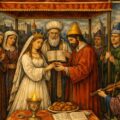
During the final stages of his conquest over Jerusalem, while military operations against remaining Hasmonean loyalists were still ongoing, Herod and Miriam tied the knot under the chuppah. Earlier that day, Herod ordered the execution of anyone deemed to be “enemies of Rome” (supporters of Antigonus), Antigonus himself (Miriam’s uncle), and many of Miriam’s relatives (anti-Roman members of the royal family). As you can imagine, there was far more representation on the groom’s side of the family at the wedding.
This essentially cemented Herod’s kingship while preserving, in name and legacy, the Hasmonean royal connection, which was his ticket to legitimacy in the eyes of the masses. Miriam feared Herod and treated him with outward respect, recognizing the power he held, but her loyalty was born of necessity rather than admiration, and she harbored deep resentment, fear, and hatred towards him because of the ruthless killings of her family members that became part of his legacy.
As queen, Miriam tried to preserve the dignity and values of her Hasmonean heritage. She carried herself with the regal bearing associated with her great-grandmother Shlomtzion, and strove to uphold the nobility, restraint, and spiritual focus the Maccabean line was meant to embody. She advocated for her surviving relatives, many of whom Herod regarded with suspicion because of their royal blood. Within the palace she maintained a fierce moral independence, refusing to flatter Herod or pretend she didn’t see the gulf between their lineages. Together they had five children—three sons (one of whom drowned in youth) and two daughters.
Miriam could not conceal her contempt for the man who had executed her family and seized her dynasty’s throne.
Josephus portrays their relationship as a tragic imbalance of power: Herod’s obsessive love set against Miriam’s quiet, unyielding disdain. He was enthralled by her beauty, pedigree, and royal dignity, to the point that love curdled into possessiveness and paranoia. Miriam, meanwhile, could not conceal her contempt for the man who had executed her family and seized her dynasty’s throne. Outwardly obedient but inwardly resentful, she spoke with a frankness that enraged Herod even as it seemed to intensify his fixation—perhaps because he relished the challenge of winning her over.
Josephus says Herod loved her “beyond all reason,” while Miriam kept a proud distance, refusing flattery or feigned affection. The marriage—politically brilliant but emotionally doomed—became a volatile mix of devotion on his side and moral revulsion on hers, spiraling into jealousy, suspicion, and tragedy.
According to Josephus, Herod’s sister Salome and his mother Cypros resented Miriam’s proud Hasmonean bearing and her refusal to disguise her contempt for Herod’s brutality. Again and again they accused her of adultery and treason. The turning point came in 31 BCE, when Herod set out to meet Octavian (later known as Caesar Augustus), Rome’s new ruler and his former rival. Before leaving, he ordered his guards to execute Miriam if he did not return. He apparently could not bear the thought of losing her—even in death—a chilling command that exposed both obsession and insecurity.
When a guard foolishly revealed the secret to Miriam as “proof” of Herod’s love, she was horrified. Salome seized on her outrage, telling Herod on his return that Miriam and the guard Sohemus had become intimate. Herod, torn between passion and suspicion, hesitated at first. But after fresh accusations and Miriam’s openly defiant demeanor, he put her on trial for adultery, and the court executed her in 29 BCE. Josephus is blunt: Herod loved her fiercely even as he destroyed her, and after her death he spiraled into grief and near-madness, wandering the palace calling her name as if she were still alive.
After fresh accusations and Miriam’s openly defiant demeanor, Herod put her on trial for adultery, and the court executed her in 29 BCE.
After Miriam’s execution, her mother Alexandra tried to exploit Herod’s emotional collapse by seizing the fortress of Alexandrium, hoping to restore the Hasmonean line—or at least save herself. Josephus portrays the plot as clumsy and poorly concealed. Herod’s informants uncovered it quickly. To him, it proved that Alexandra had always been scheming and that Miriam’s supposed treachery had been real. Not long after, he ordered Alexandra executed as well. Over the course of his reign, Herod eliminated all of Miriam’s surviving relatives—the last remnants of the dynasty—including Hyrcanus II, her grandfather, and Aristobulus III, her brother.
The tragedy reached its bitter end years later, when Herod executed his own sons by Miriam—Alexander and Aristobulus—precisely because of their Hasmonean blood. As the princes matured, they inherited their mother’s noble bearing and drew public admiration for their ancestry, intensifying Herod’s insecurity. Court factions—especially Antipater, Herod’s eldest son from his first marriage—fed those fears with fabricated claims that the princes planned revenge. Herod sent them to Rome for education, hoping distance would ease tensions, but the rumors only grew.
At last, he convened a Roman court in Berytus (modern Beirut). Under pressure and manipulation, the court condemned the brothers, and Herod had them strangled in 7 BCE. With their deaths, the Hasmonean lineage was effectively extinguished. The dynasty that had restored Jewish sovereignty, purified the Temple, and given the world the miracle of Hanukkah was gone. The final ember of Jewish political independence would not reappear for nearly two millennia.
Miriam’s story, for all its tragedy, carries the inner fire of the Maccabees whose legacy pulsed in her veins. Like her ancestors, she lived at the fault line between foreign domination and Jewish self-determination, and she refused to surrender her dignity, her identity, or the memory of a people who had once ruled themselves in their own land. Even as Herod tried to bury her lineage, she would not let it be erased.
Miriam was the final living emblem of Hasmonean resistance.
In that sense, Miriam was more than the last Hasmonean princess. She was the final living emblem of Hasmonean resistance—the last human echo of Jewish sovereignty, and a stubborn reminder that it had been real, and could be real again.
Long after her death, Jews drew strength from her story as they did from the Maccabees, a vivid reminder that political independence can be crushed for a time, but the flame endures—quietly, fiercely—waiting to be rekindled and rise again.











My heart breaks for beautiful, pure, Jewish Princess Miriam. Her mother, family members and relatives all put to death by excessively wicked Herod. And her and Herod's precious children she bore to him, all put to death by that murderer she had reluctantly agreed to, and didn't want to marry. Miriam's extreme mental and emotional agony would have been unbearable. But determined Jewish Princess Miriam, carried on with grace, dignity, strength and an unshakeable belief that the eternal flame would never die. That light that her people, the Jewish people, the Chosen People, had always carried, would be re-kindled and live on forever. Beautiful, innocent Miriam, falsely accused of adultery and treason was put to death by her own husband. Rest in eternal peace with God's Holy angels, Miriam.
Predictable failure:
After killing Miriam and her mother, Herod eliminated all of Miriam’s surviving relatives—the last remnants of the dynasty—including Hyrcanus II, her grandfather, and Aristobulus III, her brother.
The tragedy reached its bitter end years later, when Herod executed his own sons by Miriam—Alexander and Aristobulus.
===
Parents failed Miriam. Herod was a son of Cain to the end. End of all lines.
A fair lesson for today.
This article fails to mention the Talmudic story that Herod preserved Miriam in honey, and had sex with her corpse. Necrophilia was a sticky business.
Only one comment merely style. Peak and plateau don’t mix summit would be better.
This is amazing! I never knew anything about her.