







 Debunking Viral Claim About the Talmud and Minors
Jewish Geography
Jewish Geography



6 min read


Once thriving, now nearly gone—the Jewish community of Rhodesia leaves behind echoes of faith, culture, and courage.
In the heart of Southern Africa, far from Europe’s shtetls and Mediterranean shores, an unlikely chapter of Jewish history unfolded. Here, in Rhodesia’s sun-scorched plains, families who had fled pogroms, persecution, and war forged a community that was at once fragile and unshakable—its survival tested by fire, politics, and exile.
The Jewish community in Rhodesia—now Zimbabwe—was a mosaic of tradition and cultural richness. Though small in number, we were tightly knit, deeply rooted in faith, ancestry, and kinship. My family was part of this fabric, one of many threads in a tapestry woven over generations by Jews who came from scattered homelands to build something lasting in Southern Africa.
The earliest Jewish settlers arrived in the late 1800s, mostly Ashkenazi Jews from Russia and Lithuania, fleeing pogroms and persecution. They brought with them a commitment to Jewish life, a love of learning, and strong Zionist ideals. In towns like Bulawayo and Salisbury (now Harare), they laid the foundations of community life, building synagogues, Hebrew schools, youth movements, and communal organizations such as the Rhodesian Jewish Board of Deputies and the Zionist Council.
In the 1930s, a wave of Sephardi Jews arrived from the Greek island of Rhodes. They settled primarily in Salisbury, bringing their vibrant Ladino traditions and distinctive cuisine to the mix—borekas, pastelikos, biscochos, and folk songs that pulsed through community gatherings.
Six Torah scrolls carried by rabbis are held before being placed in the Aron Hakodesh, in the Sephardi synagogue, Salisbury, on 1st June 1958.
Then came the German Jews, my family among them, fleeing the rise of Nazism in the 1930s. Many were professionals—lawyers, doctors, teachers—who carried both the trauma of their recent past and the refinement of Central European Jewish culture. They integrated quickly, contributing to Rhodesia’s intellectual and economic life.
In the 1960s, as civil war broke out in the newly independent Congo, another wave of Jewish refugees arrived. They brought with them a hybrid identity—European roots filtered through the dust and layered history of postcolonial Africa—adding new threads to an already rich communal tapestry.
Each group arrived carrying the weight of what they had left behind, but with skills, traditions, and stories that strengthened the whole.
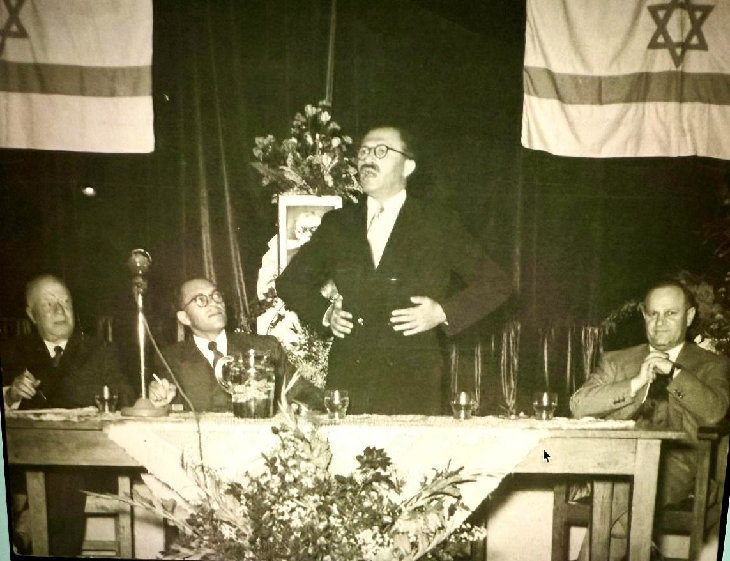 Menachem Begin Addressing Rhodesian Jewish Community 1950s
My family owned and operated a successful dry cleaning business in Bulawayo. We serviced the local hotels and the Rhodesian Railways, washing and pressing linens for the couchettes—sleep wagons that carried travelers through the night to Mozambique or South Africa. Like so many others, we were part of the country’s growing infrastructure, part of the promise of a flourishing Jewish life.
As children, we belonged to Zionist youth movements—Habonim, Betar, Bnei Akiva—depending on our families' political leanings, passed down at kitchen tables. We camped under the stars, danced the hora, sang Hebrew songs around bonfires, and grew up with a clear sense of identity and belonging.
Then, in 1965, a seismic shift occurred: Rhodesia declared unilateral independence, triggering global condemnation, economic sanctions, and escalating tensions. By the late 1960s and ’70s, the once-stable environment began to unravel. Many Jewish families, uncertain about the country’s future, began to leave. One by one, they drifted away—to South Africa, Israel, the UK, Australia, the U.S. The community dwindled, the streets emptied, until it was our turn to go.
In 1986, our family emigrated to Gainesville, Florida. We joined a synagogue within the first week of our arrival. It was instinctive, like seeking shelter. How comforting to walk into a sanctuary 5,000 miles from home and hear the same melodies, recite the same prayers. Even the food—gefilte fish, teiglach, chopped liver—was comfortingly familiar. It made the upheaval bearable. We may have left our country, but we found our people.
Then, just as we were beginning to rebuild our lives, we heard news from back home in Rhodesia: the historic Bulawayo synagogue was destroyed in a fire.
In a biblical twist of fate, the synagogue that was founded in 1894, caught fire just after Tisha B’Av, the day commemorating the destruction of the First and Second Temples in Jerusalem. A burning hedge outside had ignited the building. As word of the fire spread, members of the community rushed to the scene and stood by helplessly.
Within minutes, the sanctuary was engulfed in flames, leaping into the skies. Suddenly two men broke from the crowd and, ignoring firefighters’ dire warnings, plunged into the burning synagogue. Moments later, they emerged, covered in soot, carrying all six Torah scrolls and a 300-year-old parochet (curtain) from the Aron Kodesh.
The siddurim and holy books were destroyed but the synagogue’s most sacred treasures were saved.
Perhaps the most haunting image from that day was Rabbi Leizer Abrahamson, then 104 years old, standing beside the charred remains of the shul where he had officiated for decades. He clutched his cane with one hand, wiped away tears with the other, and asked, broken-hearted, what he would be buried in—his tallit had been consumed by the flames.
Rabbi Leizer Abrahamson
The congregation continues to function, holding services in temporary quarters. But given the community’s dwindling numbers and fragile finances, it’s unlikely a new synagogue will rise from the ashes. In a city that once boasted a Jewish population of 3,000, fewer than 70 remain—most of them elderly.
And yet, the legacy endures.
Non-Jewish students in the Carmel Primary school.
Carmel, the Jewish day school in Bulawayo still stands, but the students are no longer Jewish. Instead, children of all ethnicities attend, drawn by its reputation for academic excellence. They sing Hebrew songs and recite prayers in a language they don’t understand, unwittingly preserving fragments of a once-thriving Jewish community. The old-age home houses a few remaining Jews who chose to stay as the world they once knew slips away.
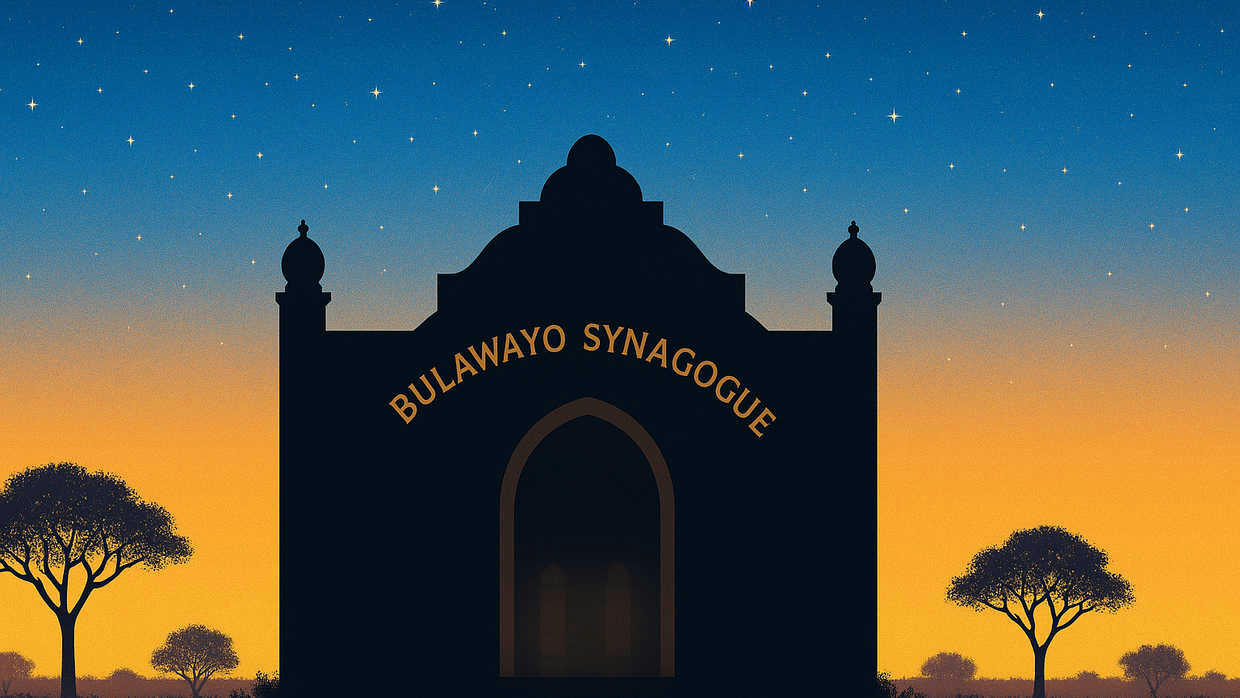
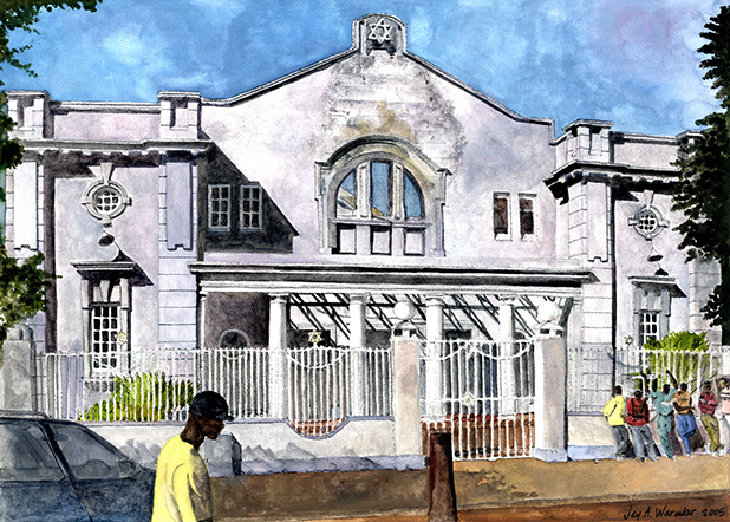 The façade of the Bulawayo Synagogue
You may never walk the streets of Bulawayo, or hear the trains rumble through the night, their linen-clad couchettes bound for Mozambique or South Africa. You may never sit in a synagogue filled with voices singing Lecha Dodi under a hot African sky, but know this: a Jewish world once thrived there. We were bakers and butchers, teachers and tailors, dry cleaners and dreamers. We built businesses, schools, and synagogues. We danced at weddings, mourned at gravesides, and sent our children to Zionist youth groups.
We were few, but we were mighty. We lived fully, fiercely, and with deep conviction in who we were. And when we left, we carried it all with us—not in suitcases, but in our hearts.
Photo credit: with thanks to zjc.org.il





Well written article, Vivien! My mother, Sarah (Sally Gruber) Glickman was born in Bulawayo, as well as my sisters, Lynette and Helene, and me. Lynette was a tennis coach, Helene is still a nurse, and I am a writer of fiction. My grandfather, Sam Gruber, who lived in Salisbury, helped Roy Welensky get a job. In his memoir, Welensky mentioned my grandfather and Mr. Menashe, as the two people who helped him. My father, Ernie Glickman, organized the choir at the Bulawayo shul, and the choir sang with cantor Golub. Both my father and mother played the organ for weddings at the Bulawayo Ashkenazi shul. The Zionist youth movements were a large part of our lives growing up. Ex-Rhodies share fond memories of life in Southern Rhodesia/Rhodesia/Zimbabwe.
My paternal Grandfather’s brother, Samuel Esserman lived in Rhodesia. He went there after the family was threatened for “being Jewish” in Courland Latvia where he was born. His siblings all went to other countries: Ireland, New Zealand, Australia, Germany, and other parts of the Russian Empire. Later some moved to the United States. My Paternal Grandfather was inducted into the Czar’s army for 25 years. After being stationed in Kaluga, he married my Grandma Sasha(Sura). My Father was born in Smolensk. Her Mother Sofia from Moscow moved to New York after her husband Boris died. My Grandpa later escaped the Czar’s army and arrived in New York on Christmas Eve in 1905 with the entire family and somehow with $1000.00. Sofia met them as they desembarked from a ship named the Coronia.
This was so well-written! I once had a co-worker in Jerusalem from Rhodesia, Jane Stein, highly professional, don't know her maiden name.
Dear Vivian, although my family and my dear Aunt Rebecca lived in Rhodesia for many years, I, as a child in Israel, did not understand the full power of Jewish life there. Thanks to your article, I learned a lot about the community that was in Rhodesia.
ויויאן יקרה, אמנם משפחתי ודודתי היקרה רבקה חיו שנים רבות ברודזיה, אך אני, כילדה בישראל, לא הבנתי את עוצמת החיים היהודיים המלאים שם. תודות למאמר שלך למדתי הרבה על הקהילה שהייתה ברודזיה
My name is Hylton Sher, my identical twin brother is Malcolm.
We both sang in the Bulawayo Shul Choir for about 5 years back in the late 50’s/early 60’s.
our joint Barmitzvahs on May 14th 1960 were the first twin Barmitzvahs in the Shul for 25 years.
I live in Tel Aviv (45 years now) and Malcolm lives in the Bay area of San Francisco.
Beautiful article The names and places as well as the pictures of the Shul brought tears to my eyes. My parents were friendly with your in-laws ( my dad being an electrician ) together with the Karpulls as well.
So many beautiful memories but in our hearts we knew it was all borrowed time. Thank you again
Julian
Thank you so much for that trip down memory lane .
My parents were very involved in communal life .My mom taught Hebrew for many years at Carmel School and my dad was president of the shul .
I myself was involved in weightlifting and represented Rhodesia at three Maccabi Games . I was also in the Rhodesian Olympic Games team in Munich in 1972. I knew many of the Israeli athletes who were murdered there.
One final point ( as I could go on for ever about the city that I loved ). Lazar Abrahamson presented me with a red velvet yarmulka in honour of his 100 th birthday . It is one of my prized possessions.
Hamba gashle.
Jock Orkin
Melbourne Australia
Shalom Jock. I remember meeting you in your home in Bulawayo. Your mother taught me Hebrew but I was an awful student! It was only when faced with a class of wild Israeli pupils that I learned Hebrew in record time!!!!
Actually, I think Leon is your brother-in-law
Great article Vivian, I really enjoyed being taken back in time and all its wonderful memories growing up in an incredible Jewish community in Bulawayo. We were very lucky to do so! I miss the simplicity and the innocence, not just of our lives back then, but of the world in general, especially pre-October 7th. I was friends with your brother Leon through Habonim.
PS. As far as my husband Daniel and I recall, Laizer Abrahamson was not in fact a rabbi?
Vivien, earlier this Century there was a very popular Radio Talk Show Host in South Africa by the name of Damian Kalvaria, is he any relation to your husband ?
This was so interesting. I have always been interested in statistics especially our Jewish Communities throughout the World. Unfortunately it seems like the Jewish Communities in South Africa are heading the same way as in Zimbabwe.I grew up in the mid 1960's in Somerset West and can recall 60% of the Shops in the Main Street being closed when it was a Jewish Holyday. In 1978 i moved to Paarl to open my Record / Music Shop, i played Soccer for Paarl which had three senior teams and i can recall all three teams soccer matches being postponed when a Jewish Holiday was on the same day that our games were meant to be played due to eight of us being Jewish. In the late 1970's the Jewish population of South Africa peaked at approx 128,000 sadly we are now down to 53,000 for me its so depressing
In population figures, South Africa and Australia are reversed in terms of the 1970s vs. now.
Thank you so very much for evoking this life so tenderly... what's beautiful is that you mentioned so many precious places and activities.. yes, even without a mention, so many 'other' places came rushing in. That's the gift of memory; the gift of the deep affection you offered of this 'our' Bulawayo... and the pictures.. word pics and photos will stay with me... I'm not sure if Isaac is in your family? I do remember him and, with this piece, think of many many in the community with nostalgia and joy and curiosity... small and mighty is a perfect description. Cheers and my warm best wishes, to you.
Thanks Shelley. Isaac is my husband.
I was born In Bulawayo in 1965 and remember that shul fondly, albeit I was a naughty kid then and went predominantly for the food! I tell my kids and friends just how lucky I was to have been born in Bulawayo and experienced the childhood i did at that time. Wonderful memories and it was so nice to read this article.
Don't flay yourself for visiting the shul for its food. Food ranks along with music and other qualities as features of ethnicity and, for us Jews, nationhood. Language surpasses them all. How is your Hebrew?
Not mentioned in the article was the Welensky family. Sir Roy Welensky was Prime Minister of Rhodesia in the 1950s when it was a British protectorate.
I did in fact mention Sir Roy but it was cut from the essay. There's a word limit. Thanks for mentioning it in your comment.
Matabele Steam Laundry? Its coal smoke used to drive over our school.
Beautifully poignant and yes, as an expat, I had tears in my eyes reading Vivien's vivid recollections .....
Thank You from the bottom of my heart.
L'Chaim!
My husband's mother was born in Livingstone and emigrated to the US in the 50's. We have been trying unsuccessfully to obtain her birth certificate for a year. If anyone has insight about how to find this record, please advise!
My late father obm, an aircraft repairer, was stationed in Rhodesia in 1944. He had many fond memories of the Jewish communities in Salisbury and Bulawayo, and in particular their hospitality to servicemen. He thought of settling there over 60 years ago but he never returned.
Thank you for sharing. A beautiful and yet a sad story
That story was truly moving. So sad but beautiful.
I did IDF service with a Jew from Rhodesia. A vet of the military there and a fine soldier. Like So Africa it was an apartheid regime before the revolution and given the demographics the days of white rule were numbered and conditions for whites in general and Jews in particular became increasingly precarious. The local currency became worthless so leaving often impoverished was difficult for those too old to start anew. A beautiful country with a tourism industry that could benefit all if the political corruption was ever solved. Until Jews come home to Israel and we have a bet ha miikdash it'll likely be good until it isn't in all of galut. Thx for sharing the memories