







 Debunking Viral Claim About the Talmud and Minors



6 min read


In the Nazi camps women forged bonds that helped them survive the horror of the Holocaust.
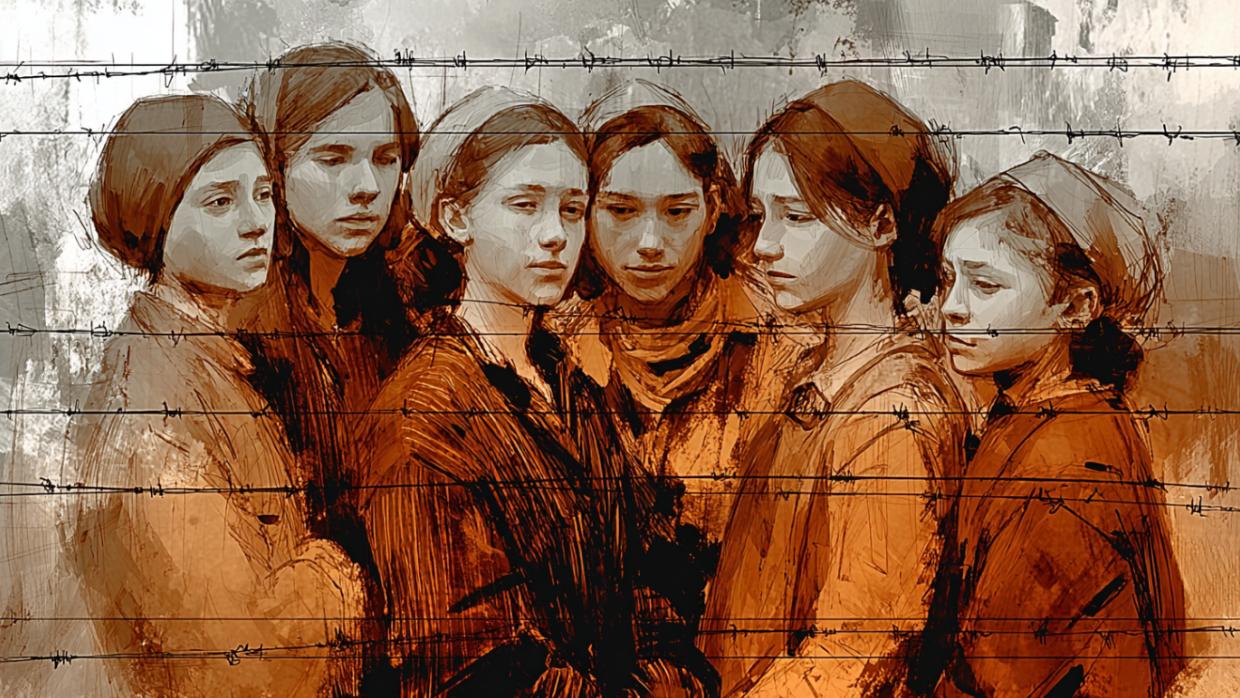
In the Nazi camps, where humanity was dismantled and death was carried out with chilling precision, survival often hinged not on strength but on solidarity. For women, survival was not just physical—it was psychological, rooted in their instinct to mother others. The only light in the darkness they had was each other.
Older inmates, many having lost their own children, fostered younger girls orphaned by war. Teenagers, like my mother-in-law, Rifka—terrified, alone, and raw with grief—were “adopted” by strangers who became surrogate mothers, sisters, and protectors. It was in this space where cruelty knew no bounds that the role of Lager Schvestern (camp sisters) quietly emerged.
Teenagers, like my mother-in-law, Rifka—terrified, alone, and raw with grief—were “adopted” by strangers who became surrogate mothers, sisters, and protectors.
Rifka spoke of one such orphan, Freidl, a beautiful 17-year-old from Odessa whose entire family had been slaughtered in a pogrom. Yet despite this catastrophic loss, hope still lived within her. She dared to dream of love, a husband, a family, sharing these secret fantasies with her camp sisters.
Then the unthinkable happened—during roll call one day, a Kapo erupted in rage when Freidl stumbled over the words of a camp song, savagely beating her, leaving her face badly disfigured. “I am no more beautiful,” she cried to the camp sisters. “Who will marry me?”
In a world where everything had been stripped from her, this final blow shattered what little hope she had, and she ended her life by throwing herself onto the camp’s electrified fence.
The camp sisters, overwrought by her death, were determined to mourn her passing. For seven evenings, after they returned exhausted from their worksites, they shared their sorrow, congregating on their bunks “to sit shiva” for her—murmuring prayers from memory, speaking her name, recalling the family she had lost and the future she would never have. In this crucible of barbarity, designed to erase every trace of personhood, they honored her in death with the same devotion they had shown her in life.
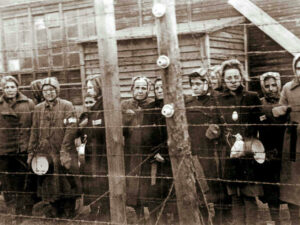
These sisterly bonds, weaving strands of hope into a tapestry of survival, were often forged in line at roll call or in the barracks during the rare lull after evening rations. In that thin sliver of time, older women mentored the younger ones, sharing advice, teaching caution, and offering what little hope could be cobbled together. And when necessary, these women absorbed pain meant for others.
There are documented instances—Rifka spoke of them—where a woman would offer herself to a Kapo to shield a younger girl from being raped or marked for the gas chamber. It wasn’t spoken of as it carried shame. But it was compassion, in its most twisted form.
These depleted women became her guides in a world where femininity was weaponized and danger lurked in every corner.
Rifka, barely a teenager at the time, came of age under the watchful eyes of D’vorah and Gitl. Though depleted themselves, they became her guides in a world where femininity was weaponized and danger lurked in every corner. On occasions, the roles reversed, when the elderly D’vorah was beaten and couldn’t stand in line for the evening meal, it was Rifka and the others who shared their bread with her, each tearing a piece from her coveted portion. Such was the heroic selflessness of the camp sisters despite their wracking hunger.
Some weeks after the beating, tragedy struck. D’vorah died from her injuries. Her body was carried from the barracks and laid among the dead on the Appelplatz for morning roll call. Upon seeing her there, Rifka collapsed onto the floor. Two camp sisters immediately rallied, pulling her swiftly to her feet, whisking her back to the barracks, defying the rule that no one was permitted to touch a fallen inmate on pain of a beating. Had they left her there, she would have been deemed unfit for work and transported to Majdanek for extermination.
Women in the camps faced especially cruel abuse. The threat of sexual assault was constant. SS guards would burst into the barracks at night, drag the women from their bunks, and violate them behind the latrines. Yet even in the face of such atrocities, the women found ways to preserve their humanity and protect the younger girls, all the while teaching them to navigate the daily perils of camp life and how to appear invisible. When to speak and when to swallow pain so the guards wouldn’t smell weakness. These small but crucial lessons were the inheritance passed from one woman to another in place of a mother’s legacy or a teacher’s wisdom.
Even in the face of such atrocities, the women found ways to preserve their humanity and protect the younger girls.
Yet, amid these sordid atrocities, there was also levity. They would compose irreverent lyrics to popular tunes and make self-deprecating jokes about their shaved heads and shriveled breasts. They performed spoofs about the camp’s demonic Kommandant and the loathsome Kapo, whom they nicknamed kakerlake (cockroach). They found comfort in sharing memories from the past. They discussed books and plays. And, when hunger gnawed in their bellies like knives, they would fantasize about food. Steaming bowls of lentil and onion soup, warm loaves of bread straight from the oven, freshly picked berries bubbling in saucepans, trying to outdo each other in a crescendo of recipe one-upmanship.
When I asked Rifka whether all this food talk wasn’t just another twist of the knife, she insisted it had a nourishing effect. They called it “kokhn mit di moyl (cooking with the mouth).” Through their tears and laughter, the specter of death never far, they bonded as sisters in their collective struggle to beat the odds even as their numbers dwindled.
These camp sisters were everyday warriors. They grieved together and celebrated small victories together. They resisted not with weapons, but with touch, with song, with camaraderie.
The lessons Rifka learned from her camp sisters never left her. After the war, she became a formidable and indefatigable force of compassion, discreetly easing the financial burdens of the struggling, comforting the sick, always alert to someone else’s need.
Her story—and countless others like it—remind us that the female experience of the Holocaust cannot be told in numbers alone. It is a tapestry spun from sacrifice, quiet heroism, and unbreakable bonds forged in hell.








Beautiful heart felt true history of young girls put in unimaginable circumstances like my mother was in the camps in Poland....Do I have stories to tell and share!!!!
Sisterhoods, humor and much love came out to US the next generation of humanity!!
Thank you Vivien♥️
Thanks Ruchama. ❤️ They deserve to be remembered.
So very many unsung heroes and heroines.
This piece is so sensitively written about a topic that's too difficult to talk about, though it must be.
As the child of Holocaust survivors, I've read a great deal about this tragic period in our history—one that's currently haunting us with the global rise of antisemitism—but few have touched me as much as this one.
Very moving. We all need to remember these heroines. Soon these women will all be gone from the living and their heritage of memories must live on.