







 Debunking Viral Claim About the Talmud and Minors

4 min read


15 min read


Jewish life is entering a moment of division, as pressure reveals who will retreat from Jewish identity and who will carry it forward.
Something has shifted in the Jewish world. Across campuses, synagogues, boardrooms, and social media, Jews are being tested as Jews. The question pressing on Jewish life today is no longer, How do we vote? Or What do we believe about Israel? It is more unsettling: Do we still believe, deep down, that being Jewish is something to stand for or something to explain away?
As we enter 2026, eight powerful trends are bringing that question to the surface. They cut across Israel and the Diaspora, young and old, religious and secular. Together, they reveal a Jewish world dividing between confidence and retreat, responsibility and evasion, ownership and apology.
Here are the eight trends shaping that divide.
For the first time in modern Jewish history, a visible and rapidly growing subset of young Jews, especially in elite Western universities, is not merely critical of Israeli policy but is actively adopting Palestinian nationalist and anti-Zionist frameworks, including language that delegitimizes Jewish sovereignty altogether.
For the first time in modern Jewish history, a visible and rapidly growing subset of young Jews is actively adopting Palestinian nationalist and anti-Zionist frameworks, including language that delegitimizes Jewish sovereignty altogether.
This phenomenon goes beyond policy critique. It includes Jewish students endorsing slogans such as “from the river to the sea,” describing Israel as a “settler-colonial” or “genocidal” project, and affiliating with movements that explicitly deny Jewish peoplehood. On some campuses after October 7, Jewish students were not merely present at anti-Israel demonstrations; they were among the organizers.
Polling data underscores how radical this shift has become. In the aftermath of the October 7 massacre, a Harvard CAPS–Harris poll found that among Americans aged 18–24, a majority expressed greater sympathy for Hamas than for Israel—an astonishing result given the nature of the attack itself. Jewish identity within that age cohort did not provide the insulation it once did.
In progressive spaces, moral status is increasingly granted through alignment with those labeled “oppressed.” Jews, now recast as white, powerful, or colonial, are expected to distance themselves from Jewish power in order to remain morally acceptable. Supporting Israel has become socially and professionally costly; opposing it often brings validation, protection, and belonging.
This represents a historic break. Previous generations of secular or left-leaning Jews might have criticized Israeli governments but they instinctively defended Jewish collective existence. That instinct is weakening and its loss has profound consequences.
Jewish assimilation in America is accelerating, and increasingly framed as a moral virtue rather than a neutral lifestyle choice.
The data are stark. According to the Pew Research Center, 72% of non-Orthodox Jews who married since 2010 married non-Jews, and fewer than one in four non-Orthodox Jews say being Jewish is “very important” to their identity. Jewish literacy has declined sharply, synagogue affiliation continues to fall, and attachment to Jewish peoplehood—especially Israel—has weakened among younger cohorts.
Jewish particularism is often portrayed as exclusionary or parochial, while universalism is framed as morally superior.
What distinguishes the current phase of assimilation from earlier ones is its ideological justification. Jewish particularism is often portrayed as exclusionary or parochial, while universalism is framed as morally superior. Strong Jewish identification is no longer merely optional; it is frequently viewed with suspicion. Downplaying Jewish difference is seen as enlightened.
This has consequences. Assimilation does not merely reduce observance; it erodes Jewish confidence. A generation uncomfortable asserting the legitimacy of Jewish identity will struggle to withstand external hostility and may instead internalize it.
Underlying many of the trends reshaping the Jewish world is a systemic failure of Jewish education, particularly within non-Orthodox Diaspora communities. For decades, Jewish educators and communal leaders have warned that large numbers of Jews were graduating from synagogue-based supplementary schools with minimal literacy, weak attachment, and little sense of Jewish purpose. What once felt like a long-term concern has now become an immediate crisis.
Fewer than half of American Jews can identify basic Jewish beliefs or texts, and only a small minority of non-Orthodox Jews report that Jewish knowledge plays a meaningful role in their lives.
According to the Pew Research Center, fewer than half of American Jews can identify basic Jewish beliefs or texts, and only a small minority of non-Orthodox Jews report that Jewish knowledge plays a meaningful role in their lives. Large numbers of young Jews reach adulthood knowing how to attend a Passover seder or recite a few Hebrew prayers, but unable to explain why Jews exist as a people, and what Judaism stands for.
One of the most prominent Jewish voices to diagnose this was the late Rabbi Lord Jonathan Sacks, who repeatedly warned that Jewish continuity depends not on memory alone, but on meaning. Ritual without narrative, he argued, produces nostalgia, not commitment. A Judaism that teaches “how” without “why” cannot compete with the powerful moral and ideological frameworks young Jews encounter elsewhere.
What makes the current moment different is that Jewish education is now competing in an openly hostile environment. Young Jews are encountering highly sophisticated narratives on campuses, online, and in social media that frame Jewish power as immoral, Israel as uniquely illegitimate, and Jewish peoplehood as ethically suspect. Without a coherent Jewish counter-narrative, many absorb these claims uncritically, or internalize them as moral truth.
In response, many Jewish institutions made a fatal miscalculation: they tried to survive by becoming neutral. Israel was softened or sidelined, Jewish particularism was downplayed, and moral clarity was replaced with balance. The result was predictable. Programs that avoided the hard questions did not protect students; they left them defenseless.
Yet alongside this failure is a genuine opportunity. New educational models are flourishing: podcasts, YouTube channels, Instagram educators, immersive Israel programs, and online learning communities that speak directly to contemporary questions of identity, antisemitism, and Jewish peoplehood. These platforms, like the one I founded, OpenDor Media, reach hundreds of thousands of young Jews, far more than most institutional programs.
The contrast is instructive. Programs that avoid Israel or Jewish particularism in the name of neutrality tend to lose students. Programs that articulate a confident, unapologetic Jewish story, even when challenging, tend to retain them.
The coming decade will determine whether Jewish education renews itself or cedes relevance entirely.
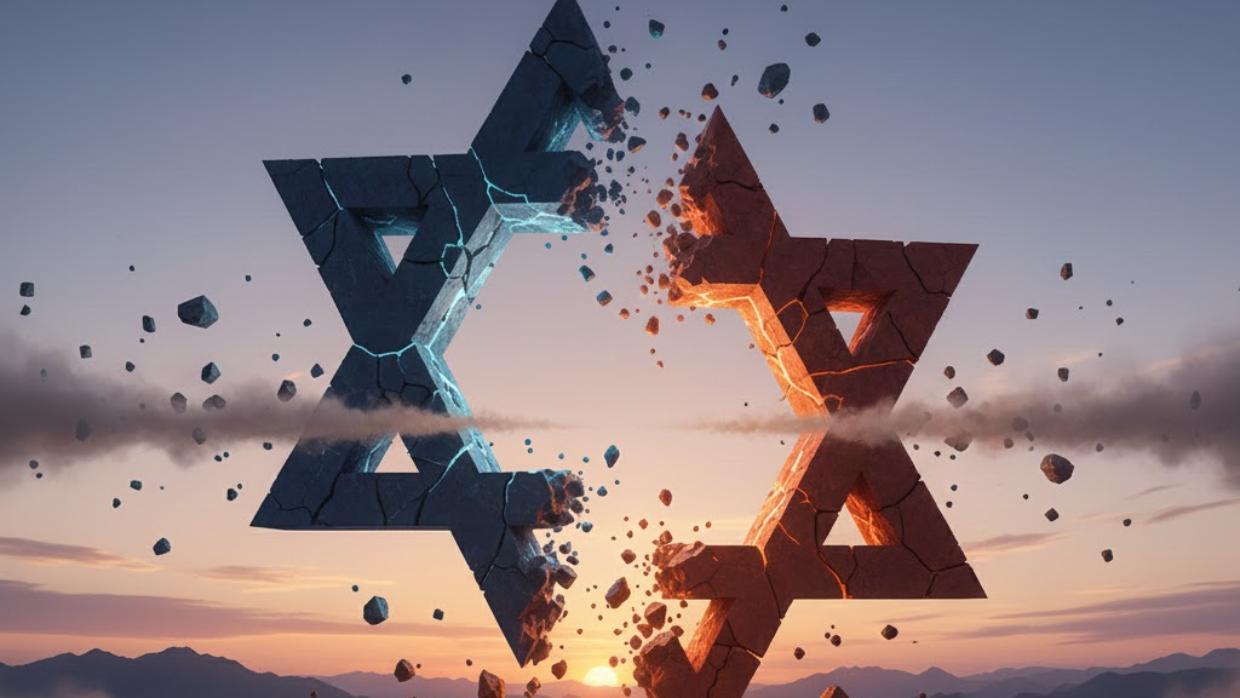
These dynamics converge into a single defining reality: the Jewish people are bifurcating.
On one side stands a large assimilating majority—intermarried, disengaged, morally uneasy with Jewish power, and inclined to retreat under pressure. On the other stands a smaller but increasingly visible minority: Jews who are publicly Jewish, unapologetically Zionist, intellectually grounded, and willing to bear social cost.
The Jewish people are bifurcating.
One sees this split vividly on campuses, in workplaces, and online. Two young Jews, raised in similar Western Jewish environments, now embody radically different paths. Shabbos Kestenbaum, a Harvard student, chose to confront antisemitism directly, wearing his Jewish identity openly, organizing Jewish advocacy, and ultimately suing Harvard University over its failure to protect Jewish students. He has refused to retreat or apologize for Jewish particularism.
By contrast, figures associated with movements such as IfNotNow represent a different response. Many of its young Jewish leaders define their moral identity through public opposition to Israel, organizing protests, disrupting Jewish institutions, and aligning with broader pro-Palestinian activism. In these spaces, Jewish identity is preserved not by defending Jewish peoplehood, but by distancing from it, especially where Israel is concerned.
The numbers currently favor the latter path. It is easier, safer, and socially rewarded. History, however, suggests that Jewish continuity is shaped less by numerical majorities than by minorities willing to carry Jewish identity openly, even under pressure.
If much of the Jewish world today is marked by assimilation, moral uncertainty, and internal fracture, there is one striking and consequential exception: the growing and increasingly powerful Orthodox Jewish community.
While large segments of secular and non-Orthodox Jewry struggle with declining literacy and membership, weakening identity, and discomfort with Jewish particularism, Orthodox Jews are bucking nearly all of these trends. Their numbers are growing rather than shrinking. Their educational systems are expanding rather than contracting. Their Jewish literacy is deep and transmitted intentionally. And perhaps most importantly, they exhibit a level of moral self-confidence as Jews that is increasingly rare outside their world.
This is not accidental. Orthodox Jewish education is not value-neutral. It does not shy away from peoplehood, covenant, or difference. It explains Jewish distinctiveness rather than apologizing for it. As a result, Orthodox Jews tend to understand antisemitism not as a shocking aberration that needs to be the Jewish people’s central obsession, but as a recurring historical phenomenon tied to Jewish survival, values, and visibility. That understanding often inoculates them against internalized self-hatred, even under intense external pressure.
A community once considered marginal or insular is increasingly becoming the backbone of Jewish continuity, education, philanthropy, and institutional leadership.
Institutionally, the change is just as significant. In past decades, secular and non-Orthodox Jews largely carried the leadership of major Jewish organizations—philanthropic, political, and cultural. Today, many of those roles are being filled by Orthodox Jews. They are leading federations, advocacy groups, educational institutions, media platforms, and philanthropic foundations. They are not only more willing to assume responsibility, they are increasingly the ones with both the financial resources and ideological commitment to sustain Jewish institutions over time.
As large segments of non-Orthodox Jewry disengage and assimilate, they are effectively abdicating roles they once held.
The result is a quiet but profound reordering of Jewish life. A community once considered marginal or insular is increasingly becoming the backbone of Jewish continuity, education, philanthropy, and institutional leadership.
The widening gap between Orthodox and non-Orthodox Jews raises difficult questions about shared language, mutual understanding, and collective responsibility. These pressures will grow in 2026 with the mainstreaming of Jew-hatred.
Left-wing antisemitism has rightly dominated attention since October 7, after it erupted openly in the language of anti-Zionism, moral inversion, and calls for Jewish erasure masquerading as human rights activism. But while focus has remained fixed on the left, right-wing antisemitism has been steadily re-entering the mainstream, often in older, more familiar forms.
Like its left-wing counterpart, this resurgence rarely announces itself explicitly as Jew-hatred. Instead, it appears through coded language: denunciations of “globalists,” obsession with “financial elites,” demographic panic, civilizational decline narratives, and conspiracy theories about hidden power.
Figures such as Tucker Carlson have repeatedly flirted with classic antisemitic tropes, platforming conspiratorial thinking about Jewish influence, defending or minimizing known antisemites, and framing Jews as shadowy actors behind national decline. Even more explicit is Nick Fuentes, whose overt antisemitism, Holocaust relativization, and calls for Jewish exclusion have gained him a disturbingly large online following, particularly among younger right-wing audiences. Likewise, figures such as Candace Owens have increasingly trafficked in rhetoric that portrays Jews as manipulative elites or uniquely malevolent actors, normalizing suspicion toward Jews within populist conservative discourse.
The danger for Jews is not choosing the “wrong side” of the political aisle; it is assuming that either side ultimately offers protection.
The Anti-Defamation League reported record levels of antisemitic incidents in the United States in 2023 and 2024, noting significant contributions from both ideological extremes.
The danger for Jews is not choosing the “wrong side” of the political aisle; it is assuming that either side ultimately offers protection. The left increasingly demands Jewish self-negation: abandon Jewish power, Jewish sovereignty, and Jewish particularism to earn moral legitimacy. The right, in its darker populist forms, demands Jewish scapegoating: blame Jews for cultural decay, economic anxiety, or national decline.
Jews are being squeezed from both sides, pressured to dissolve themselves on the left and targeted as symbols of corruption on the right. The result is familiar to Jewish history: Jews have no safe ideological home.
Many Diaspora Jews continue to interpret Israel’s political shift to the right as a temporary reaction to war, trauma, or a particular leader. This misreads Israeli reality.
Israel’s rightward movement is structural, driven by demographics, lived experience, and disillusionment with failed paradigms. Generations shaped by suicide bombings, rocket fire, and repeated diplomatic collapse no longer find abstract peace theories persuasive. October 7 did not create this realism; it confirmed it.
Polling consistently shows Israeli Jews prioritizing security over naïve diplomatic optimism, across socioeconomic and ethnic lines. To Israelis, this is not ideological extremism but earned skepticism. The gap between Israeli lived reality and Diaspora moral abstraction is widening, and misunderstanding it deepens internal Jewish fractures.
Israel is now the only Western democracy in which younger voters are more right-wing—and more traditional or religious—than their parents’ generation.
Looking ahead to the 2026 national elections, all indicators point to a decisive victory for right-wing parties, including religious and nationalist factions. The elections are expected to ratify changes that have been building for years: deep skepticism toward failed peace paradigms, prioritization of security over abstraction, and growing confidence in Jewish sovereignty exercised without apology.
What makes Israel’s trajectory especially striking is its generational character. Israel is now the only Western democracy in which younger voters are more right-wing—and more traditional or religious—than their parents’ generation. This runs directly counter to trends in Europe and North America, where younger cohorts consistently move leftward and away from religion. In Israel, the opposite is true.
Younger Israelis have grown up amid suicide bombings, rocket fire, repeated wars, and failed diplomatic experiments. They have little patience for peace theories detached from reality but laden with real security risk. October 7 did not radicalize them; it confirmed conclusions already reached. To them, security-first policies are not extremism, but realism forged through consequence. From the Diaspora, this is often misread as a slide into fanaticism.
By 2026, Israel’s movement toward a more right-leaning and traditional society will no longer be a trend to debate. It will be a political and demographic fact.
Finally, a destabilizing trend is the growing intervention of Diaspora Jews not only in Israeli political debates, but in Israeli policy itself, frequently through international advocacy, donor pressure, and external leverage, despite not living with the security, military, or societal consequences of those policies.
Increasingly, American Jewish activists, donors, intellectuals, and clergy seek to influence Israeli decision-making from the outside, funding political NGOs, issuing public moral condemnations, and pressuring international leaders to apply diplomatic and political pressure on Israel, often in rigid moral terms that allow little nuance, despite not living in Israel, not serving in its army, and not raising children under constant security threat.
An Israeli reservist who has spent months away from family under fire does not experience Diaspora moral lectures as solidarity.
To many Israelis, this behavior is troubling for two reasons. First, it represents judgment without skin in the game, demands issued by those who will not bear the cost of the outcomes they advocate. An Israeli reservist who has spent months away from family under fire does not experience Diaspora moral lectures as solidarity. He experiences them as judgment imposed from a distance, detached from the reality of danger and loss that he and his peers must navigate daily.
Second, and less acknowledged, this judgment is often impaired. Many Diaspora Jews today operate under intense pressure regarding Israel. They face workplace hostility, campus intimidation, social-media harassment, and professional risk. Their public criticism of Israel frequently functions less as dispassionate ethical analysis than as anxiety management and reputational self-protection, a way to signal moral acceptability in environments increasingly hostile to Jewish particularism. Distance from consequence does not purify judgment; in this context, it often distorts it.
This inverts moral authority. Israelis living with daily risk are portrayed as driven by fear, emotionalism and excess, while Diaspora Jews far from the consequences assert calm moral clarity. In reality, lived consequence often produces greater sobriety, not less, which in turns sharpens moral clarity.
By 2026, this dynamic threatens to erode Israel–Diaspora trust more profoundly than any single policy dispute. Advice and concern are welcome. Empathy and support is even more important. Pressure without consequence is not.
Taken together, these eight trends point to a single reality: the Jewish future will be shaped less by external enemies than by internal clarity.
The Jewish future will be shaped less by external enemies than by internal clarity.
Antisemitism is not new. It has always adapted its language to the moral fashion of the age—religious, racial, political, or humanitarian. Jews have never survived by imagining it away. We survived by knowing who we were even when the world denied it.
What is new is the scale of Jewish uncertainty from within.
A Judaism reduced to culture alone, ethics detached from peoplehood, and universalism stripped of covenant has repeatedly failed the stress test of history. It does not equip Jews to endure sustained pressure. When Jewish identity is treated as morally suspect, it collapses precisely when it is most needed.
At the same time, a countercurrent is unmistakable. Across Israel and the Diaspora, a smaller but growing number of Jews, many of them young, are choosing a different posture: public Jewishness, moral confidence, and responsibility without apology. They are unwilling to let pressure define them.
The question facing the Jewish world in 2026 is this: Will Jews meet that pressure as a people unsure of its right to exist, or as a people who remember its mission and that their survival has never depended on permission?











“Jews, now recast as white, powerful, or colonial, are expected to distance themselves from Jewish power in order to remain morally acceptable. Supporting Israel has become socially and professionally costly; opposing it often brings validation, protection, and belonging.”
In other words, “I’d better disavow my own identity and harm my people, or the ‘popular’ jerks won’t let me eat lunch at their table.”
It’s the same misguided, conformist thinking that has driven so much tragic assimilation over the past 200 years.
When we wake up and realize that our enemies hate us anyway?
One big factor with the misguided anti Israel and self hating generation is with the parents. They did not bother to give their children their identity and birthright. My own family didn’t work hard to give us that. Long story short, I had my moment of truth in my early 20’s. It took thousands of years to build a society embracing Jewish tradition. One generation to destroy it. I chose sides, gave my family their heritage and never looked back.
Wonderful!
This article is right on the money. I was raised secular, but with a love and support for Judaism. Of all the various adolescent ruminations, up to and including a belief in Hashem, I never wavered in being a Jew. Late in life, thanks to my daughter who became frum, married frum, and is raising her children frum, this has added a dimension to my beliefs. Frankly, I am grateful that she has chosen this path, and is a vibrant liberal human being while fiercely frum. Given my lack of Jewish neighbors, and the difficult habit of secular ways, I am stuck between my old ways and more frum ways. I am growing, though, not as quickly as I would like.
As I say, while still having fond memories of a Jewish but not frum life, I have come to believe that frum is the way of Jewish future
Re: Intermarriage. Back when I was a pre-adolescent, my friends and I thought that kids could make their own decisions about religion when they grew up. None of us had grown up in observant homes, and I guess we thought we were being cool. Fortunately I was smart enough not to repeat that sentiment to either one of my grandmothers, z'l. The 2 grandmas disliked one another but both of them would have given me a LONG lecture about not marrying outside of our faith. They would be happy to know that I did indeed marry within the faith.
Doesn’t it seem like trying to convince the antisemitic fomenting masses of their glaringly irrational mindsets is a futile waste of time and energy? The world ship is sinking and there is simply no stopping it. My family lives in the US but we understand and recognize that, biblically, the time will eventually come when the only truly safe place to live is the Holy Land, while simultaneously encouraging, strengthening and financially supporting all those still standing strong for Israel, Hashem, Torah and conservative Jewish life.
After living as a Christian for nearly 50 years, for some strange reason Hashem decided to pop my opaque bubble and opened wide the eyes of my family to the significance and importance of Torah. That was six years ago and we have been doing our best to diligently and respectfully keep His commandments ever since - and life continues to get better every year (go figure).
Of course, respectfully recognizing what all serious and genuine Jews (i.e. conservative, Orthodox) already know, this lifestyle comes at a price. Our extended family members think we’ve lost our minds and we have very few friends left. Regardless, though the world is absolutely a scary mess and it’s becoming more spiritually and morally dysfunctional by the day, my family has never felt more clarity and shalom over knowing we are on the only path that truly leads to safety, protection and blessings. How billions of people throughout history are completely blind to God’s own explicit words in Deuteronomy 5:29, 11:13–15, 28:1–14, 30:16 etc., etc., etc., not to mention the importance of respecting and honoring the Jewish people, is hard to understand. This goes especially for Jews.
That is, until one finally recognizes the giant elephant in the room – the millions of reform, leftist, “enlightened” Jews, past and present, who essentially spit on Hashem and Torah and instead bow down to full assimilation as the golden calf answer to life. I never understood the damage reform Judaism can cause to Jews until several Aish commentators recommended the sobering and eye opening book A Divine Madness by Rabbi Avigdor Miller. After reading that book, now I feel like I’m watching a surreal movie in slow motion as “progressive” Jews and Westerners obstinately charge straight ahead into yet another holocaust.
Do you belong to a shul? That can be a good place to make new friends.
Wow! Kol Hakavod!
A rather thorough article, well worth reading and pondering....Although I disagree that the right poses a threat on par with the left. Here in America, the Second Amendment to the Constitution is key. Jews should utilize it "early and often!"
As I struggle to understand the issues surrounding the modern Zionist State I am led to consider the possibility that the modern Zionist State is the ‘Golden Calf’ of our time.
You are wrong. Study your Tanach. Study the history of your own people. Get out of your American bubble and Study the history of world Jewry and perhaps you will realize that the golden calf of our time is not modern zionist state, but the United Nations who cynically single out Israel while closing its eyes for all the crimes committed by other nations. The existence of the state of Israel as homeland of Jews is a miracle. Jews thought they were safe in Germany (1930-1944), in Spain ( 16 century) . Do not be so sure you or yours will be safe in USA in this century. I am.a zionist and proud of it. At the University they curse me and I curse them back. They punch me and I punch back. If they vome to take my life I will shoot them first and I mean it. They hate jews who fight back
The way it looks around the world with Jews the only ones that will survive are the Orthodox, and anyone that is proud to be a Jew, with anti Jewish sentiment around the world a lot if Jews will make Aliyah, in Israel even if they are not Orthodox they are still traditional and are proud of their heritage, also a lot of Sephardic Jews like Syrian Jews are very proud of their Jewish heritage, and bought buildings in Jerusalem for Millions of dollars before Mamdeni ( Y"S) became mayor, some Jews know to be on the right side of history, the ones that side with our enemy will have a rude awakening and wished they were with the very proud Jews
I can't believe that Jews these days made the same mistake the Jews in the time of the Holocaust did, assimilated and intermarriaged Jews ended up in concentration camps and even, people that they didn't consider themselves Jewish in their picture, also any Jew that is with their enemies according to history they will be targeted first, a Jewish person has a better chance when you are a proud Jew, and learn self defense and to carry legal firearms, as a child of a Holocaust Survivor ( obm) the survivors fought back in different ways, one way was to make Seders and blow Shofar in concentration camps and/ or labor camps, these Muslims are using the Nazi ( Y"S) playbook with propaganda and lies, Joseph Gobbels ( Y"S) the Nazi( Y"S) propaganda minister would be proud
ABSOLUTELY TRUE!!
This is what I have been thinking. Hitler didn't ask if someone was religious or not. Any Jewish blood and even non-Jews married to Jews received the same fate in the holocaust.
Perhaps, we are heading to the fullfillment of the prophecies, Isiah 10:22 , 11:11, and Zechariah 8:12, Remnant of the people.
You articulated the situation with brilliance and clarity.
Unfortunately The Palestinian , the left , the terrorise , have better ghost writers PR Firms , organisers , secret financial supporters. They Lie , they distort truth , they turn morality upside down. They make the world think good is bad. Right is wrong. And we Jews are now living in a corrupt perverse world.
The orthodox are continuing and growing, but we are all subjected to the hate and fear of Irving in an increasingly antiSemitic world. It’s unbelievable! What can we do ?…
Hi Esti! Thanks, and I agree. We can do 2 things: 1) We can be confident in ourselves, and 2) understand clearly that the world has a problem with Jews...(fyi my book helps with both of these: https://aish.com/eight-jewish-trends-to-watch-closely-in-2026/)
https://a.co/d/gNsdL0t Who's Afraid of the Big, Bad Jew: Learning to Love the Lessons of Jew-Hatred
Shalom, in whatever situation we are in, the best thing to do is to pray, to continue to study Torah, keep the Sabbaths holy, and to believe that NOTHING IS TOO DIFFICULT FOR HASHEM.
1. Some of the criticism of “financial elites” has nothing to do with Jews. US billionaires are legally able to avoid taxes at the rates paid by workers.
2. Education is imperative but for some families, day school education is not affordable. I went to law school so that my husband and I would earn enough to send our children to day schools. Then I had a life-threatening illness and became disabled. After that, our only option was public school.
3. My children support Israel but are not religious. They see Shabbat as a burden on career. One married another Jew, but with that marriage ending in divorce, they no longer see the value in excluding non-Jews as potential partners.
4. The government of Israel does terrible public relations. Nasty comments about Arabs and Muslims.
So to the people who rated my previous post negatively, would you mind telling me why? I shared a painful circumstance. If you have any suggestions, for me or for Israel, I am interested in reading that. My final sentence was cut off due to length, but I think the Israeli government needs to address PR better. Condemning terrorism and perpetrators including Hamas, ISIS, Hezbollah is obvious. But there are decent Arabs and Muslims (not all of whom are Arab). Someone should be working on reminding the world that terrorists attacked Israel and also committed antisemitic crimes elsewhere. Israel defended itself. Crime victims elsewhere did nothing to antagonize the antisemites.
Fabulous article!
I'm not overly surprised at this analysis. Lately - there have been some EXTREMELY PROFESSIONALLY PRODUCED DOCUMENTARIES on TV Media - that are depicting various stories in G-D's Written Torah - (EG: The great flood - & Exodus - Etc,.). They're depicting the stories - with a hodgepodge of quotations - ideas - intellectual thoughts - from various - supposedly Torah sources (not necessarily Orthodox). As well as - mixing in a hodgepodge of scientific analysis OF EVENTS - & relate them to what are OTHER POSSIBLE PHYSICAL EVENTS - THAT CAN BE SUSPECTED AS HAVING BEEN RELATED TO - OR BEEN THE RESULT OF - OTHER PHYSICAL - OR MYTHICAL ASSOCIATIONS/TRADITIONS. TO THE UNLEARNED TORAH STUDENT - THEY MAKE GOOD SENSE - as they are from supposedly reliable sources?.
Insufficient evidence for 'facts' presented to warrant discussion.
The article focuses on numbers in orthodoxy, there's a growing movement of progressive Judaism in UK, last year reform and liberal synagogues merged. There's also masorti the conservative movement too.
I'm not being a wise guy--can you please explain what is meant by progressive Judaism and is it a UK thing?
It doesn’t actually exist as a theistic religion. It’s the last gasp of Jews who’re simply substituting radical left ideology for Judaism.
OK. I didn't know it was a political thing. I like your term "last gasp"; it makes them sound desperate.
Not flourishing, though, according to reports from various (not just central Orthodox) sources.
Can't expect anything that's diluted to last too long. Members either desert altogether or strengthen their Jewish practices and switch to Torah-true Judaism.
No, merging synagogues is a function of declining membership combined with a need to pay bills: four facilities with 100 members each can’t cover costs; one facility with 400 members stands a better chance. However, “progressive “ Judaism, when combined with the birth rate of “progressive Jews” is still deeply negative and so not viable over the long or even mid term.
Superb analysis. Thanks!
I was born into an Conservadox J family, attended Yeshiva of Flatbush and for many years struggled with my Jewish identity. I wandered into every other spiritual/religious tradition, exploring meditation, gurus, The Course in Miracles, and more. From each I took away something precious. Judaism has always been an evolving tradition, and as the world has changed, I have found stronger religious and spiritual convictions within our more diverse communities. Jews who support the people in Gaza are not anti-Zionist or anti-Israel. We are opposed to the current policies of the Israeli government which are lacking in compassion and humanity. We believe that ALL people are created in God's image.We believe that we are responsible for TIKKUN OLAM and that is where many of us find our Judaism.
"Judaism has always been an evolving tradition"
Deary, Judasm is the most authentic non evolving religion there is. The laws and traditions are thousands of years old.
So sorry that your mind has been polluted with wrong thinking, Arab propaganda and social media lies.
Sadly, your Jewish identity is now so weak that you can no longer realize the truth. E.g., no defensive war has ever been fought anywhere in the world by an army that takes undue risks to save civilian enemies, as the IDF does, so shame on you for making false accusations; you obviously don't know what you're talking about and can't even tell the difference between the attacker and the victim!
Judaism certainly believes that the entirety of humankind was created in Hashem's image. But when attacked by monstrous brutes who breed on unjustified hate, we needn't "turn the other cheek."
Learn the truth instead of parroting empty rhetoric (or worse).
My deepest desire in this life it was to be born Jew, and for me it's really disturbing looking modern days Esav giving less value,or nothing at all to their Jewish heritage, I can't understand why? You're the chosen one, G'd presented itself to no one else but you! The miracle of thriving and surviving, the Beauty of the Torah,a Jewish household,and many,many more things.
It seems like G'd gave an apple to someone who doesn't have any teeth at all.
Israel shall prevail 🧡🍊🍊🐝
Right- on analysis. Excellent.
Bravo for this insightful point-by-point analysis!
We are between the holidays of Chanukah and Passover, two times in our history when we lost many assimilated Jews: the Hellenists, many of whom betrayed their brethren by urging the Syrian-Greeks to prohibit basic tenets of Judaic practice, and 80% of those enslaved in Egypt (who preferred the known to the unknown).
Thus, we clearly see that that the number of faithful is not what determines our protection and salvation by the G-d of Israel. We will prevail despite our inner and outer enemies because that's what Hashem promised His eternal nation.
The question is only on which side of the (unfortunate) divide does each individual Jew stand
I know where I stand. Spoiler alert: I will not be hiding out, I WILL be standing tall and wearing my Magen David as I walk to Shul on Shabbos. Btw--I will continue to improve my knowledge of Hebrew and level of religious observance.
Very glad to hear!
Gorgeous article! You truly nailed every important aspect as it is unfolding. We stand so pivitoly on a precipice. Moshiach is in his way and we need to prepare our families, both at home and in the klal.