




The Maghreb, Africa’s Northwest, is a region with a rich Sephardi-Jewish history. According to my husband, whose family emigrated from there, its inhabitants make a dish so good they named it twice: Couscous.
To learn more about couscous, I harassed consulted my friend, Sarah Benamou, who is of Tunisian, Moroccan, and Algerian heritage. Like many Maghrebi Jews, she grew up with couscous on the Friday night dinner table every Shabbat. She described this dish to me as the ultimate mom-bait. In her words, “When a mother misses her children, she tells them she’s prepared them couscous.”
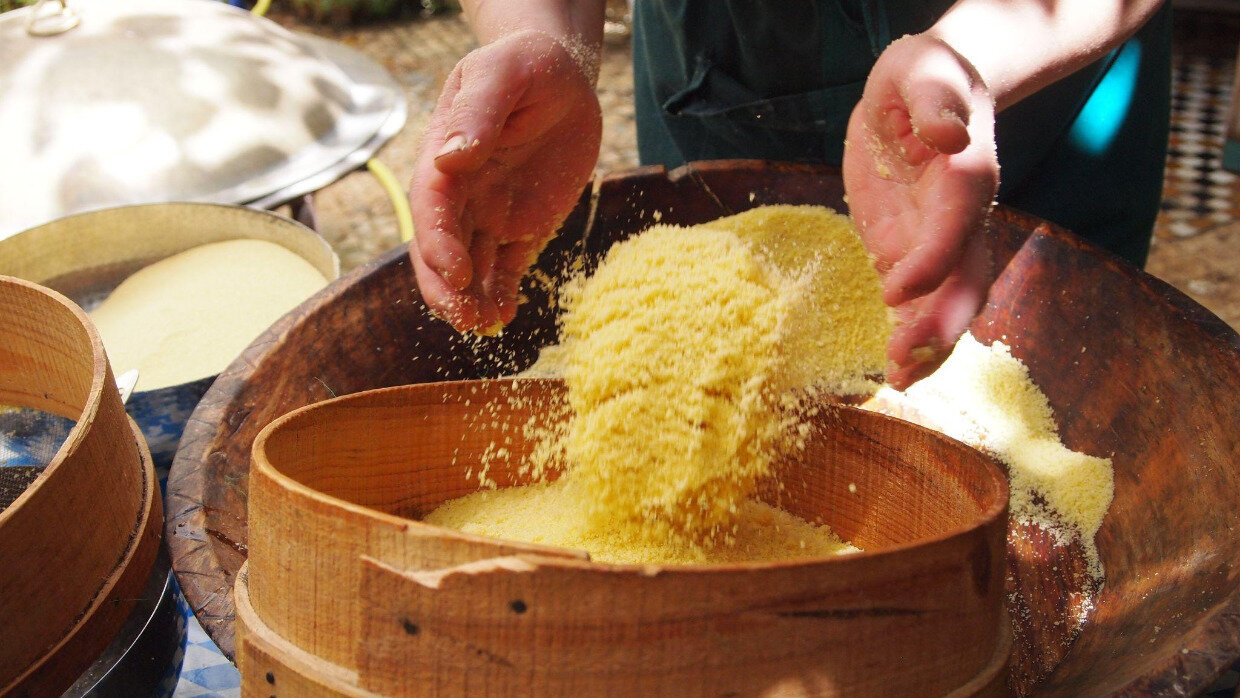
Sarah explained that the French word “couscous” comes from the Berber kaskasa, meaning rolled. It refers to the process of rolling and steaming semolina to prepare couscous.
Moroccans prefer large semolina grains, whereas Tunisians use medium-sized grains and Algerians use fine grains. Traditionally, Algerians roll their couscous in fermented butter which is similar to cheese. Since Jewish law prohibits eating meat together with dairy foods, the Jews of Algeria would only add butter for sweet dairy couscous. My husband’s grandmother used to make sweet couscous for the mimouna party after Passover and serve it with Revion (a mixture of milk and yogurt), raisins, and onion and eggplant jams.
Traditionally, the steaming process is pretty long and often done using a special steam pot, also known as a couscoussier. I'm not going to delve into the cooking process because Sarah, my in-laws, our Moroccan-Tunisian friend, Reuven, and his mother, all assured me that everybody uses instant couscous nowadays and there's no difference in taste.
While there's a modern consensus on the grains, the real fighting starts with the soups. The best Ashkenazi analogy to better understand this inter-Sephardi conflict I can make is the ancient debate over applesauce vs sour cream on the latkes. Families haven't split over this but there are some strong opposing opinions.
Pretty much every Maghrebi region has its own style of soup for the couscous. Many cities also have their own twist on this dish but discussing them all would be beyond the scope of this article. So let’s break it down by country:
Algeria
As the lightest broth, the Algerian version is often called “white” soup. Technically, it is beige. Like all variants, it contains bone-in chicken and vegetables. Algerians aren’t strict on the type of vegetables they’ll cook, which offers an element of surprise. However, turnips, zucchini, fava beans, onion, and chickpeas are most common. Often seasonal pumpkins find their way into the soup too. Pepper, cumin, paprika, and most importantly, cinnamon, give the soup its flavor. The soup is complete with a chunk of lamb or beef meat.
Morocco
No fewer than seven vegetables need to be in a Moroccan couscous soup for it to be authentic. The most common ones are zucchini, carrot, squash, white cabbage, turnip, chickpeas, tomato, and onions. Some recipes call for eggplant as well, which Sarah said is a “big no no” for Tunisians. Saffron or turmeric give the Moroccan soup a distinct yellow color. The yellow soup is the one I'm most familiar with and I think it just looks great with the yellow grains. Ginger, cumin, chili and coriander round out the flavor profile for this version. As far as meat is concerned, Moroccans add cubed or whole stew beef. Another famous Moroccan version is a prune couscous that combines cooked prunes with caramelized onions and chicken.
Tunisia
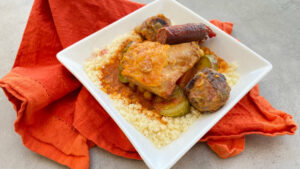
The following recipe describes how to prepare a traditional Tunisian couscous. Adding anything sweet to it, such as dried fruits, is considered a culinary crime. Tomato paste gives this soup its special “it has to be red” color. This version has the most variety of meats including chicken, meatballs and merguez sausages. While Sarah said that the merguez are optional, including them elevates the soup to the title of “Royal couscous,” and who wouldn't want that? Another difference is that Tunisians like to soak their couscous in the red soup, whereas Moroccans will eat the couscous either soaked or dry.
Tunisia is also famous for its fish soup couscous. Spicy and packed with flavor, it deserves its own article.
With so many choices, I asked Sarah what the very best couscous is. “Everyone will give you the same answer,” Sarah replied. “My mom's!”
So here is Sarah’s mom’s traditional Tunisian Couscous and soup you can now make for yourself.
Traditional Tunisian Couscous