







 Debunking Viral Claim About the Talmud and Minors
Jewish Geography
Jewish Geography



21 min read


From medieval times to modern day, uncover the compelling history of the Jews of Vienna and its haunting lessons about antisemitism.
The Jewish community of Vienna has a fascinating but tragic history. It’s a city where Jews were powerful financiers, advisors, Nobel prize winners, and world-renowned psychologists. Yet, in this same city, the Jews were expelled three times, their homes and synagogues destroyed, and even in the best of times, they lived in an environment of open antisemitism. It is no coincidence that Hitler was an Austrian who lived in Vienna for years and that many of his ideas came from that period.
Although a Jewish presence existed in Vienna as early as the 10th century, the first recorded Jews arrived in Vienna in the late 12th century. The first Jew, known as Shlom (Solomon), was a mint master and financial adviser to Duke Leopold V and his presence was documented by 1194. In a cruel pattern that would repeat itself in Vienna’s history, in 1196, Shlom and 15 other Jews were murdered by Christians from the Third Crusade.
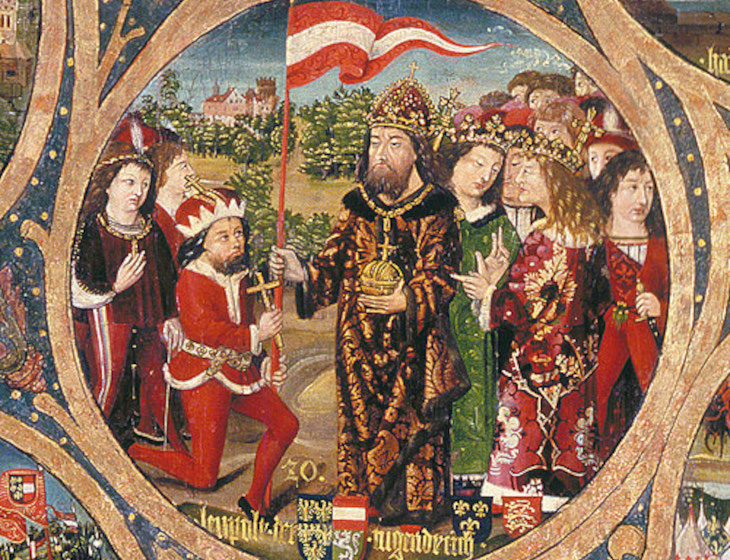 Leopold receiving the banner from Emperor Henry VI, Babenberger Stammbaum, Klosterneuburg Monastery, 1489–1492
In 1238, Emperor Frederick II granted Vienna's Jews a Charter of Privileges, identifying Jews as "chamber serfs" – meaning that the legal status of Jews was that they "belonged" to the Roman-German emperor. Six years later, Duke Frederick II issued the “Charter of the Jews,” spelled out terms for their protection and money-lending guidelines.
During the Black Death epidemic in 1348-9, Vienna was one of the few cities that did not blame the Jews for causing the plague. Consequently, it became a haven for Jewish refugees, which will be seen again in Vienna’s history. During the 14th century, Jews comprised about five percent of the city's population.
During this period, Vienna’s community was led by world-famous rabbinical leaders. Rabbi Yitzchak of Vienna (circa 1200-1270) was a student of the Tosafists of France and Germany. He brought a high-level Talmud study to Vienna, the standard hallmark of a learned Jewish community. He is renowned for his work, Ohr Zarua, a work of Halacha (Jewish law) quoted by scholars since he published it.
His son, Rabbi Chaim Ohr Zarua, also served as a rabbi in Vienna. He adapted his father’s classic Ohr Zarua to make it more accessible, including only the decisions without the complete justification.
Rabbi Meir ben Baruch Halevi (1320-1390) served as the Rabbi of Vienna for the last 30 years of his life and instituted a requirement that a Talmudic student could not officiate as a rabbi unless he had ordination from a properly ordained rabbi. This practice requiring rabbis to have ordination was accepted by Ashkenazi communities in the succeeding generations, and it continues to this day.
Rabbi Yisrael Isserlin (1370 to l440) is considered the last great rabbi of medieval Austria. He authored the classic work Terumas ha-Deshen and a super-commentary on Rashi's Torah commentary.
Toward the end of the 14th century, antisemitism began to rise among the burghers, likely due to jealousy of their Jewish neighbors. In 1406, during a large fire that destroyed the synagogue, the burghers used the opportunity to attack Jewish homes.
The persecution soon became far worse. On May 23, 1420, Duke Albert V issued the Vienna Decree, ordering all Jews of means imprisoned and their possessions confiscated. Jews who were impoverished before the Vienna Decree were forcibly expelled to Hungary. The imprisoned Jews were tortured, and attempts were made to forcibly convert them to Christianity. Children were separated from their parents and given to monasteries for conversion. After the Pope spoke out against the forced baptisms, the duke responded by having the remaining Jews - 210 men and women - burned at the stake on March 12, 1421. Even the synagogue was not spared; its stones were used to build a new faculty building for the University of Vienna.
The Jewish community of Vienna was utterly destroyed, and Jews were forbidden to live in Vienna.
The leading Ashkenazi Sage, Rabbi Yaakov Moelin (1365-1427), known as the Maharil, who lived in Mainz, Germany at the time, recorded the horrific events and sharply referred to Austria as "the land of blood."
In 1451, a few Jews were permitted to return to Vienna and were given special protection from the Hapsburg Emperors. By 1512, there were 12 Jewish families in Vienna. A small number of Jews continued to live in Vienna during the 16th century, although they lived with the constant threat of expulsion hanging over them.
In 1624, Emperor Ferdinand II limited the Jews of Vienna to a ghetto on the present-day Leopoldstadt quarter site consisting of 15 dwelling houses. Their numbers steadily increased; by 1670, 136 dwellings housed 500 families. When Jews of Ukraine faced the infamous Chmielnicki Massacres in 1648-49 known as Tach v’Tat, some chose to escape to the safety of Vienna.
For a time, the community of Vienna resumed its respected position in the Jewish world and the rabbis of the renewed community were once again world-famous leaders. Among them were Rabbi Yom Tov Lipman Heller, known as the Tosfos Yom Tov (1579-1654), and Rabbi Shabsai Sheftel Horowitz (1590-1660), the author of Vavei Amudim, who was renowned for his expertise in both Halacha and Kabbalah.
The second expulsion of Jews from Vienna took place in the middle of the 17th century.
Bishop Kollonitsch, a conniving and influential antisemite, served as the Lord Chamberlain to Emperor Leopold I (1658-1705). At his urging, Emperor Leopold decreed to expel the Jews of Vienna, despite the tremendously negative financial impact this would have on his kingdom, because the Jews were his financiers and advisors.
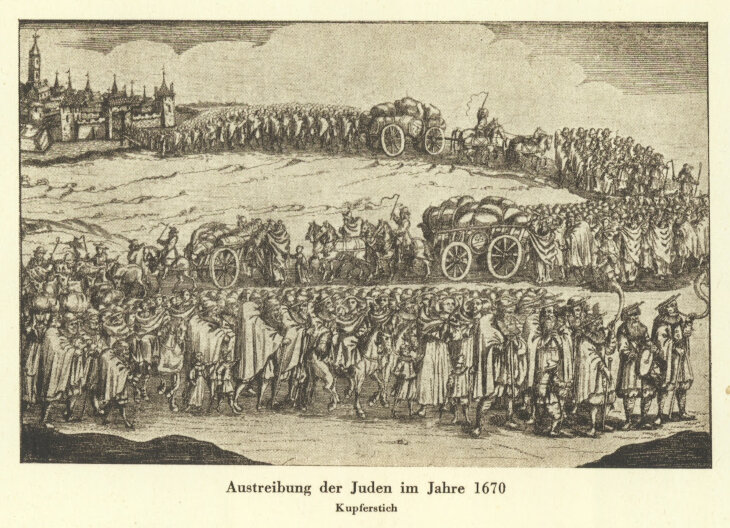 Expulsion of the Jews from Vienna 1670, Print from a 1932 pamphlet on the expulsion of the Jews from Vienna and other places
The influential Jews of the community did their utmost to stop or limit the expulsion. They tried giving the emperor the enormous sum of 100,000 florins but were refused. They asked Queen Christina of Sweden to intervene, but although she did, her words were ignored. On March 1, 1670, Emperor Leopold ordered all the Jews to leave Vienna and all of Austria. The deadline was August 1, and the last Jews of Vienna were exiled in the month of Av. The Great Synagogue was converted into a Catholic church, and the Jewish area was renamed Leopoldstadt in honor of Emperor Leopold I’s success in removing the Jews from Vienna. (And that name remains to this day.) As an aside, Bishop Kollonitsch continues to be revered by Viennese citizens, and a giant statue of him stands in front of the town hall in Vienna.
Within a short time, the expulsion began to negatively impact Vienna’s economy.
The first Jew allowed back into Vienna to reside was Samuel Oppenheimer, who was officially permitted to reside in the city in 1676. Those accompanying him became the nucleus of the very small, not-legally recognized community. They were not permitted to have a synagogue and all services had to be held in private homes.
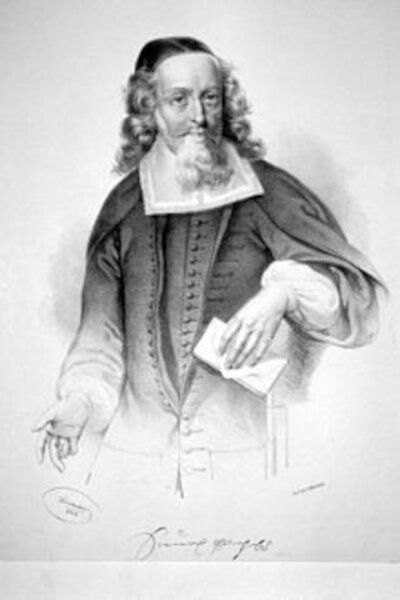 Samuel Oppenheimer by Josef Kriehuber
Oppenheimer provided needed supplies for the Austrian army, including uniforms, food, horses for the cavalry, and even supplies for the hospital. Yet, despite all he accomplished on behalf of Austria, he still suffered from antisemitism. Bishop Kollonitsch accused Oppenheimer of trying to murder Rabbi Samson Wertheimer (Oppenheimer's protege who was a great Torah scholar and the future leader of Austrian Jewry), and Oppenheimer was jailed. Only after paying an enormous sum was he released, and his claim of innocence was accepted. Oppenheimer supported many Jewish scholars and built synagogues and yeshivas in various communities. He also redeemed Jews taken captive in Turkish wars. After he died in 1703, his son Emmanuel appealed to have the debts owed to his father repaid by Austria. In response, rather than pay Emmanuel the six million florins they owed, the state claimed that Emmanuel needed to pay them four million florins. This wealthy family was left penniless.
Along with Oppenheimer, a very limited number of Jews were permitted to return to Vienna. In all, ten wealthy families - mostly known as Court Jews - resided in Vienna. They initially paid 300,000 florins for this privilege and an additional tax of 10,000 florins each year.
Despite the antisemitism and lack of civil rights, the Viennese Court Jews’ influence increased. As a result, Vienna became a center for Jewish diplomacy and philanthropy for Jews throughout the empire.
In 1718, due to peace treaties with the Ottoman Empire, Turkish citizens were granted permission to travel to and temporarily reside in Austria. Ironically, although Austrian Jews could not reside live in Austria, Turkish Jews could. The Sefardic Jews from Turkey formed a legally recognized community in Vienna. (With typical Jewish ingenuity, there were Austrian Jews who traveled to Turkey, obtained Turkish citizenship and passports, and returned to reside legally in Austria.)
During the reign of Maria Theresa, a Jew from Lisbon retained a particularly powerful position in the Empire. Diego D'Aguilar was born to a Converso family in Spain and was forcibly taken from his parents as a child and raised to become a Catholic Priest. After he was ordained, his mother managed to obtain an audience with him and emotionally reminded him of his Jewish roots. His sister had been caught practicing Judaism, and his mother hoped he might be able to stop her being burnt at the stake.
Although he was unable to save his sister, this meeting reawakened in him a desire to return to the Judaism he barely knew, and he and his mother escaped to Vienna. In Vienna, D’Aguliar became a full-fledged observant Jew and was financially successful due to his reorganization of the tobacco industry. Ironically, he became a favorite of the antisemitic Empress Maria Theresa. He raised tremendous amounts of money for government loans and rebuilt the Schoenbrunn Palace in Vienna. He remained loyal to the Jewish community and was able to prevent the expulsion of Jews from Moravia and Prague in 1744.
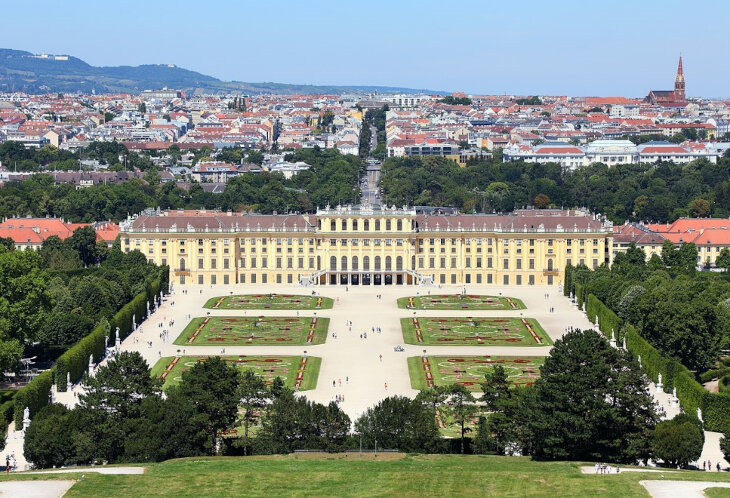 The Schoenbrunn Palace
Empress Maria Theresa made D’Aguilar’s a baron in recognition of his services to Austria. Due to his influence, she also abandoned her plans to expel Jews from the Empire in 1748.
D’Aguilar left Vienna suddenly in 1749 when the Spanish government demanded his extradition. He moved to London with his wife and a large family of 14 children. Before leaving Vienna, he presented the community with beautiful silver crowns for the Torah scrolls, upon which his name was inscribed.
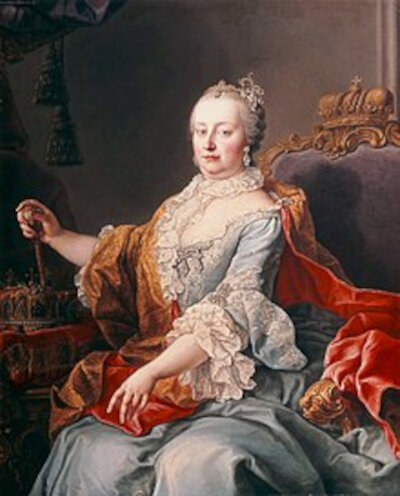 Empress Maria Theresa
Despite her positive feelings towards D’Aguilar, Empress Maria Teresa remained an ardent antisemite. Aside from the 12 prominent families, no Austrian Jews were permitted to live in Vienna, and all antisemitic decrees remained in place.
The slow process of removing restrictions on the Jewish community began in November 1780 when Joseph II, Maria Teresa's successor, became Emperor and ruled the Hapsburg Lands from 1780-1790. In 1781, he discontinued the Leibmaut poll tax, which had been paid by Jews to enter certain cities since the Middle Ages. (This was a particularly degrading tax, as it was a property tax and made the statement that Jews were property and not people.)
In 1782, Emperor Joseph II proclaimed an Edict of Tolerance to make the Jews “of better use to the state,” as was stated in the prologue to the resolution. Jews no longer had to wear a yellow band, they could attend schools and universities (although they were still limited in their choice of professions) and they could live anywhere in Vienna (although they could not own property). He took steps to assimilate the Jews into society, requiring that Hebrew and Yiddish be replaced by the country's national language in public discourse and forbade documents and textbooks to be printed in Hebrew. He also required Jews to take on last names approved by the Austrian officials.
Many Jews took advantage of the new opportunities granted them, but in the process, many also lost their Judaism. At the Congress of Vienna in 1815, salons of assimilated Jewish hostesses served as meeting places for the rulers of Europe. One of the most famous hostesses was Fanny Arstein was had a salon attended by the prominent personalities of the time, including the emperor and Mozart. In 1821, nine Jews of Vienna were knighted and raised to the nobility.
With newly acquired rights, the Jewish community hired renowned architect Josef Kornhäusel to construct the Stadttempel, the central synagogue of Vienna, the first legal synagogue to be opened since 1671. The magnificent synagogue was inaugurated in 1826, but in deference to the law, it was built hidden from the street view.
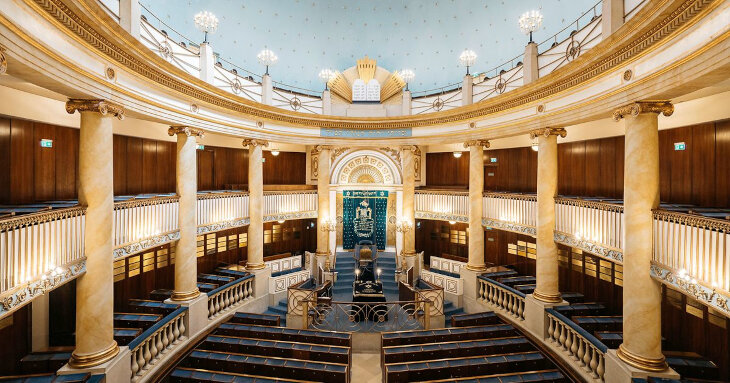 The Stadttempel, the central synagogue of Vienna
Despite all the “tolerance,” the Jews continued to exist as a non-community, as they were forbidden by law to establish themselves as a community, until 1867, when Jews were recognized as equal citizens.
In 1848, under the reign of Emperor Franz Joseph, Jews were granted limited civil rights. In 1852, the Jewish community was permitted to establish a legally recognized community, albeit with a temporary status. Finally, in 1867, the Constitutional law created complete equality for all citizens of Austria, including Jews. With their official acceptance and legal recognition as a community, Jews from the Eastern part of the Austro-Hungarian empire, particularly Galicia, Czech, and Hungary, immigrated to Austria.
After the outbreak of the First World War in 1914, Jewish refugees from Eastern war regions escaped to Vienna in large numbers. For the first time, thousands of Hassidic Jews and their rebbes moved to Vienna, joining the Oberlander Vien followers of the Chasam Sofer. They assumed they would reside in Vienna’s relative tranquility until the war ended.
Yet, Vienna unexpectedly became a thriving center of Hasidism over those few years. By the time the war ended, the refugees realized Vienna was a far better option than their destroyed hometowns. They began to settle and rebuild their communities in Vienna.
Following World War I, by 1923, the percentage of Jews in Vienna reached its peak at 10.8 percent of the population, making Vienna the third-largest Jewish community in Europe.
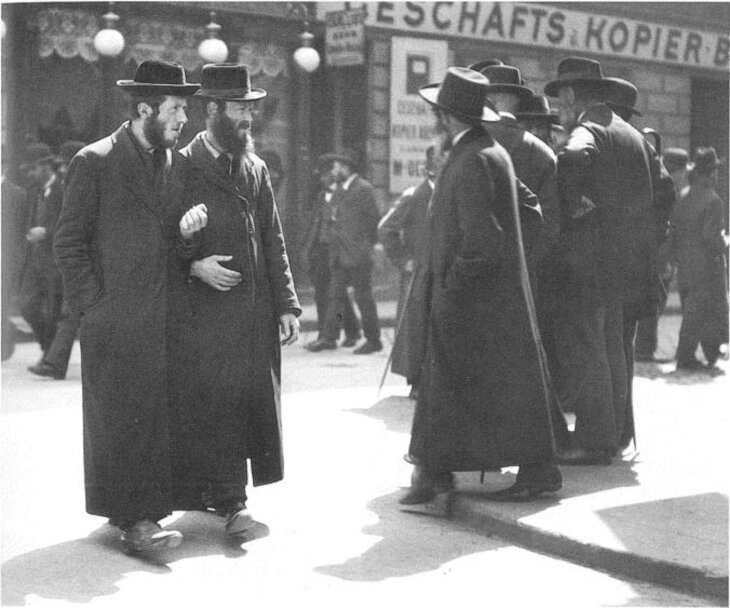 Hassidic Jews in Leopoldstadt, 1915
Due to its prominent rabbinic residents and community, Vienna would go on to host the first two Knessiah Gedolahs (The Great Congress) of the International Agudath Israel in 1923 and 1929.
During its Golden Age, Vienna also became a center of the “Enlightenment Movement,” which promoted the move toward secularism and decreased Jewish education. Between 1848 and 1938, secular Austrian Jews were prominent in Vienna's intellectual, cultural, and political life. However, unlike the earlier affluent and influential Viennese Jews, who were very observant, many prominent Jews of this era assimilated or even converted to Christianity.
Assimilated Jews contributed to Vienna's cultural and scientific achievements. Prominent Jewish physicians and psychologists, including Sigmund Freud, Alfred Adler, and Victor Frankl, resided and taught there. Jews were active in music and theater, including Gustav Mahler, Arnold Schonberg, Oscar Straus, Emmerich Kalman, Max Reinhardt, Fritz Kortner, Lily Darvas, and Elisabeth Berner. Writers Arthur Schnitzler, Stefan Zweig, and Felix Salten became world-renowned for their works.
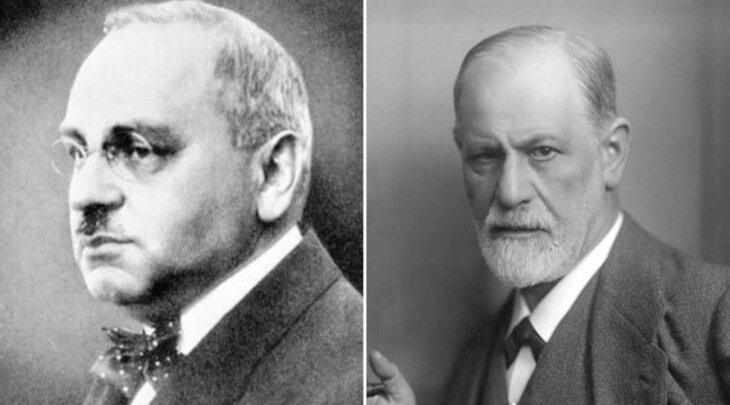 Alfred Adler and Sigmund Freud
Theodor Herzl, founder of secular political Zionism, lived and died in Vienna. Many Jews were leaders of the Social Democratic Party. Victor Adler and Otto Bauer, who served as Austrian foreign ministers after World War I, were both Jews.
In the field of medicine, three out of four Austrian Nobel Prize winners in medicine at the time were Jewish. More than half of Austria's physicians and dentists were Jews, as were more than sixty percent of the lawyers and a substantial number of university teachers.
Yet, despite their success and fame, antisemitism remained a constant in the environment of Austria. As Rabbi Berel Wein, a noted Jewish historian, observed, “Austria was always known for its antisemitism.” And this hatred of Jews would soon rear its ugly head in the most vicious way imaginable.
While Jews were focused on integrating and excelling within Viennese society, a renewal of antisemitism developed. This time it wasn’t religious antisemitism that targeted the Jews for not becoming Christians. It was racial antisemitism which applied to all Jews, whether their religion mattered to them or not.
Two particularly influential antisemites were Georg Ritter von Schönerer and Karl Lueger.
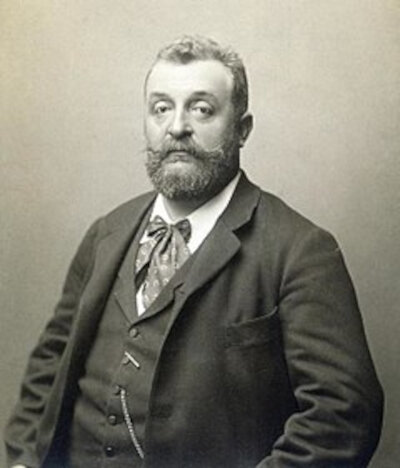 Georg Ritter von Schönerer
Georg Ritter von Schönerer was a politician who innovated ideas that Hitler would adopt, such as expelling Jews from his movement, adopting the title Fuehrer and the greeting of Heil. He told his followers that a battle would take place between the Germans and the Jews and that “if we don’t expel the Jews, we Germans will be expelled!” He was jailed after ransacking the office of a Jewish newspaper and attacking their employees. Yet, after his release, he continued to successfully build his Pan-German movement. Twenty-one members of the antisemitic nationalist party, Alldeutsch Parti, were elected to the Austrian Parliament.
Another rabid, influential Austrian antisemite, Karl Lueger, was elected mayor of Vienna five times between 1897 and 1910. At first, Emperor Franz Joseph refused to support him due to his antisemitism, but after Lueger’s fifth reelection, he accepted Lueger’s power. (As an aside, his political success is another indication of how acceptable antisemitism was in Austria.) Lueger blamed the Jews for Vienna's financial problems and roused crowds with his antisemitic fervor. Interestingly, in private, he still had several Jewish friends. Lueger is said to have responded to questions about this contradiction with the statement, "I decide who is a Jew,” a comment that fits well with Vienna’s overall approach to its Jews historically.
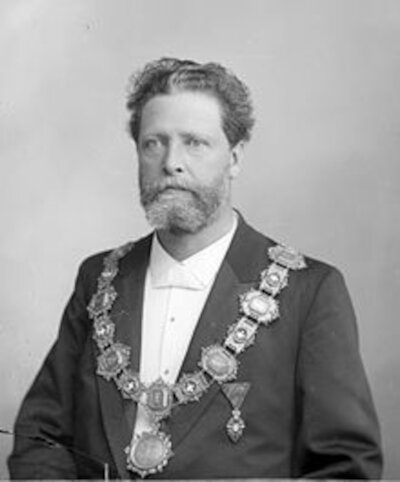 Karl Lueger
Lueger’s ideas strongly influenced Adolf Hiter, who moved to Vienna in 1906. In Mein Kampf, Adolf Hitler refers to Lueger as one of the personalities who shaped his views about Jews, as well as von Schönerer as discussed above.
On March 12, 1938, German troops marched into Austria, and Nazi Germany annexed Austria in an event that became known as the Anschluss. That same night, Jewish stores and apartments were pillaged, and Jews were chased into the streets and humiliated, forced to scrub sidewalks, to the cheers of the Austrian observers. Almost immediately, the Nazis carried out the first deportations to Dachau of Jews. This overnight turnaround from successful integrated citizens to a hunted and degraded people, was a complete shock to Austrian Jewry.
By May, the Nuremberg Racial Laws were applied in occupied Austria. Within a short period, the Jews - who, as discussed above, were so prominent and influential in Austria, both politically and professionally - lost their civil liberties. They were expelled from universities, excluded from public service and most professions, and were forced to wear a yellow star. Other decrees followed, banning Jews from public parks, closing Jewish stores, and requiring Jews to take on a first name of Sara or Israel.
All Jewish organizations and institutions were shut down. However, afterward, some organizations were re-opened when the Nazis forced emigration, and the Jewish organizations were to coordinate that. Adolf Eichmann worked closely with Vienna's Security Police to establish the Central Office for Jewish Emigration in Vienna, which he sadistically established in the “Aryanized” Palais Albert Rothschild in Vienna, which they had confiscated from Louis Van Rothshild.
By May 17, 1939, nearly 130,000 Jews left Austria under the forced emigration policy. Most of the Jews’ assets were “legally” taken by the Germans through various taxes and exit permit requirements. When Jews tried to emigrate to Switzerland, the Swiss responded by asking Germany to mark the passports with a J, for Jew, so they would know who to refuse. Austrian Jews went wherever they could - to England, France, Czechoslovakia, America, Shanghai, Africa, Australia and Argentina.
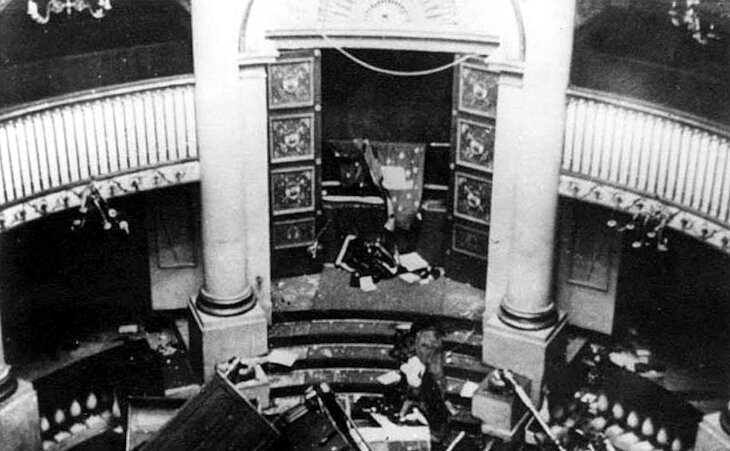 The synagogue in ruins
During the Kristallnacht pogrom of November 9-10, 1938, the city's synagogues were burned down, and 4,000 Jewish stores and businesses were vandalized and ransacked. The only synagogue that remained was the central synagogue, which had been hidden from street view due to the law. Perhaps this was also so the fire wouldn’t spread to the nearby Hotel Metropol, which was the headquarters for the Nazi party. During Kristallnacht, over 6,500 Austrian Jews were deported to Dachau and Buchenwald.
Beginning in October 1941, 35,000 Viennese Jews were deported to the ghettos of Minsk, Riga, and Lodz, as well as Theresienstadt and elsewhere in Eastern Europe. By the end of 1942, only 8,102 Jews remained in the city. These Jews were eventually taken to the largest concentration camp in Austria, Mauthausen.
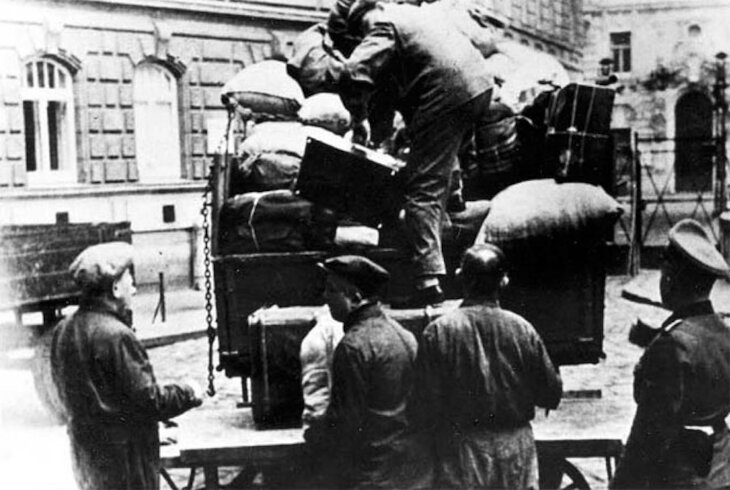 Mass deportations of Viennese Jews started in October 1941
Before the war, there were approximately 190,000 Jews in Austria. Only 5,816 lived to see the liberation of Austria, and 65,459 Austrian Jews were murdered. This was a smaller percentage than in other countries because the Austrian Jews were initially forced to emigrate.
Compared to other countries, there were very few Austrians who tried to save Jews. Yad Vashem lists Righteous Among the Nations who saved Jews during the Holocaust. Austria ranks 18th, with only 113 individuals listed. Even more telling, Simon Wiesenthal who lived in Vienna after the war, is quoted as having said “Only eight percent of the population of the Third Reich were Austrians. [However] Austrians were responsible for half of the murder of Jews perpetrated under Nazi rule.”
In April 1945, the Vienna Jewish Community re-established itself, although very few Viennese Jews returned to Vienna to live after the war. They were rebuffed when they attempted to reclaim their homes and other properties. Vienna was also a Displaced Persons camp for Jewish survivors from Eastern Europe.
In the decades after the Holocaust, Austria has had a very mixed approach to their Jewish citizens. On the one hand, when the Soviets allowed Jews to leave, there was a transit camp in Vienna for them in route to Israel. A few years later, when Iranian Jews escaped Iran after the Shah's fall, and they needed a stop-over place, they used the same transit camp.
On the other hand, open antisemitism continues to be prevalent and acceptable in Austria. Among other examples, in 1986, Austrians elected Kurt Waldheim, a Nazi collaborator, as President of Austria. This was despite his role in World War II as an interpreter and intelligence officer for the German army unit that deported most of the 56,000 Jews of Salonika to their deaths. Understandably, U.S. Ambassador to Austria, Ronald S. Lauder, refused to attend Waldheim's inauguration.
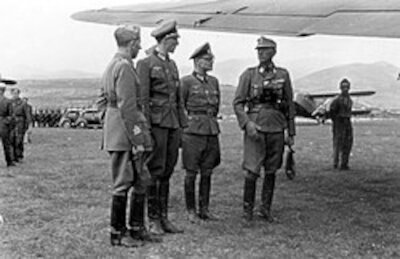 This May 22, 1943 file photo released by the World Jewish Congress shows former United Nations Secretary General Kurt Waldheim, center, at an airstrip in Podgorica, Yugoslavia.
In 2000, the extremist right-wing Freedom Party of Austria (FPÖ), led by Jörg Haider, a man with open neo-Nazi sympathies, entered the Austrian government. After Haider publicly made anti-Semitic comments against Ariel Muzicant, President of the Federation of Austrian Jewish Communities, Israel chose to recall its ambassador in protest. After talks in Jerusalem with the Austrian foreign minister, full relations were restored in 2003.
Due to public pressure, in the late 1980’s, the Austrian government began reexamining its role in the Holocaust, revising the “Austrian Victim Myth” they had clung to since World War II. In 1991, Chancellor Franz Vranitzky gave a speech to the Austrian parliament in which he acknowledged the shared responsibility of Austrians for the suffering inflicted on the country’s Jewish community. In July 1993, Vranitzky reiterated this admission in a speech before the Israeli Knesset.
Additionally, Austria began instituting several programs and incentives to support Holocaust education and fight anti-Semitism.
Today, there is a growing Jewish population in Vienna. It primarily consists of descendants of survivors and Eastern European refugees from the post-Holocaust era. There are also Russian and Iranian Jews who came to Vienna for its transit camp and chose to stay rather than continue to other destinations. Recently, there has also been a growing Israeli population. Vienna has approximately 15,000 Jews registered in its community, although the actual number of Jews is likely higher.
Most Jewish institutions, organizations, and kosher restaurants are in the historically Jewish area of Leopoldstadt, which is the central Jewish district. The Stadttempel, the only synagogue that survived the Holocaust, houses the community offices and chief rabbinate. The synagogue has limited visiting hours and heavy security due to the August 1981 terrorist attack by Palestinian terrorists. Remarkably, many of the synagogue's members do not live in Vienna. They support the community because their great-grandparents were synagogue members, and they have strong emotional ties to the community.
Today, Vienna's Jewish community is regarded as one of the most dynamic in the European Union, yet it is a shadow of its Golden Age greatness. Vienna’s more significant impact is its lesson for eternity: Jews may be successful, powerful, and influential. They may be government leaders, successful businessman and famous academics. Yet, if there exists unchecked antisemitism in the community, the Jewish position remains precarious.









NYC didn't read the memo:(
This article is a great reminder to never take antisemitism lightly...
A truly important message
This article virtually ignored one of the most prominent figures in Austrian Jewry's history. That is the great Rabbi Samson Wertheimer, who was known as the "king of the Jews" during the late 17th and early 18th century. As a court Jew and the wealthiest Jew of his day he not only saved entire Jewish communities worldwide but was also widely regarded as the greatest sage of his time. How is the history of theis great Rabbi missed in article like this one???
Wow. A great lesson. Rabbi Levine, keep these articles coming. You are my teacher!
just trying to figure out why the hand of God - proving that anti semitism is directed by divine control is missing from this otherwise Great history piece,
how else could you understand the hatred to jews who dressed ,spoke ,married etc just like
all the gentiles around them,
WW2 was not a madness it was a divine madness directed to send a wake up call for all of our nation to return to our roots.
One of the leading post WW2 anti-semites was himself a Jew,namely Chancellor Bruno Kreisky. Kreisky never met an Arab terrorist he didn't like. And he had a soft spot for ex-Nazis-one of whom served in his government.
My father Fritz Deutscher was expelled from Vienna Medical School in April 1938. He had finished all his studies but had not taken the final MD examination.
He fled to England that year.
86 years later , in March 2024, Vienna Medical School awarded him a posthumous doctorate in acknowledgement of the injustice done to him . The Times (London) published an article about the award on 26th March 2024.
Fascinating!
Excellent and thoroughly researched article. My father and his brother were young refugees from the Viennese Jewish community. They ultimately became world renouned Jewish leaders living in NYC, my father as a great Rabbi and my uncle as a great physician. Your article is a great piece on the rise and fall of Jewish communities in Europe over the centuries. But I fear that your author missed the most important conclusion of all: we have only one Land that is ours, and the place of all Jews is not in Vienna or London or Paris or NYC. And until Jews the world over begin to internalize this message, they will be condemned to relive this past again and again. Come join me and all my family in our one Promised Land. Eretz Yisrael is calling you Home! Moshisch is waiting for you HERE!
Debby, Your comment left me with 'goose-bumps'. Yes, Moshiach will be first in Eretz Yisroel. Yes, he is calling us HOME, and yes again - Moshbiach is waiting for us there!
May we already hear the call of the Heavenly Shofar that will sound the ingathering
of our People from all corners of the Globe. And never again will we 'need to bow' to otrhers - Only to Hashem Echod!
I would love to make aliyah! Are you going to pay for it???
Thank you for this timely history lesson that very few are aware of, whether they be Jews or non-Jews.
A wonderful piece, with a contemporary lesson.
A Prayer for the Souls of the Jews Horrifyingly Burned at the Stake
And For All the Jewish Souls of the Murdered
Thank you very much for this informative and educational article.
The reading of Jewish history almost anywhere is so very sobering.
Yashar Koach Rabbi Menachem Levine for a great article. Chazak v"Ematz!
Amazing, amazing article. Very informative and SAD.
Concur!