







 Debunking Viral Claim About the Talmud and Minors



13 min read


In Tehran, during the 1979 revolution, one rabbi’s faith saved lives and defied tyranny.
1979 was a year of profound change and unrest in the streets of Iran. The country was in the throes of an Islamic Revolution that toppled the Western-backed secular monarchy led by Shah Mohammad Reza Pahlavi. After months of mass protests and political upheaval, the Shah had fled the country, leaving behind a power vacuum. Into this void stepped Ayatollah Ruhollah Khomeini, a previously exiled and enigmatic figure who would come to shape the destiny of the Middle East for decades to follow.
Khomeini's return from exile in France and his rise to power as "Supreme Leader" electrified the nation. His arrival marked not only a political upheaval but also the founding of a new theocratic regime. The revolutionary fervor quickly descended into chaos: armed factions fought for control of cities, revolutionary courts carried out summary executions of former regime officials, and anti-American protests intensified, fueled by anger over the U.S. granting refuge to the deposed Shah.
On November 4, 1979, Iranian revolutionaries and student groups stormed the American Embassy in Tehran, taking 52 U.S. diplomats and citizens hostage. Among the captives were three American Jews: Barry Rosen, Michael Metrinko, and Jerry Plotkin. During negotiations between the U.S. government and Iran's new regime, UN mediators proposed that clergymen from outside Iran be permitted to visit the hostages during the holiday season, check on their wellbeing, and deliver letters to their families.
The Iranians suggested Rabbi Avraham Mordechai Hershberg, then the Chief Rabbi of Mexico, to serve as the Jewish representative in Tehran.
The first delegation approved for this humanitarian mission included two American Protestant ministers and two Catholic priests—one from the U.S. and another from Algeria. Following this, several Jewish organizations advocated for a rabbi to be included in a second delegation to provide spiritual support for the Jewish hostages. Iranian authorities agreed, with the stipulation that the rabbi not be American or Israeli, and that he be accompanied by Christian clergy from Middle Eastern countries.
Rabbi Avraham Mordechai Hershberg, then the Chief Rabbi of Mexico, was selected—at the suggestion of the Iranian authorities themselves—to serve as the Jewish representative in Tehran.
The selection of Rabbi Hershberg was anything but accidental. While the Christian clergy chosen for the delegation came from Syria and Lebanon, the Ayatollah’s regime was intent on avoiding any appearance of direct engagement with Israeli or American Jewish institutions, which might have ties to the Israeli government. By inviting a respected rabbinic leader from Mexico—a country without direct political entanglements in the Middle East—Iran positioned itself as taking a more neutral stance in its engagement with the Jewish faith. This approach allowed Iranian authorities to address religious and humanitarian concerns without compromising their revolutionary ideological posture.
Rabbi Avraham Mordechai Hershberg, a Polish-born Holocaust survivor and renowned Torah scholar, was serving at the time as Chief Rabbi of Mexico. He was widely admired for his profound Torah knowledge, eloquence, and steadfast Jewish identity. Though Mexico's Jewish community was relatively small, it was spiritually vibrant, and Rabbi Hershberg served as its guiding force. His influence extended far beyond Mexico—he was well known in both Jewish and diplomatic circles, and maintained a close relationship with the Lubavitcher Rebbe, who had encouraged him in this mission.
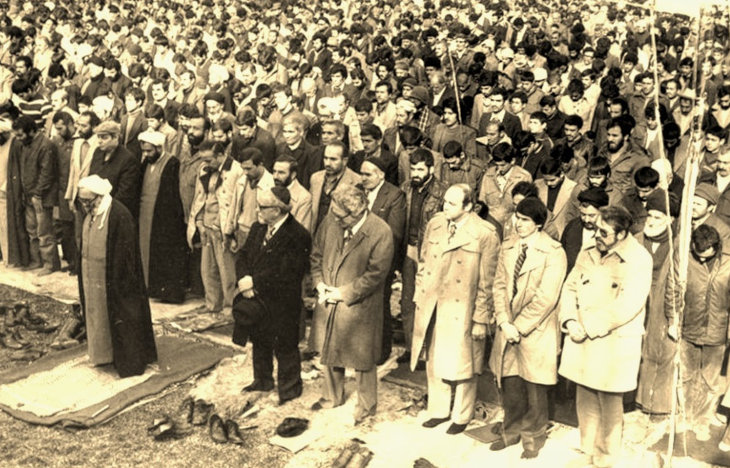 Rabbi Avraham Mordechai Hershberg in Iran
Rabbi Hershberg’s non-American, Spanish-speaking background lent him a sense of impartiality in the eyes of the Iranian regime, while still enabling him to minister to the spiritual needs of the Jewish hostages. Shortly before Hanukkah in 1979, he arrived in Tehran, visited the U.S. Embassy, and spent time with the three Jewish hostages. Together, they lit Hanukkah candles, sang, and danced—a powerful, emotional moment that brought light into the darkness of captivity. His visit offered hope, solidarity, and spiritual strength at a time when it was most needed.
The day after the delegation visited the U.S. Embassy, the clergymen were invited to attend the mass Friday prayers held in an open-air space on the grounds of Tehran University, where Ayatollah Khomeini himself would be present. For the Jewish delegation, this posed a significant halachic dilemma. Islamic congregational prayer involves full prostration—bowing and touching one’s forehead to the ground—a gesture that is strictly forbidden in Judaism except on certain occasions during the High Holidays (Rosh Hashanah and Yom Kippur), and only within the Temple in Jerusalem.
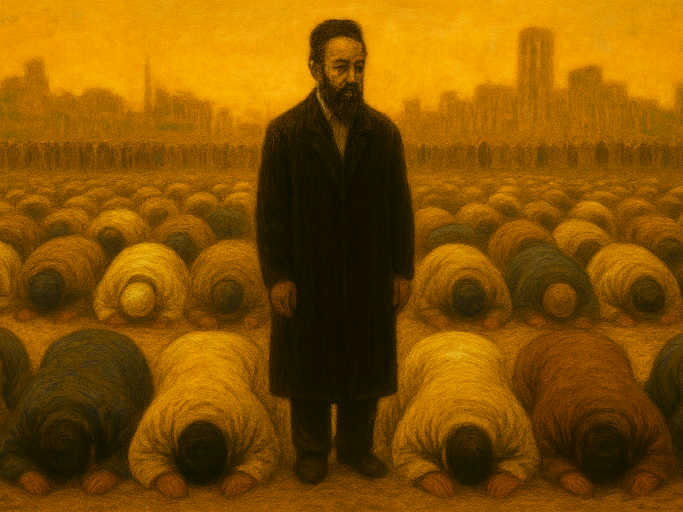
Rabbi Avraham Mordechai Hershberg stood upright, refusing to kneel—even as his fellow Christian clergymen did.
That Friday, hundreds of thousands of worshippers and Khomeini followers assembled in a vast sea of devotion. As the call to prayer rang out across the open space, the crowd moved in unison, prostrating themselves low to the ground, all facing the direction of Khomeini. In the midst of this powerful moment, Rabbi Avraham Mordechai Hershberg stood upright, refusing to kneel—even as his fellow Christian clergymen did.
His quiet act of defiance evoked a powerful historical parallel: in ancient Persia, another Mordechai had likewise refused to bow before a man of power—Haman. Now, in modern Iran, Rabbi Hershberg stood firm before a different but equally imposing figure, Ayatollah Khomeini, embodying the enduring Jewish commitment to faith and principle.
A visibly irritated cleric approached Rabbi Hershberg and demanded, “Why did you not show respect? Why did you not bow like the others?”
Rabbi Hershberg explained that his refusal was not meant as an insult, but stemmed from religious law and personal conviction. The cleric told him, “The Ayatollah requests your presence.”
Calmly and without provocation, Rabbi Hershberg explained that his refusal was not meant as an insult, but stemmed from religious law and personal conviction. He noted that he did not understand the Arabic being spoken, making any outward gesture of submission not only meaningless but, according to Jewish law, potentially idolatrous.
His composed and principled response defused the tension. The cleric, though storming off at first, returned moments later with an astonishing message: “The Ayatollah requests your presence.”
The gravity of the moment was not lost on Rabbi Hershberg. With a silent prayer on his lips, he accepted his fate and was led to meet the man who was rapidly emerging as one of the most powerful—and feared—leaders in the world.
To his surprise, Ayatollah Khomeini greeted him with unexpected respect. Turning to a translator, Khomeini spoke in Persian: “Thank the rabbi for not pretending to be what he is not. I respect that he remained true to his faith and did not bow as the others did.”
“Thank the rabbi for not pretending to be what he is not. I respect that he remained true to his faith and did not bow as the others did.”
Rabbi Hershberg responded without hesitation: “Our Torah commands us, ‘You shall not bow down.’ I could not, in good conscience, take part in an act that I neither fully understood nor believed in.”
Khomeini nodded and replied, “This I can respect. A man must follow his faith. That is the way of the righteous.”
Sensing a rare and divinely orchestrated opening, Rabbi Hershberg acted immediately. Realizing he had gained favor in the Ayatollah’s eyes, he requested a longer audience to discuss the welfare of Iran’s Jewish community. Khomeini agreed and instructed his son, Ahmed, to arrange a follow-up meeting in Qom—the spiritual heart of Shiite Islam.
The moment echoed another from Jewish history: like Queen Esther who found favor in the eyes of King Achashverosh and requested a second audience, Rabbi Hershberg stood before the ruler of a modern Persian empire, using the opportunity to advocate for his people.
At the subsequent meeting in Qom, Rabbi Hershberg raised several pressing concerns regarding the wellbeing of Iran’s Jewish community. At the time, Iran was home to nearly 100,000 Jews—the largest Jewish population in the Muslim world. Jews had lived in Persia continuously since the Babylonian Exile over 2,500 years earlier, making it the oldest uninterrupted Jewish community in existence. Prior to the 1979 revolution, Iranian Jews enjoyed relative freedom, with many holding prominent roles in business, medicine, and other professional fields.
Amid the revolutionary chaos, however, the situation changed dramatically. Members of the Revolutionary Guards began confiscating religious items bearing the Star of David, wrongly associating the ancient Jewish symbol with the modern State of Israel. During the meeting, Rabbi Hershberg clarified that the Star of David was a sacred emblem of Jewish identity, deeply rooted in history and entirely distinct from contemporary political affiliations.
Impressed by the rabbi’s explanation, Ayatollah Khomeini agreed to issue directives permitting Jews to retain their religious symbols without interference. Rabbi Hershberg also secured critical religious concessions, including permission to use wine for Sabbath and festival rituals—despite Islam’s prohibition on alcohol—and an exemption allowing Jews to attend early morning Selichot prayers, even during the strict curfew hours then in effect.
Rabbi Hershberg received assurances that Jews would not be harassed on account of their religious identity, and be allowed to practice Judaism openly in the new Islamic Republic.
In further meetings with Iranian officials, Rabbi Hershberg received assurances that Jews would not be persecuted or harassed solely on account of their religious identity, and that they would be allowed to continue practicing Judaism openly within the framework of the new Islamic Republic. In private conversations, he reminded Iran’s leaders of the long-standing Jewish presence in Persia, reaching back to the time of King Cyrus and Queen Esther. He appealed not to political interests but to shared history and mutual respect, embodying the principle of Darchei Shalom—the pursuit of peace.
Through these tireless efforts, Rabbi Hershberg protected not only the material safety but also the spiritual continuity of Iran’s Jewish community during one of the most volatile moments in its history.
While Jewish life in Iran was being preserved through Rabbi Hershberg’s diplomatic efforts, many Jews remained apprehensive about life under an Islamic theocracy. Despite a degree of religious tolerance achieved through his advocacy, the situation on the ground remained precarious. Numerous Jewish-owned businesses, particularly in manufacturing and import-export, were being confiscated by the revolutionary government. Following the upheaval of the revolution and the outbreak of the Iran-Iraq War—which would drag on throughout the 1980s—tens of thousands of Iranian Jews felt compelled to flee the country permanently.
While Rabbi Hershberg worked to ensure Jews could live and worship freely within Iran, he also used his rapport with the authorities to quietly organize rescue efforts for those who sought to leave. Encouraged by figures such as the Lubavitcher Rebbe, Rabbi Ovadia Yosef, the Israeli Chief Rabbinate, and various American Jewish organizations, Hershberg partnered with Tehran-based rabbi and community leader Yedidia Ezrahian to coordinate discreet escape routes for Iranian Jews.
At the time, Jews were technically allowed to emigrate legally but faced intense bureaucratic hurdles, harassment, and the risk of property confiscation. Although the regime permitted Jewish emigration in theory, it only issued passports to a single member of a Jewish family at a time—a calculated policy designed to prevent the kind of mass Jewish exodus that had occurred in Arab countries in previous decades. For the Islamic Republic, maintaining a visible Jewish population served as a propaganda tool to counter accusations of religious oppression and to distance itself from Zionism.
Through careful negotiation, Rabbi Hershberg helped ensure that Jews could continue to gather in synagogues, retain religious items, and sustain a measure of communal life, all while making quiet preparations for departure. Since many families lacked full travel documentation, they were forced to flee overland through treacherous mountain passes and desert terrain, often relying on paid smugglers to reach neighboring countries—primarily Turkey and Pakistan. From there, international Jewish organizations such as the Joint Distribution Committee (JDC) and the Hebrew Immigrant Aid Society (HIAS) facilitated airlifts to Austria, where refugees were granted temporary shelter and helped to obtain visas for resettlement in the United States, Israel, or parts of Europe. In time, thriving Persian-Jewish communities began to form across the diaspora.
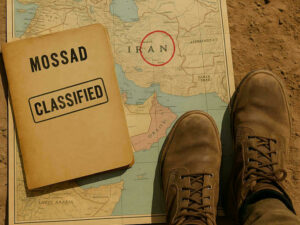
Rumors swirled that the rabbi might be aligned with Western intelligence interests, possibly even acting as a Mossad agent.
Some rescue efforts also involved discreetly transferring funds out of Iran to support fleeing families—activities that eventually placed Rabbi Hershberg under the scrutiny of Iranian authorities. Despite the risks, his dual mission—protecting those who stayed while assisting those who fled—helped preserve the dignity, safety, and future of Iranian Jewry during one of its most turbulent chapters.
In the volatile atmosphere of post-revolutionary Iran, suspicion and paranoia were pervasive—particularly toward foreigners. Despite Rabbi Hershberg’s early success in advocating for the Jewish community and his initially positive relations with the Iranian leadership, his continued presence in Tehran began to draw dangerous attention. Rumors swirled that the rabbi—a foreign religious figure from Mexico with broad international connections—might be aligned with Western intelligence interests, possibly even acting as a Mossad agent. His private meetings with Ayatollah Khomeini and his engagement with other revolutionary figures only intensified these suspicions.
By early 1980, the exodus of Iranian Jews was becoming more visible, heightening the regime's anxiety. Iranian authorities—already deeply distrustful of Zionism, Israel, and any perceived Western influence—began to suspect that Rabbi Hershberg was secretly involved in facilitating these illegal departures. The Revolutionary Guards, increasingly radicalized and emboldened, began to view him with growing distrust. The atmosphere surrounding him turned tense and hostile.
Recognizing the escalating danger, sympathetic contacts within the Iranian government quietly warned Rabbi Hershberg that his safety could no longer be guaranteed. Faced with the very real threat of arrest—or worse—he made the painful decision to leave Iran.
He fled the country under the cover of night, narrowly escaping what could have become a life-threatening ordeal.
With the help of local intermediaries, he fled the country under the cover of night, narrowly escaping what could have become a life-threatening ordeal. His abrupt departure from Iran marked the end of a brave and perilous chapter in Jewish advocacy, underscoring both the volatility of revolutionary fervor and the fragile balance he had maintained throughout his mission.
Though the Iranian Revolution brought sweeping and often repressive change, and though the vast majority of Iranian Jews ultimately emigrated, a small yet resilient Jewish community remains in Iran to this day. Their continued survival owes much to moments like these—when a lone rabbi from Mexico stood firm in the face of immense political and spiritual pressure. Rabbi Avraham Mordechai Hershberg's presence in Iran in 1979 is more than a historical footnote; it is a powerful testament to the enduring values of the Jewish people.
In a time of chaos and extremism, he upheld the principles of faith, dignity, and peace. Without weapons, armies, or political leverage, he confronted fear with wisdom and prejudice with moral clarity. His story is a reminder that even in the darkest times, one person’s conviction can make a difference—not only for their own self-preservation, but for the welfare of the wider community and serve as an example for generations to come.
As the Prophet Zechariah declared: “Not by might, nor by power, but by My Spirit, says the Lord of Hosts” (Zechariah 4:6).
Sources:








However, now the Jews in Iran are forced to remain. They are held hostage.
SO inspiring!
Very interesting.
Very interesting. Thank you.
HE WAS MY GRANDFATHER ZT"l.
HERE ARE SOME PICTURES FROM THE SCENE: https://forum.otzar.org/viewtopic.php?f=17&t=13342&p=864875&hilit=%D7%9C%D7%90+%D7%99%D7%9B%D7%A8%D7%A2&sid=21659492da21cbb6a00725eddb041e50#p864875
WOW, thank you so much for sharing! May your grandfather's shining soul continue to rise ever higher - enlightening all our lives!
Unbelievable! I want to hang this picture in my home.